

Fixing the wrong problem first costs you months of wasted work.
Most practices chase more Google attention when the real problem is that patients land on the page, find nothing useful, and leave in seconds. Before touching anything, decide whether patients are not finding you at all, or finding you and walking away.
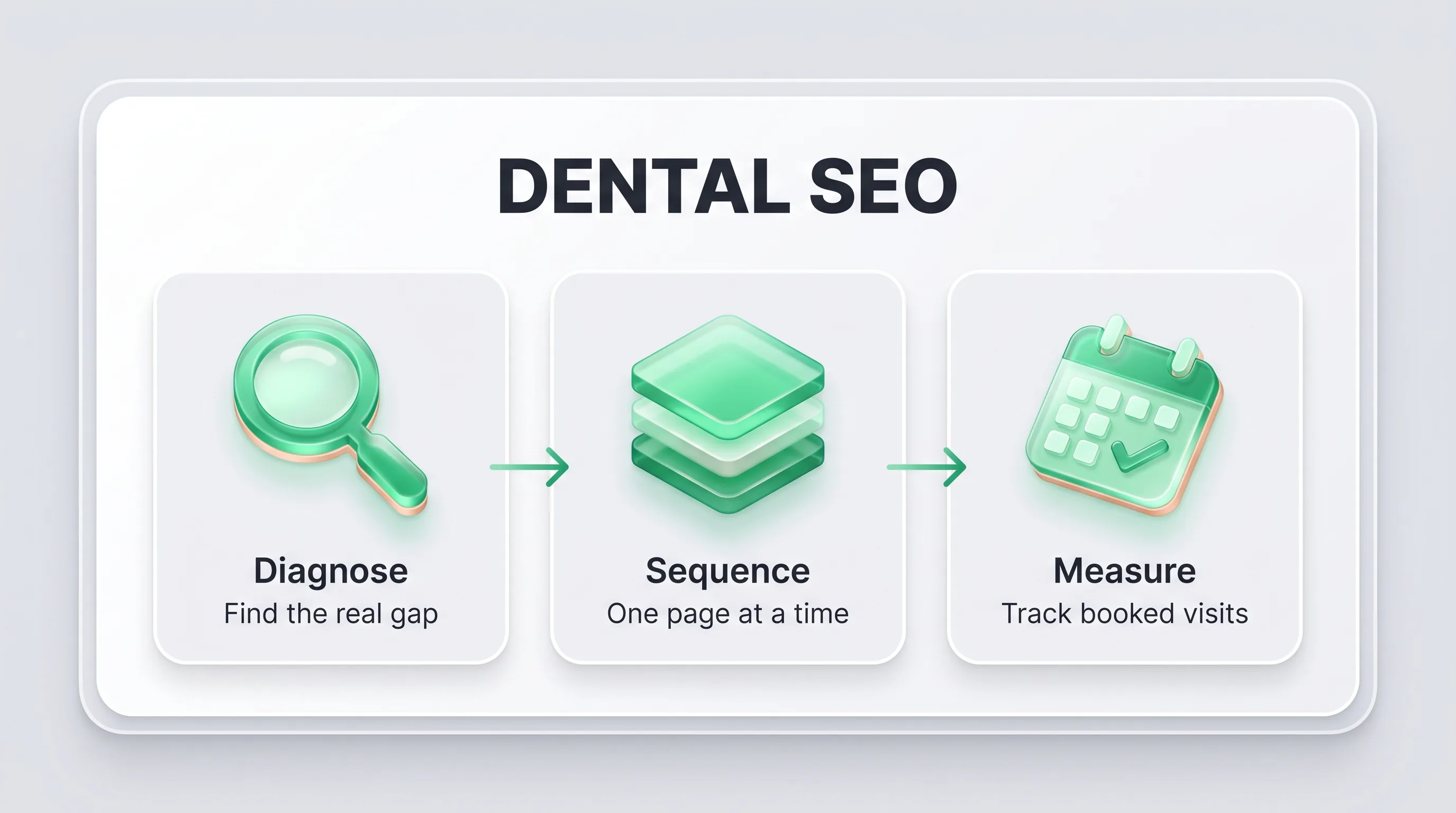
A patient searches for implant consultations in your city during her lunch break. Your practice does not appear on the first page. That is a visibility problem. A different patient finds you, clicks through, reads three sentences, and leaves. That is a page problem. The fix for each is completely different, and applying the wrong one wastes months. Your dental SEO work should start by placing every underperforming service into one of those two buckets before touching anything else.
Pull your ranking data for three or four core service terms. If you rank below position fifteen consistently, the site needs more authority and relevance signals pointing at those pages. If you rank on page one but click-through rates stay low, the title and meta description are failing the patient before the click even happens.
A prospective Invisalign patient lands on your treatment page between meetings, reads for eight seconds, and closes the tab. Your analytics show the visit. Your front desk never hears from her. Most practices interpret this as an SEO failure and chase more rankings. The real failure happened on the page: no clear next step, pricing buried, a stock photo of someone else's smile.
Check your analytics for pages where organic sessions exist but form submissions and calls are near zero. That gap is your post-click conversion problem. For deeper site-level issues driving those drop-offs, website SEO fixes for dental practices cover the structural causes in detail. Fix the page before adding traffic to it.
When I ran my own clinic, we pushed SEO on six services at once. Rankings improved on two. New inquiries came in for a procedure the associate had left to handle, and she was already at capacity. The leads went cold. Operational capacity is the variable most dental SEO guides ignore entirely.
Pick the one service where your schedule has real room, where your fee supports case profitability, and where patients actively search in your area. Build one strong page, earn its rankings, watch it convert, then expand. If you want a broader look at SEO strategy across your full service mix, that is the right next step once this first line is working.
Most dental websites carry thirty or forty pages. Three of them drive nearly all booked consultations. Your job is to identify those three, not rewrite everything at once. Look at which service pages already receive some organic traffic but convert poorly, and which high-value services have no dedicated page at all. Those are your targets. Solid SEO keyword planning for dental services tells you which terms patients actually use to reach those pages, so your rewrites answer real searches rather than internal vocabulary.
A revised implant page sits in a shared folder for six weeks because nobody confirmed who approves clinical language. This is the most common reason dental SEO stalls. It is not a strategy problem. It is an ownership problem. Before any work begins, name one person inside the practice who approves copy within five business days and one person who owns the monthly review of what went live. Without that, even a well-built plan moves at the pace of whoever remembers to follow up.
If outside execution support makes more sense than managing it internally, understanding what dental SEO services typically include helps you scope that conversation accurately.
Rewriting three service pages while simultaneously restructuring your site navigation and launching a blog creates a measurement problem. When rankings shift two months later, you cannot tell which change drove the movement. Work in sequence: stabilize technical foundations first, then improve page content, then build new content. Each phase should run for at least four to six weeks before the next one begins. That timeline lets signal settle and lets you attribute results cleanly. For a prioritized list of quick actions that fit this sequencing, practical SEO fixes for dental practices is a useful companion resource.
Rankings rising while booked consultations stay flat is a common and misleading result. It usually means you are gaining ground on informational searches, not on high-intent treatment queries. Track four numbers together each month: keyword positions for your target service terms, inbound calls attributed to organic, booked first visits from organic, and what those visits were actually for. A patient who books a cleaning after finding your implant page did not move the needle on case revenue. That last number tells you whether your rankings are attracting the right searches. If your map pack visibility is the weaker layer beneath these numbers, local SEO for dentists covers that diagnostic separately.
Plan on 12 to 24 weeks for initial ranking movement on competitive service terms in a mid-size market, based on what consistently appears across credible SEO sources. Lower-competition queries in smaller markets can move in six to ten weeks. Neither number guarantees a booked patient; they mark when the signal stabilizes enough to read. If you see no movement after four months on a page with clean technical foundations and a genuine service-plus-city match, the issue is usually authority: the page needs more credible links pointing at it, or the domain itself needs broader topical coverage before that single page earns trust. A fuller overview of where this connects to broader practice growth is in the dentist SEO overview.
Diagnose before you build, sequence the work, and measure what actually gets signed and seated.
We review your pages, search visibility and enquiry path, then show you what to fix first.
.svg)