
Most eye care practices chase clicks and miss the real SEO gap: patients decide on clinical fit before they ever call. The playbook below shows how to build pages that answer that decision and fill your schedule with cases worth keeping.

Most specialty pages draw patients who look but never pick up the phone.
When a patient who has already tried artificial tears searches for something more specific, a page that buries meibomian gland dysfunction under a generic conditions list tells her you are not the practice she is looking for, and she closes the tab and calls the next clinic. The gap between the visits a specialty page receives and the calls it actually generates is the clearest sign that the page is speaking to the wrong patient, or saying too little to the right one.
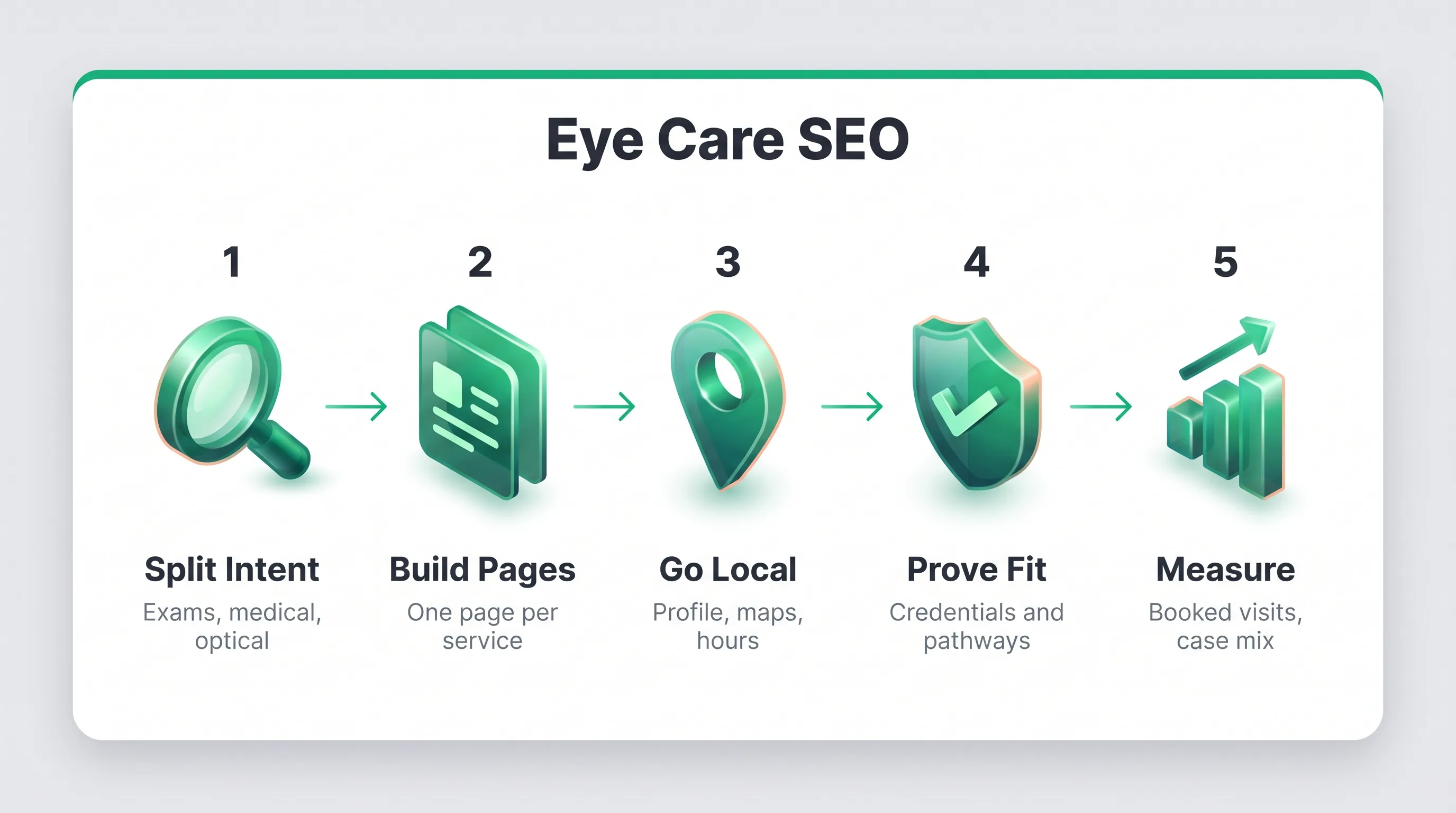
A parent booking a back-to-school exam types something entirely different from the patient who woke up with sudden floaters. Both land on your site, but they arrive through different searches, with different fears, and ready to act on different information. Treating them as the same visitor is the most common structural error in eye care seo work.
The routine exam seeker wants convenience: hours, insurance acceptance, online booking. The medical visitor wants clinical credibility fast, whether you handle anterior uveitis or diabetic retinopathy monitoring, and whether they need a referral or can be managed in your chair. The optical shopper is already past the exam; they are comparing frame selection, lens brands, and turnaround. One page cannot serve all three without diluting the signal for each. These same intent-matching principles apply broadly to medical seo for any specialty practice.
Understanding which eyecare services to prioritize before you build pages saves months of effort spent optimizing the wrong content for the wrong intent.
Dry eye patients have often already seen one provider who told them to use artificial tears and come back in six months. They are searching for something more specific: LipiFlow, IPL, meibomian gland evaluation, a practice that takes the condition seriously. A generic services page that lists dry eye in a bullet under "conditions treated" will not capture that search or that patient.
Myopia management searches carry a similar weight. Parents researching orthokeratology or soft multifocal lenses for a nine-year-old are comparing practices on clinical specificity, not proximity. Contact lens fit pages work differently again: the patient has a prescription, a brand preference sometimes, and wants to know your fitting fee, your trial lens policy, and whether you fit scleral lenses for irregular corneas. Each of these lines has a distinct search pattern, distinct patient questions, and enough search volume to justify standing alone before you build anything else.
Pull your last three months of call tracking or form submissions and sort them by the page the visit originated from. Most practices find that one or two pages, usually the homepage and the generic eye exam page, account for nearly all conversions, while service pages for dry eye treatment, pediatric vision, or specialty contact lenses show traffic but almost no calls. That gap between visits and calls is where the search work lives.
If you do not have call tracking by page yet, open Google Search Console and filter by URL. Pages with growing impressions but low click-through rates are already being seen in search results but failing to pull the patient in. That is a title and description problem, not a rankings problem. These two checks together tell you what to fix before adding any new content.
The patient booking a wellness exam is planning ahead; the patient with a sudden red eye, discharge, and light sensitivity is deciding in real time whether you are the right call or whether they should go to urgent care. Both deserve a page that speaks directly to their situation, and the language on each must match where they are in that decision.
Annual exam pages should lead with scheduling ease, insurance participation, and what the exam covers, including dilation, retinal imaging, and glaucoma screening. Problem-focused visit pages need clinical language: you see patients with sudden vision changes, flashes and floaters, corneal abrasions, and foreign body concerns. Urgent red eye pages require careful wording about same-day capacity, since promising next-day access when your schedule cannot support it damages the patient relationship before it starts.
A dry eye page that leads with "we care about your comfort" converts at a fraction of the rate of one that names meibomian gland dysfunction, describes point-of-care testing like meibography, and explains what a treatment plan looks like across four to six sessions. Patients who have already done their research bring that clinical vocabulary into the consult room, and they want confirmation that you speak it too.
Pediatric eye care pages should address amblyopia detection, binocular vision testing, and the difference between a school vision screening and a full pediatric exam. Myopia management pages need to explain what slowing axial elongation means in practical terms for a child's long-term eye health, and which modalities you offer. Clinical specificity is not jargon for its own sake; it is the signal that separates a practice managing the condition from one that simply lists it.
Patients searching for an optometrist often carry an unspoken worry: what if the exam finds something beyond your scope? A page that explains your referral relationships with retinal specialists or oculoplastics surgeons, and how quickly that handoff happens, answers a fear most patients never articulate aloud but absolutely weigh.
The same logic applies to optical and contact lens follow-up. If a patient orders custom progressives from your dispensary, they want to know the fitting process and what happens if adaptation takes longer than expected. Naming that process on the page, even briefly, reduces the calls your front desk fields and increases the conversion on the initial appointment request.
Your Google Business Profile primary category determines which searches Google considers you relevant for. "Optometrist" and "Ophthalmologist" return different results for the same neighborhood, and a practice that provides both medical eye care and optical dispensing may need to think carefully about which category leads. Secondary categories let you add "Eye care center" or "Contact lenses supplier" where accurate.
Photos matter more than most practices realize. Images of your slit lamp, your OCT, or your contact lens fitting suite communicate clinical scope without a single word. Keep service attributes current: if you accept medical insurance for diabetic eye exams or glaucoma management, that should be visible in your profile, not buried in a website FAQ.
A patient choosing between two practices of equal clinical reputation will often decide based on which one made the logistics easier to figure out. If your location page requires three clicks to find where to park or whether you are in-network with VSP, you have already lost some of those patients to a competitor whose page answered both questions immediately.
If your location pages feel functional but still underperform on calls, the issue is sometimes structural rather than content: how sections are ordered, how the booking call to action sits relative to the insurance list, whether mobile users hit a wall before they reach availability. That kind of layout problem is where page structure decisions cross into design work rather than copy alone, and it is worth separating the two before rewriting content that was never the real obstacle.
Writing "same-day appointments available" on a page your scheduler cannot consistently honor creates a specific problem: the patient arrives already disappointed, because the first available slot was three days out. That friction shows up in reviews and in no-shows. Match the language on urgent access pages to what your actual schedule can deliver, and update it when capacity changes seasonally.
For symptom-based searches like sudden blurry vision, eye pain, or a new floater, the page should explain your triage process clearly. Does the patient call first? Use an online form? Is there a number that routes to a clinical staff member? Patients in this search state are anxious; a page that tells them exactly what to do next converts better than one that leads with your credentials.
A patient searching for glaucoma management is not searching for an eye exam. They want to know whether you perform visual field testing, whether you manage medically with drops and monitoring, and at what point you co-manage with a surgeon. Listing your OD or MD credential at the bottom of the page does not answer that question; describing the care pathway does.
If your practice bridges optometry and ophthalmology, or operates a co-management model, spell that out on the relevant service pages. Patients comparing providers read care descriptions closely. Naming your OCT, Humphrey field analyzer, or corneal topographer by what it detects, not just what it is called, tells a patient their condition will be properly monitored, which is the actual reassurance they are seeking.
Scleral lens candidates have almost always already tried standard soft lenses and failed: keratoconus, post-surgical irregular corneas, severe dry eye that makes soft lenses unwearable. A page for this service needs to acknowledge that history and explain your fitting process, the number of appointments typically involved, and what determines success or a referral onward. That honesty builds more confidence than a headline promising clear vision for everyone.
For myopia management, the evidence supports slowing progression, not stopping it, and patients who understand that distinction arrive for the consult with realistic expectations. State what the research shows, which modalities you offer, and how you track axial length over time. A parent who reads that level of detail before the appointment is far more likely to accept the care plan in the room.
A ranking report that shows your dry eye page on the first page of results looks good until you check how many dry eye consultations you booked last month. Rankings describe where you appear; conversion data describes whether the patient decided to act. Those two numbers move independently, and practices that watch only one of them end up optimizing for visibility while their chairs stay in the wrong case mix.
Set up call tracking numbers at the page level, even if you start with just three pages: your highest-traffic exam page, your top specialty service, and your location page. Watch the ratio of calls to ranked sessions monthly. A page with strong rankings and weak calls has a messaging problem. A page with strong calls but low rankings has a search visibility opportunity worth prioritizing.
A treatment plan left unsigned after a dry eye consult is sometimes a case fit problem that started at the search stage. If your dry eye page draws patients who expected a simple prescription update, the page attracted the wrong intent. No-show patterns by appointment type tell you the same story: a spike in no-shows from a particular service line often traces back to a mismatch between what the page described and what the patient encountered at booking.
Review your front-desk notes or intake forms from the past two months and flag inquiries where the patient's stated concern did not match the service they booked. A pattern there points to a specific page that needs its language tightened, not more traffic sent to it.
A monthly report that leads with keyword rankings loses most practice owners in the first row. A report that opens with booked visits by service line, then shows which pages generated those bookings, then notes where sessions came from, runs in the opposite direction: outcome first, then the mechanism that produced it. That order keeps decision-makers focused on the practice goal rather than on search metrics that require separate interpretation.
Four columns cover most of what a partner or practice manager needs to act on: top five pages by booking contribution, top three service lines by accepted care this month versus last, pages with growing sessions but flat bookings (the conversion problem list), and one recommended adjustment for the coming month. If your reporting currently does not separate accepted care from booked visits, that single distinction is worth adding before anything else in the report changes.
Open your Search Console today and filter by your top specialty service page to check whether click-through rate has dropped below five percent.
We review your pages, search visibility and enquiry path, then show you what to fix first.
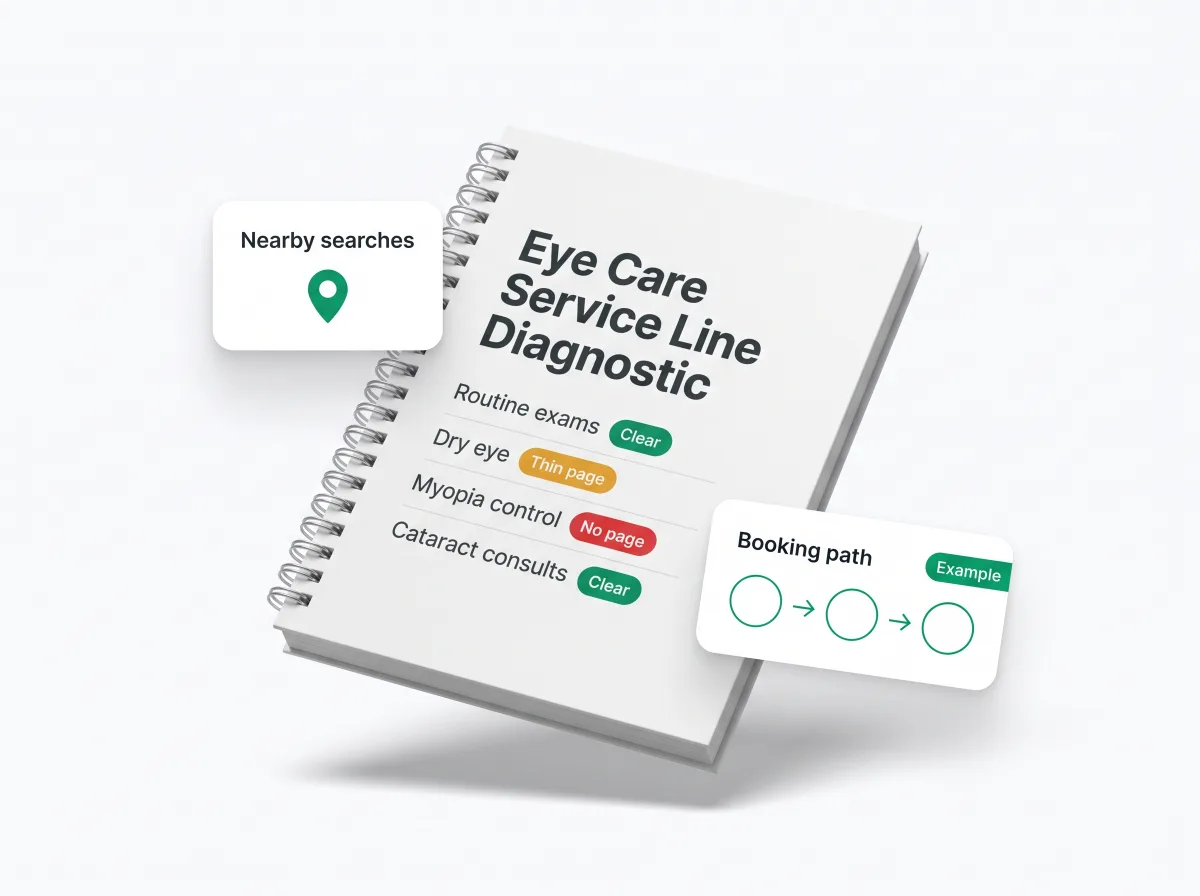
You have read where eye care searches break by service line. We check each of your services against your site and show where a patient finds nothing to book.
.svg)