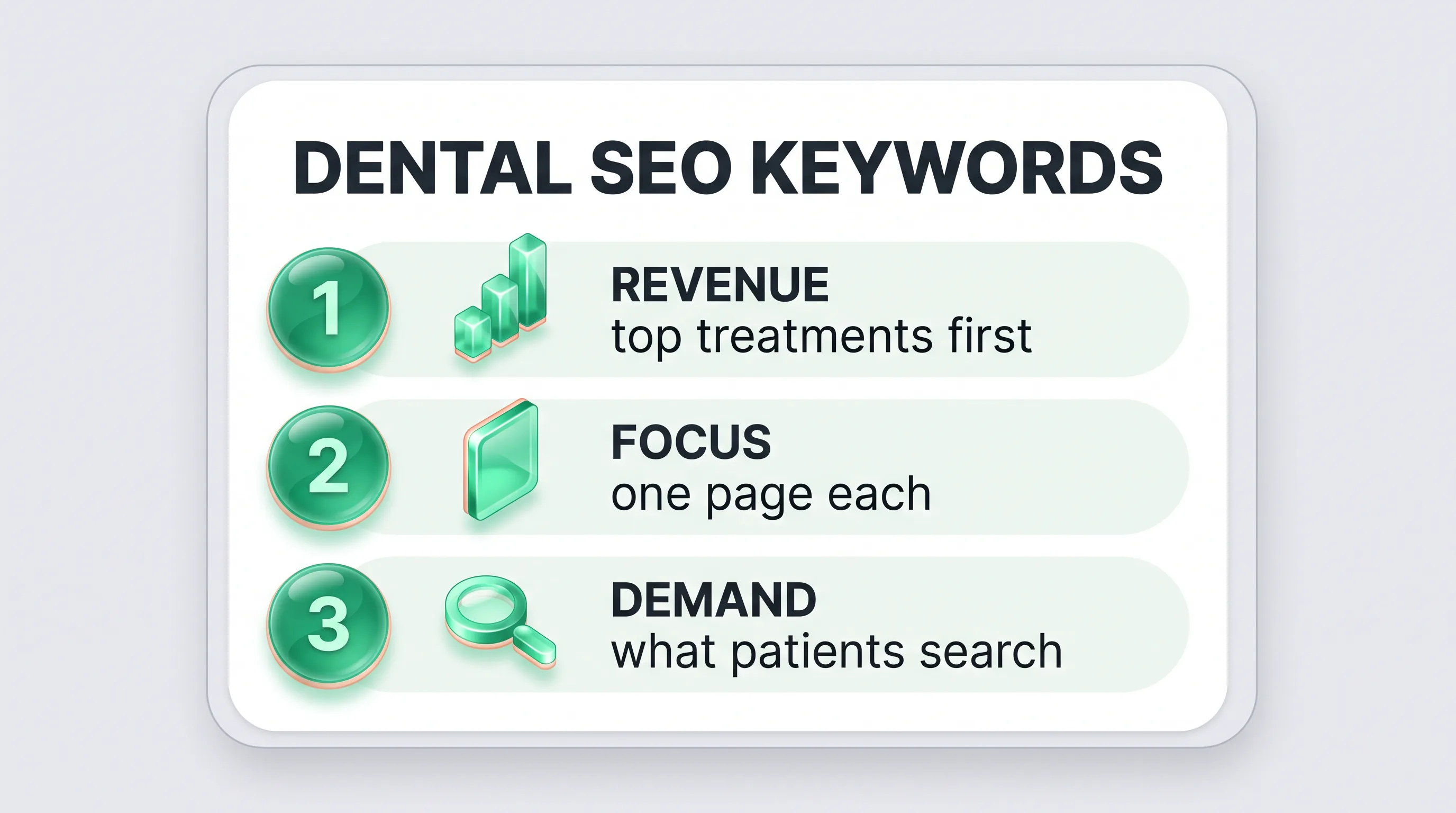
Build a dental SEO keywords list that matches real treatment demand
Start with the services that drive revenue, not every procedure you offer
Pull up your last six months of production reports. The top three to five line items by revenue are your starting point for dental SEO keywords, full stop. Most practices scatter effort across twenty service pages that nobody outside the building searches for, while the three treatments that actually fill the schedule get generic copy and no keyword focus.
Dental implants, clear aligner therapy, and full-mouth restorations each carry a decision cycle of weeks or months. A patient weighing implants searches a dozen times before she calls. If your page is not present during those searches, a competing practice gets the consultation you should have had. Start your keyword list where your revenue already concentrates, then build outward.
Split terms by patient intent: ready to book, comparing options, or just learning
A patient typing "emergency dentist open now" and a patient typing "how long does a dental implant last" need completely different pages. Grouping them under one target misaligns both. Ready-to-book phrases, such as "dental implants in [city]" or "Invisalign provider near me," belong on service pages with a direct call to action. Comparison phrases, like "dental implants vs bridges cost," belong on supporting content that earns trust before asking for anything.
The broader picture of how these intent layers connect to your site's architecture is covered in a solid dental SEO strategy, but at the keyword level the rule is simple: one intent group, one page type. Do not ask a single page to serve a researcher and a patient ready to book at the same time.
Keep a short core list and a longer support list so pages do not compete with each other
Six to eight primary terms, one per revenue-driving service page. That is your core list. Every other phrase you discover goes into a support list, assigned to blog posts, FAQs, or location variants. When two pages target the same primary term, Google picks one and suppresses the other, often not the one you intended. That internal overlap quietly stalls rankings across your whole site without a single obvious error appearing in your data.
The governance rule that prevents this: each primary term appears on exactly one page, listed in a simple spreadsheet alongside its URL. Supporting terms can echo the topic but never duplicate the exact head phrase. If you run more than one location, the overlap risk multiplies fast, which is why multi-location dental SEO requires its own separate keyword map per office, not a copied set of pages.
Choose terms your site can actually win
Pair broad service phrases with longer local variations your pages can support
"Dental implants" as a standalone phrase returns national directories, manufacturer sites, and academic content. Your single-location practice cannot displace them. But "dental implants in [neighborhood] [city]" returns a much shorter list, and a well-built service page with local signals can appear there within a realistic timeline. The broader dental SEO work that supports these local variations includes citation consistency and review velocity, but the keyword choice itself is where you decide whether you are competing for a phrase your domain can realistically reach.
For location-specific demand, the map pack drives a meaningful share of clicks on local service searches. How your Google Business Profile, reviews, and directory listings support that map pack visibility is a separate layer, covered in depth for local SEO for dentists. At the keyword planning stage, just flag which terms carry heavy local intent so you know those pages need both on-site and off-site signals to rank.
Check the current search results before you commit a page or campaign
Before you finalize any target phrase, search it in an incognito window from your city. Note what type of page ranks in positions one through five: a directory, a national chain, a single-practice page, or informational content. A term dominated by WebMD and Healthline signals Google reads it as informational. Sending a service page after it wastes crawl budget and produces no bookings.
Specialty practices face a narrower window. A pediatric practice targeting general implant phrases competes in entirely the wrong pool. Specialty keyword choices, like those that drive pediatric dentist SEO, require matching the term's intent to your actual patient, not just your broadest possible audience.
When should you update your keyword list?
I revised keyword targets at my own clinic twice a year, always after reviewing which treatments had grown and which had been dropped from the schedule. A term you no longer perform becomes a liability: it attracts inquiries you cannot fulfill, erodes patient trust, and signals mismatch to Google over time.
Beyond schedule changes, check your list when you add a new service, when a competitor opens nearby, or when a new modality, such as a different clear aligner brand, shifts how patients phrase their searches. A dental keyword list is not a spreadsheet you build once. It reflects living demand, and living demand shifts.
Turn the list into pages that bring the right calls
Assign one primary term to each service page and keep overlap tight
A patient lands on your veneers page during her lunch break. She has been comparing practices for three weeks. If that page also tries to rank for teeth whitening and smile makeovers, its signals are diluted and its message is blurred. She reads two paragraphs, sees nothing that speaks directly to her question, and closes the tab. One primary term per page sharpens both the SEO signal and the conversion message for a patient already leaning toward a decision.
The full implementation of this across service pages, location pages, and supporting blog content is part of what dental SEO services handle month to month, but the assignment logic starts here, in the keyword plan, before a single word of page copy is written.
Your dental implants page should naturally include phrases like "implant placement," "bone grafting," "implant crown," and "cost of dental implants" because patients scanning that page are already thinking about those details. These related phrases, sometimes called semantic variants, tell search engines the page covers the topic in depth rather than just repeating one keyword. They also match the questions a patient asks during a consultation, which makes the page feel written for her rather than for an algorithm.
High-value service lines like implants often justify a deeper specialty approach. If implants represent a significant share of your production, reviewing dental implant SEO as its own discipline gives you a more granular keyword map than a general services page can support.
Watch which terms lead to booked visits, not just impressions and clicks
Google Search Console shows you which queries drove clicks to each page. Cross that against your practice management software: which inquiries from the web converted to a booked appointment? A term generating two hundred impressions but no bookings is a traffic metric, not a business metric. A term generating forty impressions and six booked consultations is a keyword worth protecting and expanding.
Most practices stop at impressions. The ones that grow fast stop at cases patients actually accept. If a page ranks well and draws clicks but converts poorly, the problem is usually a mismatch between keyword intent and page content, not a ranking failure. Fix the alignment and the conversion follows. For a broader view of how keyword performance fits into the full system of rankings and patient flow, dentist SEO covers the moving parts beyond the keyword list itself.
Get the keyword assignment right at the planning stage and every page you publish starts with a clear purpose and a real patient in mind.