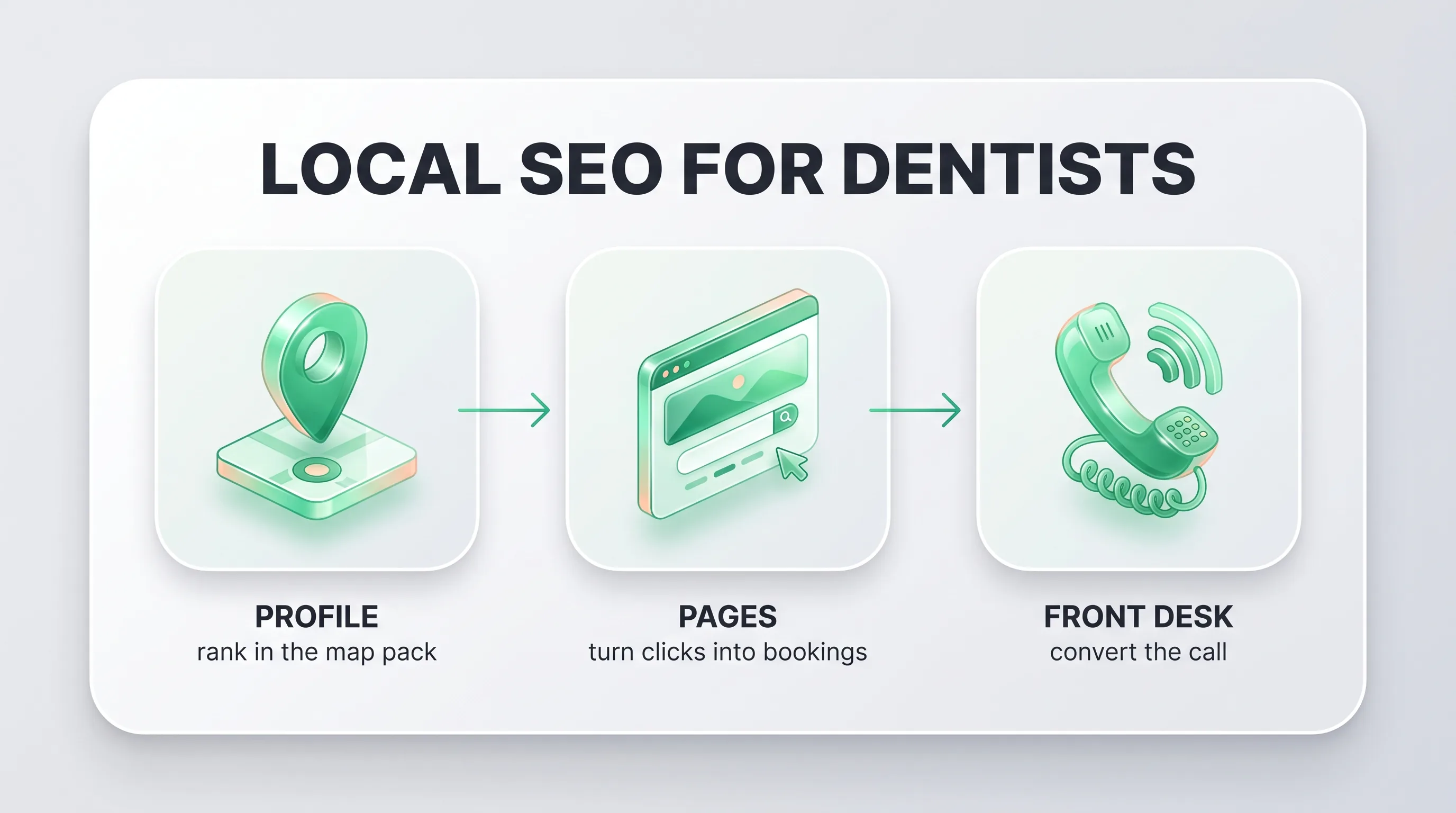
Local SEO for dentists starts with the map pack
Set your Google Business Profile to match the practice you actually run
A patient searching "dentist near me" during a lunch break sees three results before she sees any website. That three-pack is where the decision happens. Your Google Business Profile, the listing that controls whether you appear in those three slots, is the single highest-leverage asset in local SEO for dentists. Most practices claim it, then leave it half-finished.
Set your primary category to match what you actually do most. If you place implants every week, "Dental Implant Provider" as a secondary category is not optional. Complete the services editor with individual treatments, not a generic paragraph. Google reads those fields to match your profile against what patients type. A broader dental SEO strategy for your practice builds on this foundation, but the profile itself comes first.
Keep your name, address, hours, and services identical across every listing
"Suite 200" on your website and "#200" on Healthgrades look trivial. To Google they are a discrepancy, and discrepancies erode the confidence a search engine needs before recommending a medical provider. NAP consistency, your name, address, and phone number matching exactly across every directory and insurance profile, is what converts Google's doubt into local trust.
Pull your listings on Yelp, Zocdoc, Healthgrades, and your local chamber of commerce. Compare them character by character against your Google Business Profile. Fix hours first: a profile showing you closed on a day you are actually open costs you calls directly. If you run more than one office, the architecture for each location is its own problem, covered in depth under multi-location dental SEO.
Use photos, categories, and service details that help the right patients choose you
Practices with a substantial number of real photos on their profile draw meaningfully more direction requests and calls than those with a handful of stock images. Upload your exterior signage so an anxious first-timer can find the door, your operatory so a patient weighing a full-mouth restoration can see the equipment, and your team so there is a face before the first handshake. Stock photos read as stock photos. Skip them.
Secondary categories do targeting work you cannot do with words alone. "Emergency Dental Service" and "Cosmetic Dentist" alongside your primary "Dentist" category tell Google which adjacent searches you are eligible for. Each service entry in the profile editor is a relevance signal. Fill every field you run. Patients who arrive having already seen your space, your team, and your specific services show up closer to a decision. That is the point.
Turn local visibility into booked appointments
Build service and location pages that answer one visitor's next step
A patient who clicks through from the map pack lands on your website already warm. She searched "Invisalign dentist in [her neighborhood]", found you in the three-pack, and tapped. If she lands on a homepage with no mention of Invisalign and no obvious next step, she bounces. The visibility worked; the page failed.
Build one dedicated page per high-value service, tied to your city or neighborhood. "Clear aligners in [City]" ranks for specific intent and gives her a place to read, see before-and-afters, and book. Generic pages that try to cover every treatment in one scroll do not rank and do not convert. If you need to map which terms each page should own, dental SEO keywords by treatment type is a useful next layer. Keep every page's call to action singular: one phone number, one booking link, one clear step.
Make reviews part of follow-up, not a one-time push
60 to 90 minutes after a patient leaves, send a text with a direct link to your Google review page. That window, when the appointment is still fresh and she is back at her desk, is when she is most likely to write three sentences. A review sent at that moment converts at a rate a weekly blast never matches.
Review recency moves rankings. A practice with 40 reviews spread over the last six months can outrank a competitor sitting on 200 reviews from three years ago. Respond to every review within 48 hours. For a rare negative one, take it offline immediately: acknowledge it, give your office manager's contact, and say nothing clinical in public. Consistent volume over time beats any one-time push campaign.
What should you fix first if calls are not moving?
When traffic is flat, it is tempting to assume the problem is rankings and to keep pushing for more visibility. A simple check of the call log often shows the real issue: a practice can rank in the map pack, get views, and still lose calls because the listed number rings an unmanned extension outside office hours. In that case the SEO is working. The front desk is not.
Before touching another listing, check your profile's call and direction-request data against your actual booked appointments. If views are healthy but calls are low, the profile or the first page patients land on is the problem. If calls are healthy but bookings are low, that is a front-desk or booking-flow problem, separate from the ranking work entirely. Treating them as the same issue wastes months. Understanding how a full dental SEO strategy fits together helps you see where the local work ends and the conversion work begins.
Know if your local work is paying off
Track map views, calls, direction requests, and booked patients together
Your Google Business Profile dashboard shows map views, calls initiated, and direction requests. Those numbers tell you whether local SEO for dentists is generating attention. They do not tell you whether attention is becoming revenue. Pull them alongside your actual booked appointments for the same period, and the gap becomes visible.
If map views climb but calls stay flat, patients are finding you and not choosing you. That is a profile or credibility problem. If calls climb but booked appointments stay flat, your front desk or booking flow is the leak. Separate these metrics deliberately. Combining them into a single "leads" number hides which layer broke. For readers who want to see what this measurement looks like across a real practice, a dentist SEO case study shows the pattern concretely.
Spot the bottleneck between ranking, trust, and what your team does with each inquiry
Most competitors in the local SEO space stop at rankings. They show you a position and call it a result. The actual bottleneck for most practices sits one or two steps further down: a patient who found you, read your reviews, liked what she saw, called, and then heard a voicemail or a rushed front desk who could not quote a price or timeline for the crown she was asking about.
Run the diagnostic in order. Check ranking first. Then check profile-to-call conversion. Then check call-to-appointment conversion with your front desk. Each layer is a different fix. A ranking problem needs SEO work. A profile problem needs better photos, a clearer service list, and fresher reviews. A call problem needs front-desk training or a booking tool. Mixing them up means you spend on the wrong layer for months. If after this audit you decide the work belongs with a specialist, choosing a dental SEO company that can diagnose across all three layers, not just rankings, is the right filter to apply. Budgeting realistically starts with understanding how much dental SEO costs before selecting a company to hire.
Local SEO for dentists works when every layer from the map pack to the front desk operates as one connected system, not a set of separate tasks.