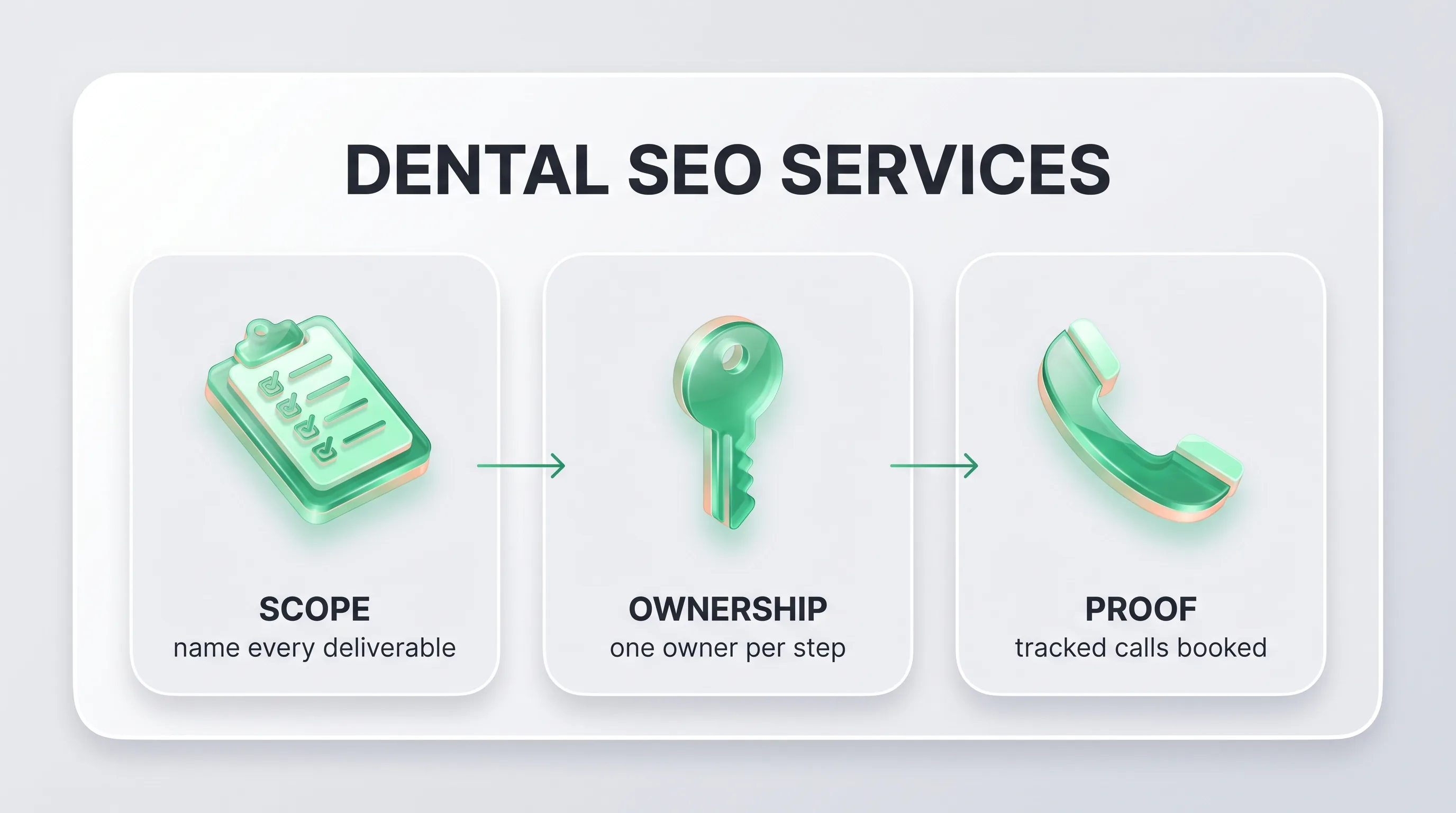
Choose dental SEO services that fit the practice
What should be included before you sign?
Some contracts list a short set of bullet points, none of them measurable: no defined deliverables, no content volume, no reporting cadence. Without those details, a practice can keep paying without knowing what it is actually getting. Before you sign anything, the scope should name exactly what runs each month: which pages get written or updated, how citations and technical issues are handled, and what the reporting covers. If a provider cannot specify those items in writing, the ambiguity will cost you time. A useful starting point is understanding what a coherent dental SEO engagement actually covers, so you can hold any provider to that standard from day one. Knowing how much dental SEO costs helps you judge whether the deliverables in a contract match the price you are being asked to pay.
When local visibility is enough and when the site needs deeper work
A single-location general practice drawing patients from a five-kilometre radius has different needs from a specialist running implant cases across a city. Map pack presence and a well-maintained Google Business Profile often drive the majority of inquiries for the first type. For deeper treatment categories such as implants or full-mouth rehabilitation, patients research heavily before calling, which means service pages and condition-focused content carry real weight. Understanding where your leads actually come from shapes which part of the service scope deserves the budget. The detail on local SEO for dentists is worth reading if you are still weighing how much of the work sits in local signals versus the broader site.
Who handles approvals, content, and reporting each month
Most service stalls happen here, not in the strategy. A provider drafts a treatment page, it waits three weeks for your approval, then misses the publishing window, then gets revised again. Multiply that by six pages and you have lost a quarter. Before signing, ask who owns the approval workflow: does a dedicated point of contact chase the process, or does it fall to you to ping the account? Reporting should arrive on a fixed date each month, cover calls and form submissions alongside rankings, and require no chasing. Ownership of each step must be named, not assumed, and the operating model should be written into the agreement. Comparing top dental SEO companies before signing shows whether this level of accountability is standard practice or a rare exception.
Judge the service by booked patients, not promises
What proof matters more than rankings screenshots
A rankings screenshot shows a keyword moved from position eleven to position four. It tells you nothing about whether a single patient booked. The metric that matters is a tracked inquiry: a phone call attributed to organic search, a form submission tied to a specific page, a direction click that preceded an appointment. Ask any provider to show you these figures from a current client, with the same practice type and market. If they cannot, they are optimising for optics. The better providers connect dental SEO marketing spend directly to new-patient volume, and that connection should be visible in the reporting before you commit.
How to read reviews without missing delivery problems
Five-star reviews for dental SEO services often cluster around onboarding: the setup call was smooth, the team was responsive in month one. Look instead at reviews posted after month four or five, when the early enthusiasm has passed. Phrases like "we had to follow up ourselves" or "reporting was inconsistent" point to execution gaps that rarely appear in headline scores. Check for patterns across multiple platforms, and if the provider has a public case study, verify that the timeline and results match what the review claims. A dentist SEO case study with verifiable timelines tells you more than a portfolio page of logos.
How long should progress take once the basics are fixed?
Technical corrections and citation clean-up can produce movement in sixty to ninety days. Meaningful organic growth from new content, earned authority, and improved service-page rankings typically takes six to twelve months to compound. Any provider promising page-one results in thirty days is selling you a number, not a process. Set a realistic internal benchmark: by month three you should see cleaner technical health and early ranking shifts; by month six, measurable inquiry growth. If neither has appeared by that point, the plan needs a direct conversation, not more patience. Knowing what a sound dental SEO strategy should deliver at each stage gives you the language for that conversation.
Avoid the service gaps that waste months
Separate strategy, execution, and the handoff to your scheduling team
A patient finds your implant page during her lunch break, reads it carefully, and submits a form. Your front desk sees it the next afternoon. By then she has called the practice that responded the same evening. Dental SEO services generate inquiries; they do not close them. A provider who optimises your visibility without asking how your team handles after-hours leads is covering only part of the problem. Strategy, execution, and front-desk response are three separate links, and the chain breaks at the weakest one. If you are evaluating whether to use a specialist or a broader agency, the comparison between a dental SEO expert and a full-service team is worth working through before you commit.
Make sure the plan matches what you actually treat and where
A practice focused on clear aligner cases in a suburban market competes on completely different dental SEO keywords than a downtown emergency clinic. A generic package that builds the same five service pages for every client ignores that gap. The right service scope asks what your two or three highest-value treatments are, which neighbourhoods your patients actually travel from, and who your real search competitors are at that postcode level. Matching the plan to your real case types is what separates a plan that fills your schedule with the right cases from one that drives traffic you cannot convert. Raise those specifics in the first call and judge the provider by how precisely they respond.
The right dental SEO service earns its place by putting patients in your chair who already understand what they need and are ready to say yes.