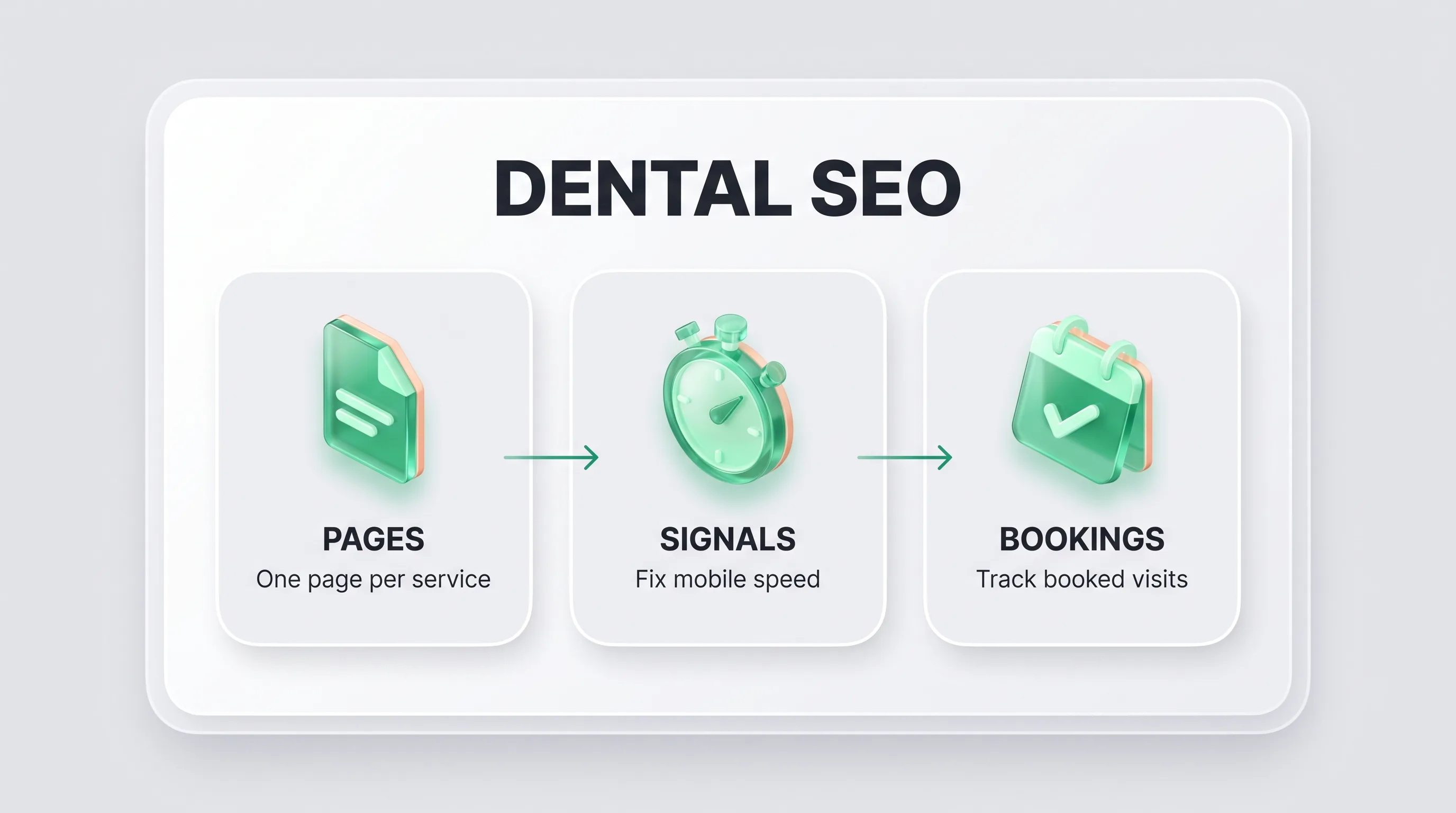
Best dental website SEO starts with pages that earn the next click
Give each core service one page with one patient decision
A patient researching dental implants on a Thursday evening does not want to scroll past veneers, whitening, and crowns to find her answer. When every treatment shares one page, she leaves. Each high-value service deserves its own page built around one patient decision: am I ready to book this procedure?
The best dental website SEO begins here, not with technical fixes. A dedicated implants page can rank for implant searches; a page called "Our Services" ranks for nothing specific. Keep the scope tight: one treatment, one target visitor, one clear next step.
Write treatment details in the words patients use before they call
Patients do not search "osseointegration timeline". They search "how long do dental implants take" or "does the implant surgery hurt". Writing to clinical vocabulary loses the patient at the search bar before she ever reaches your page.
Match the language to the moment of uncertainty. For choosing dental SEO keywords that match patient intent, the decisive signal is the question a patient types when she is weighing the procedure, not when she has already decided. Answer that question plainly and early on every service page.
Your title tag is the first sentence a patient reads about your practice, and she reads it before your website loads. A title like "Dental Implants Manchester | Book a Consultation" tells her and Google exactly what the page offers. A title like "Services | City Dental Practice" tells neither.
Each page needs one H1 that matches the title's promise, meta copy that names the procedure and a specific benefit, and headings below that follow the patient's actual questions in order. This structure also signals to Google which visit type the page targets, which affects which searches trigger it.
Fix the site signals that quietly waste good demand
Keep mobile speed, image size, and page layout from killing conversions
Over 70% of local dental searches happen on a smartphone. A page that loads in four seconds on mobile has already lost a share of those visitors to the practice that loaded in two. Compressed images, deferred non-critical scripts, and a layout where the call button sits above the fold cost nothing to implement and protect every visit the page earns.
On plenty of practice sites, the mobile booking form sits below three paragraphs of small text. Fixing that one layout detail routinely moves more inquiries than six months of link-building.
Use internal links to move visitors from broad pages to treatment pages
Your homepage and about page collect the most external authority over time. Left disconnected, that authority stays on those broad pages while your implants or Invisalign page sits invisible. A deliberate internal link from the homepage to each core service page transfers authority and sends real visitors one click closer to booking.
The mechanism is straightforward: Google follows internal links to understand which pages matter most to the practice. Visitors follow them to go deeper. When your "About" page mentions cosmetic work and links to the veneers page with a phrase like "see what the procedure involves", both signals move in the right direction. Spread these links across your highest-traffic pages, not just the footer. For this to fit a wider growth plan, a clear dental SEO strategy determines which pages deserve priority and in what order.
Add schema where it helps Google read the practice and the page
Schema markup is structured code that tells Google your surgery hours, location, accepted payment types, and the specific dental specialty of each page, without making the visitor read any of it. Google uses it to build rich results and to verify that what your page says matches what your other signals say.
Dentist schema on the homepage, service schema on treatment pages, and FAQ schema where you answer common patient questions are the three most practical starting points. None of this replaces strong page copy, but it removes ambiguity that silently suppresses rankings. For the map pack and citation side of local visibility, local SEO for dentists covers that separately.
Judge your website by booked visits, not prettier reports
Watch which pages lead to calls, forms, and the procedures patients actually book
Rankings are a proxy. The number that matters is which page drove the patient who signed a treatment plan last Tuesday. Google Search Console shows you which pages earn clicks; your booking system or CRM shows you which treatments those patients requested. Connecting those two datasets tells you whether your implants page pulls implant patients or just browsers.
Set up goal tracking on your call button and contact form for each service page separately. When you review those numbers monthly, you are measuring conversion by page, not aggregate traffic. A page with 200 visits and four bookings outperforms one with 800 visits and two. For a view of how real practices moved from rankings to revenue, a dentist SEO case study shows what that timeline actually looks like.
Spot whether the leak is search visibility, page trust, or a slow reply
A patient finds your Invisalign page, reads it, and submits the enquiry form during her lunch break. Nobody replies until the following business day. By then she has booked with the practice that answered first. The page did its job — the response time is what failed.
Separate the three failure points before spending more on the site. Low impressions in Search Console mean a visibility problem: the page is not ranking. High impressions but low clicks mean a trust or title problem: the page appears but does not earn the visit. High clicks but no bookings mean a page or follow-up problem: visitors arrive but do not convert, or conversions go unanswered. Each failure requires a different fix, and confusing them wastes budget. If you want a broader lens on where the wider mix of dentist SEO signals interact, that separation matters there too. The dental SEO services that move results treat these three layers as distinct problems, not one undifferentiated "SEO" task.
Every fix on this page points at one outcome: a patient who arrives at your chair already certain about the treatment she wants to discuss.