
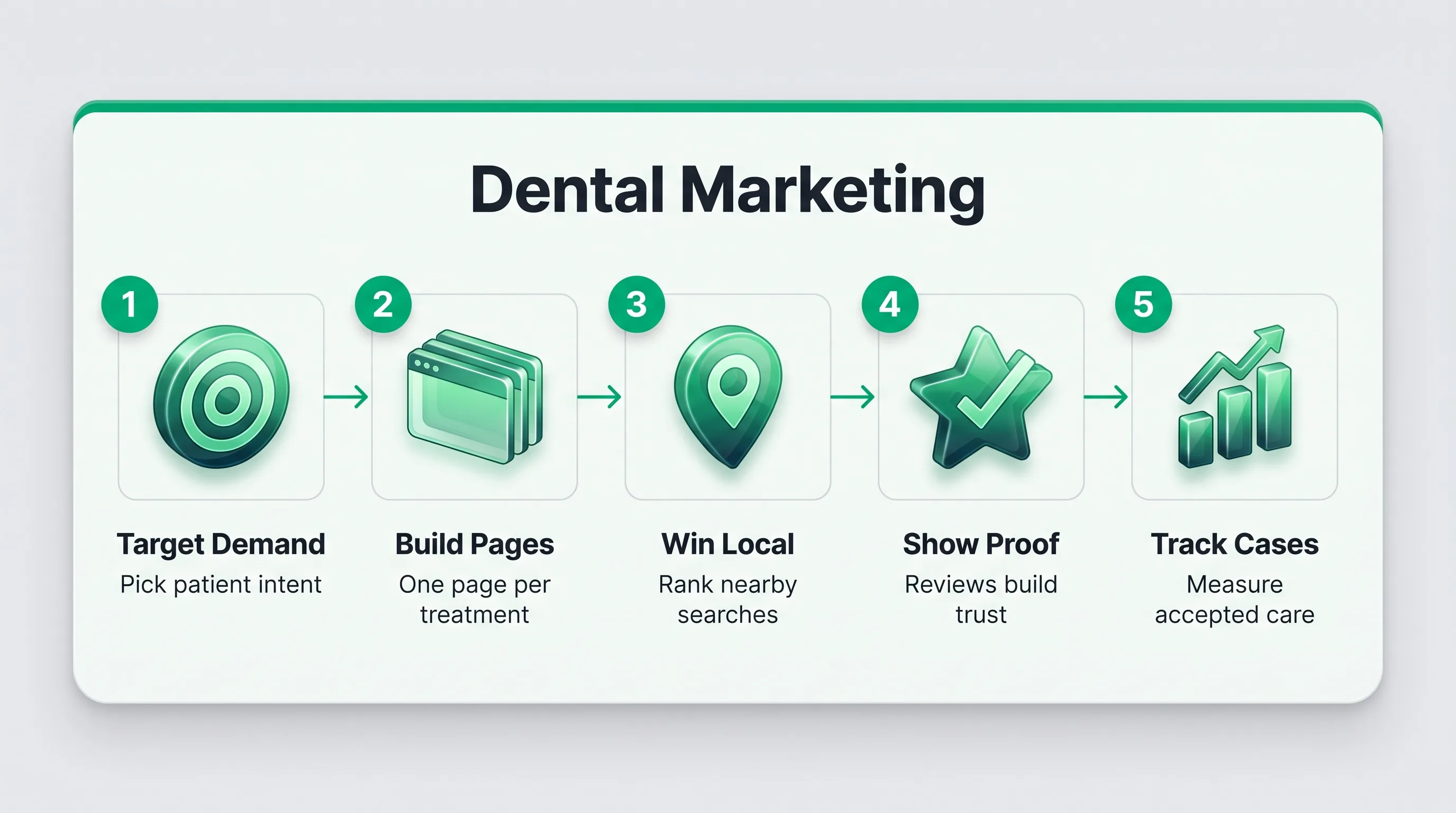
If you had to cut one dental marketing channel tomorrow, would you know which to kill? Paid search, SEO, and your Google profile each claim credit for the same patient. Pricing every channel against accepted cases settles it.

Your implant pages may be filling hygiene chairs, not implant chairs.
When you sort your last three months of new patients by the treatment they actually accepted, not just the appointment type they booked, you often find your pages are pulling in a different patient than you built them for. That mismatch costs more than empty chairs: it means your full-arch and cosmetic content is doing work that never turns into accepted treatment.
A patient searching "tooth pain open now" at noon on a weekday has already decided to call the first practice that signals same-day availability. That search behavior is categorically different from someone booking a six-month recall. Your page for emergency exams, same-day crown prep, or acute pain needs a visible same-day access promise near the top, a phone number that answers, and a booking path that does not ask for insurance verification before the patient even speaks to anyone.
Dental marketing that treats urgent-care pages the same as hygiene pages loses these inquiries before the phone rings. If your schedule genuinely holds emergency slots, say so explicitly: a sentence naming the specific treatments you can fit the same day outperforms any generic "we welcome new patients" statement. For practices where fast-turnaround demand is competitive, when faster demand needs paid promotion is worth reviewing before relying on organic discovery alone.
A patient weighing a single-tooth implant after an extraction typically spends several weeks comparing osseointegration timelines, bone graft requirements, and total treatment length before they contact anyone. A full-arch candidate, often someone who has been managing failing dentition for years, may research intermittently across months, revisiting cost-spread financing and surgical staging before committing to a consult. Invisalign inquiries sit somewhere between the two: the patient is often comparing aligner brands and attachment protocols rather than questioning whether to treat at all.
Each research window demands a different depth of content and a different consult format. A single-implant page that forces a full-arch consultation process loses the shorter-cycle patient. Knowing which dental service lines first deserve your content and budget investment keeps you from building deep implant content while your bread-and-butter restorative line goes unaddressed.
Pull the last three months of new patient source data from your practice management software and sort by the treatment accepted, not just the appointment type booked. If your implant pages generate inquiries that convert to single-tooth fillings, your content is attracting a different patient than you intended. That gap is not a traffic problem; it is a message-to-patient mismatch.
A case mix audit this simple takes under an hour: count consult-to-accepted-treatment rate by service line, then compare which channels or pages each accepted case came through. Hygiene-heavy intakes are not automatically a problem, but if you have invested in full-arch or cosmetic content and the accepted case log shows none of it, your pages are not closing the distance between patient curiosity and an accepted case. Fixing that mismatch is the first move dental marketing should make, before adding spend or building new pages.
The patient weighing a crown after a cracked molar asks different questions than the one deciding between root canal treatment and extraction. Crown candidates ask about prep visits, temporaries, and material options like full-zirconia versus porcelain-fused. Root canal patients are often managing fear of the procedure itself and want sedation details before they want clinical outcome data. Extraction patients, especially pre-implant ones, want to understand the socket timeline before the replacement conversation begins.
Grouping these under a single "restorative dentistry" page blurs those distinctions and leaves each patient without the specific next step they need. Each service benefits from a page that names the clinical situation plainly, addresses the most common objection for that treatment specifically, and ends with one clear action: a call, a form, or a stated expectation for what the consult involves.
A patient asking about whitening is often deciding between an in-office procedure and a take-home kit; the consult is short and the commitment is low. A veneer candidate is comparing feldspathic to pressed ceramic options, asking about prep versus no-prep protocols, and often bringing in reference photos. A smile makeover patient is navigating a multi-phase treatment plan that may include orthodontic alignment, gingival recontouring, and full-coverage restorations across multiple arches.
Blending these on one cosmetic page means the whitening patient scrolls past surgical complexity that does not apply to them, and the makeover candidate never finds the staged-planning detail they need to feel confident booking. Separate pages with separate calls to action serve the actual decision each patient is making.
Single-tooth implant content and full-arch content are not variations of the same message; they target patients at different stages of clinical urgency, financial readiness, and emotional investment. A patient replacing one premolar wants specificity on crown emergence profile and healing time. A full-arch candidate wants to understand whether fixed or removable options apply to their bone volume, and they need to picture what the surgical day looks like.
Combining these under one implants page and then running paid or organic promotion to it means your budget drives traffic to a page that fully answers neither inquiry. Split the pages before promoting either, or your cost per booked consult climbs without a clear diagnosis of why.
Your Google Business Profile primary category determines which search surfaces your practice appears in; a general dentist listing that also performs oral surgery benefits from adding the specialist category where the search volume sits. More practically, your listed hours must match your actual scheduling window. A patient who calls based on hours your profile shows as open, and reaches voicemail, does not call back.
Photos carry more weight than many practice owners realize. Treatment-room images showing a CBCT unit or digital scanner tell the implant or Invisalign researcher something specific before they dial. Staff photos reduce first-visit anxiety in ways that a logo banner does not. Audit your profile quarterly: categories, hours, and photos should reflect the schedule you are actively filling, not the one you built the profile around two years ago.
A "dental implants in [city]" page earns rankings when it contains genuine local signals: the neighborhoods patients realistically travel from, parking or transit access if relevant, and language that matches how people in that area search. A page that simply swaps a city name into a template adds nothing the search index values and nothing the patient trusts. Depth on the local treatment landscape, including which cases you see most from that catchment area, distinguishes a page that converts from one that only indexes. The structural work behind pages like these is covered in detail when you look at how service page depth and local search structure interact.
A veneer patient who arrives having already seen three comparable smile transformations on your site has already done a large part of the consent work before the consult chair. The same applies to a full-arch patient: seeing a before photo showing severely resorbed ridge anatomy and an after showing fixed prosthetic restoration answers questions no paragraph of text can address. Place documented, consent-cleared photos on the specific service page where the patient's decision lives, not behind a generic gallery the patient has to find separately.
Photos do not replace written proof. For services where visual results vary with healing, add a note on the timeline the photos represent. Review-based proof, including the pattern of what patients say after implant placement versus after a smile makeover, belongs in a separate workflow; if that side of your practice needs structure, how review workflows support treatment proof addresses that without overlapping with the visual content decision here.
A patient considering IV sedation for a full-arch procedure wants to see your sedation training credential named explicitly, not buried in a provider bio. A patient deciding on clear aligner treatment is often comparing your Invisalign case volume against a nearby orthodontist; your case count or iTero scan availability answers that comparison. Financing details matter most on high-investment treatment pages, where the objection is often not clinical doubt but deferred commitment because the patient cannot picture how payment works.
Match the proof to the objection the patient is holding at that specific page, not a credentials block copied across every service. Specificity converts; a generic "experienced team" line does not answer the question a full-arch candidate is actually asking before they book.
Channel choice is a capacity question before it is a marketing one. A plan only works if the front desk can answer the calls it creates, the schedule has open chair time for the promoted service, and the payer mix makes that service worth promoting. Start with the channels your current team can run every week, and add the rest when capacity changes.
Extra inquiry volume is not progress if it arrives faster than anyone can respond. A front desk splitting attention between phones, check-ins, and insurance verification will drop calls created by a new campaign, and those callers book elsewhere.
Payer mix decides which services deserve promotion. Where a contracted rate leaves thin margin, filling chairs with that service can crowd out dentistry you cannot reschedule later. Promote what the schedule has room for and what the fee arrangement supports.
When you are deciding what to run first, order matters more than variety:
Give every addition an owner and a routine. A channel that only runs when the schedule is quiet is not a channel; it is an intention. If a tactic cannot survive a fully booked week, it belongs on the list you revisit after hiring, not in the plan you are running now.
A review cycle keeps channel decisions from drifting. On a set schedule, check accepted cases by source, call volume, and review count, then ask whether the plan filled the chair time you named at the start. If that answer is unclear, the problem is tracking rather than budget. Cut whatever sits idle before you add anything new.
When results disappoint, diagnose before you spend. Weak performance usually sits in one of three places, and each one calls for a different fix.
| What you see | What it points to | Where the work belongs |
|---|---|---|
| Few qualified inquiries | Targeting or visibility | Search terms, geography, and the service page the click lands on |
| Inquiries arrive but go cold | Handoff after the click | Who replies, on which channel, and how quickly outside office hours |
| Consults do not lead to accepted care | Presentation or financing | Treatment explanation, options offered, and payment arrangements |
The distinction is practical. More ad spend against an acceptance problem buys more unconverted consultations at a higher cost per case. More content against a handoff problem adds inquiries to an inbox nobody opens in the evening.
Map the path once, in order: inquiry received, reply sent, consult booked, visit kept, care accepted. Each step can break on its own, so review them separately instead of judging the channel on a single total.
Keep the review short and repeatable. A plan the team can read in one sitting gets acted on; a dashboard nobody opens does not. Simpler plans hold up better in the weeks when everyone is treating patients.
Sitewide session counts tell you very little about whether your dental marketing is working. A practice can grow organic traffic by thirty percent and see no change in accepted implant cases if the traffic growth came entirely from informational queries that never reached a consult form. The measurement that matters is service-line-specific: how many implant inquiries became booked consults this quarter, and of those, how many accepted treatment?
Set up call tracking numbers by service line if you have not already. Most practice management platforms can export booked appointment type by source if you tag your forms and calls consistently. Once you see calls, forms, booked consults, and accepted cases in one view per service, you stop optimizing for the wrong metric. Traffic means nothing without a line that runs all the way to a patient who says yes.
An implant inquiry submitted midweek that doesn't get a callback for two full days is competing against a practice that called back within the hour. The patient does not wait; they move through their shortlist. For emergency inquiries, the window is even shorter: a patient in acute pain who cannot reach your front desk routes immediately to whoever answers.
Response speed is not a marketing variable; it is a scheduling and staffing decision. But marketing that drives high-intent implant or urgent-care inquiries without a confirmed fast-response protocol wastes the spend. Check your average first-response time for web form submissions right now, and compare it against your booked-from-form rate for implant and emergency lines specifically.
Hygiene recall campaigns show results in weeks because the booking cycle is short and the patient list already exists. Emergency marketing can shift call volume within days of a change. Invisalign and full-arch implant work operate on longer patient consideration cycles, so a review window of three to four weeks tells you almost nothing about whether those pages are building toward consults. Give high-investment service lines a longer assessment period before drawing conclusions, or you will cut what was actually working.
Build a simple review cadence: hygiene and emergency lines reviewed monthly, cosmetic and implant lines reviewed quarterly with case-accepted data included. That separation stops you from applying a short-cycle standard to a long-cycle service and misreading the result.
Open your practice management software now and pull accepted-treatment count by service line for the past 90 days.
We review your pages, search visibility and enquiry path, then show you what to fix first.
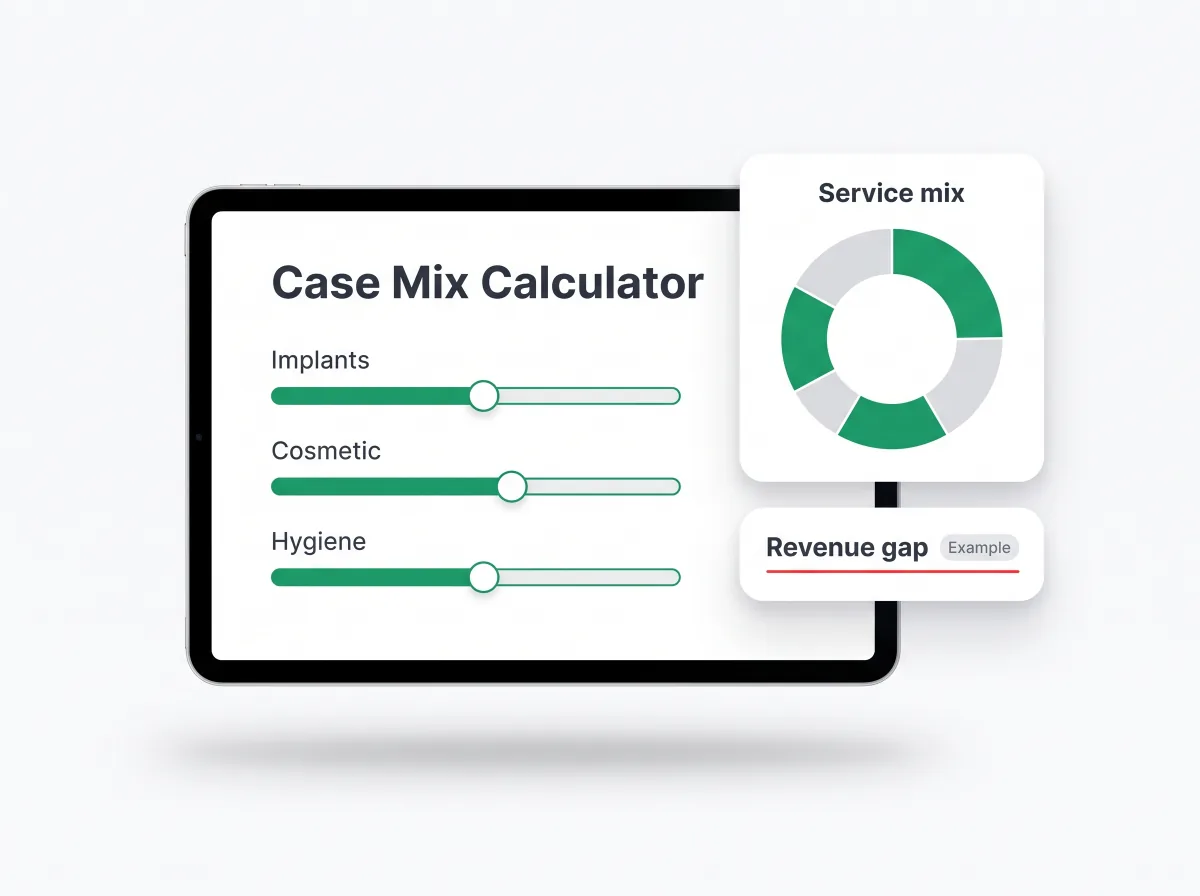
You have read how the wrong pages pull the wrong patients. We compare the treatments your marketing attracts with the treatments you want to grow, using your own figures.
.svg)