Search visibility
Medical SEO That Turns Searches Into Booked Patients
Rankings built on accounts in your name, not ours. Timelines depend on your starting point and agreed scope. From €1,200 a month, published before you talk to anyone.

Rankings built on accounts in your name, not ours. Timelines depend on your starting point and agreed scope. From €1,200 a month, published before you talk to anyone.
Someone in your city types a symptom or a treatment into Google tonight. That search happens whether your practice appears in it or not, and it happens a few hundred times a month.
Three names come back in the map block, then a page of links, and increasingly an AI answer that names two or three practices and stops there. The patient picks from what she was shown.
Nothing about that process assesses your clinical judgment. It assesses whether your profile is complete, whether a page on your site answers her exact question, and whether other people have vouched for you recently. Those are the three things SEO fixes.
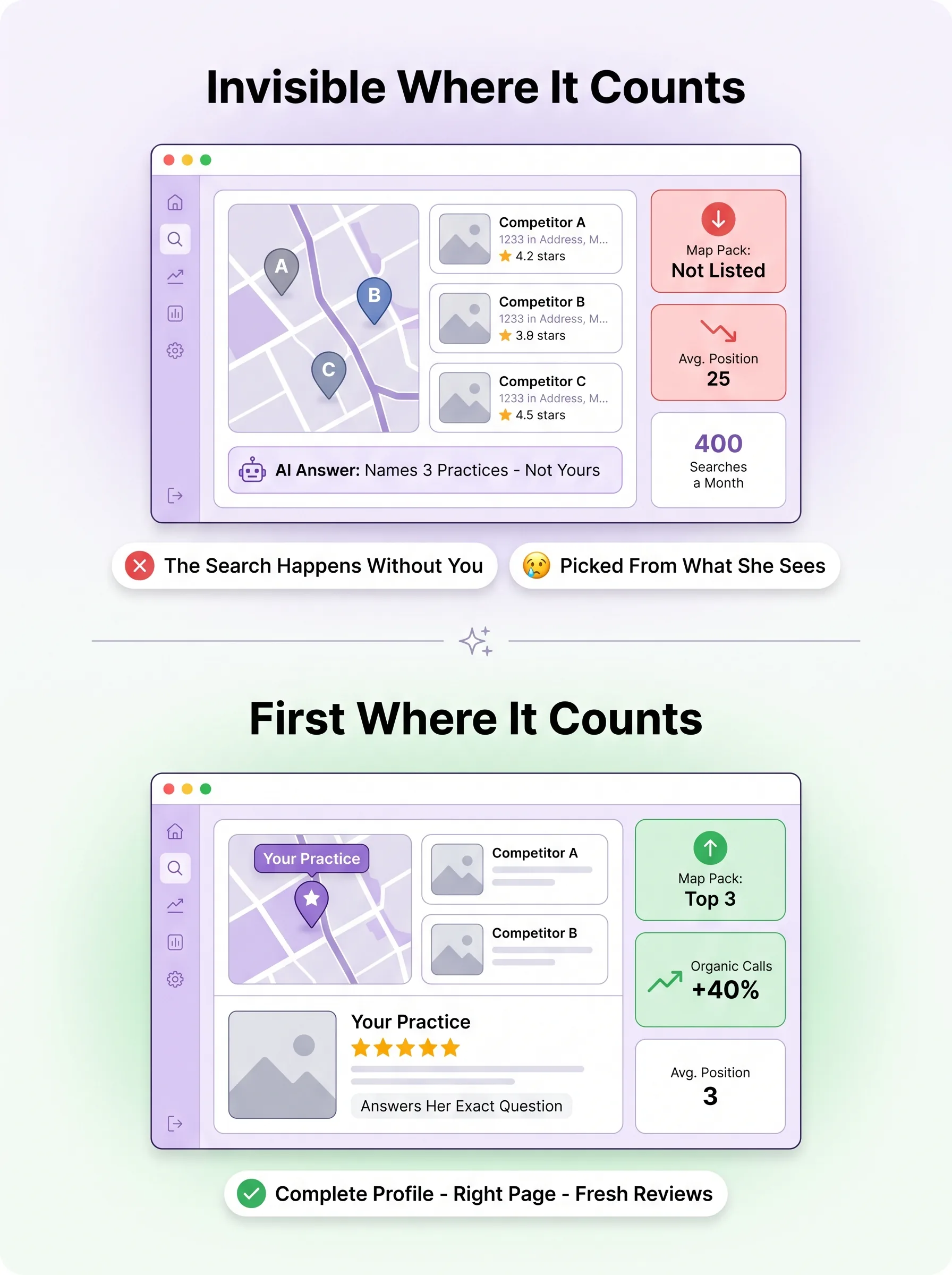
Illustrative comparison of incomplete and more complete local-search listings. Rankings and percentage changes are hypothetical examples.
Your Google Business Profile, your site, your content, your analytics. All registered to you from day one, so the visibility you pay for stays yours.

Most patients never scroll past the map. Getting into those three results is a different job from ranking a website, and it is the one that produces calls.

Google ranks pages, not practices. A single services page competes for everything and wins nothing. One page per treatment is what turns a search into a booking.

Assistants now name two or three practices per city. They pull from the same signals as search, but they only cite content specific enough to be quoted.
Medical SEO gets sold as a monthly subscription to something vague. It is four concrete pieces of work, and each one moves a different thing.
Most patients click the map block before they reach a single website. Getting into those three results depends on categories, proximity, consistent address data, photos, hours and above all review volume and recency. It is the fastest part of SEO to improve and the part most practices leave half-finished.
Google ranks pages, not practices. A page built around a single procedure can carry the pricing, the recovery timeline and the objections that particular patient has, which is what makes it rank and what makes it convert. A combined services page does neither.
Speed on mobile, indexation, structured data and a site architecture a crawler can follow. None of it wins on its own. All of it can quietly cap everything else, which is why the audit comes before the plan.
It will not fill your schedule next month. It will not fix a site that cannot convert a visitor into a call. And it will not compensate for a practice that answers the phone badly. Paid ads cover the short term while this is being built, and a good agency tells you which lever produced what.
How long until I rank, and what exactly moves in the first ninety days?
Anyone answering thirty days is selling you something. Honest local SEO takes six to twelve months to change patient volume. What moves in ninety days is impressions, map visibility and the pages being indexed. If nobody separates those two answers, walk away.
Honest local SEO takes six to twelve months to change patient volume. Anyone compressing that is either describing paid ads or counting impressions and calling them patients.
That profile is the single most valuable asset in local search, and it carries every review you ever earned. If the agency owns it, leaving means starting from zero.
A real agency shows movement on your priority terms and the calls that came from it, separates impressions from booked patients, and publishes its price before any conversation.
I trained as a maxillofacial surgeon, moved into orthodontics, and co-founded a three-clinic group in Paris. I then spent time inside Publicis Health learning how medical marketing actually works at scale.
While running the clinics I hired an agency. I paid them more than 20,000 EUR over a year. They owned my Google and Meta ad accounts, not me. They spent a fraction of the budget, kept the rest, and delivered one patient, who came in for a cleaning, while I was selling orthodontic treatment. I only found out when I pulled the account myself and read the raw numbers.
That is why Forge exists. I read every audit personally. A specialist team runs the day to day. Every account we build stays in the client's name from the first day, because I know precisely what it costs when it does not.

Most healthcare SEO agencies sit between $3,000 and $6,000 a month and will not show you that number until you are already on a call. Here it is upfront.
My team works to the deliverables and review process agreed in the written proposal. No minimum-term commitment. Scope, fees and terms are confirmed in writing. Search positions, patient or booking counts, revenue and a fixed results timeline are not guaranteed.
Practitioner exclusivity: one practitioner per city, with the specialty and territory confirmed in writing. Nationwide exclusivity may be considered for selected specialties.
The first 90 days
A free audit maps your map-block position, the treatment searches you do not appear for, and the technical issues capping the rest. No call, no pitch, read by a physician.
Priorities are set by the treatments you want more of, not by whatever is easiest to rank. You approve the plan before anything goes live.
Google Business Profile rebuilt, treatment pages published one per search, review flow switched on, technical issues cleared. Impressions and map visibility move first.
Reporting separates impressions from calls so you see which stage you are in. The cost per patient falls as the organic base takes over from paid.
Medical SEO is the work that makes a practice appear when a patient searches for the care it provides: the Google Business Profile, the map results, treatment pages built one per procedure, review volume and the technical health of the site. Done properly it changes who finds you, not how much traffic you get.
Six to twelve months in most competitive markets before rankings translate into a consistent flow of new patients. Impressions and map visibility move earlier, often within two or three months, which is why reporting should separate the two. Anyone quoting thirty days is describing paid ads or selling something.
Local SEO is the part that fights for the map results, driven by your Google Business Profile, proximity, consistent address data and reviews. Medical SEO includes that and adds the clinical layer: treatment pages, condition content, credentials and the compliance constraints a generic local business never has to think about.
Yes, because Google ranks pages rather than websites and each treatment is a different search with different intent. A single services page splits authority across everything you offer and ranks well for none of it. Separate pages also let each one carry the pricing, recovery and expectation detail that turns a searcher into a booking.
Managed medical SEO starts at €1,200 per month at Forge, covering strategy, execution and reporting. Most agencies charge between $3,000 and $6,000 and will not publish it. The number that matters more than the fee is what one additional booked patient is worth in your case mix, because that tells you what the work has to produce.
Review count and recency are direct ranking factors in the local map results, the block most patients click first. They also decide the comparison once a patient has three names in front of them. A practice with a hundred reviews from four years ago is weaker than one with thirty from this quarter.
It matters more, not less. AI assistants draw on the same structured signals as search, authoritative content, clean local data and review depth, and they name a shortlist rather than a page of links. Being absent from that shortlist is worse than ranking fifth, and the work that gets you cited is the same work that ranks you.
Track calls and form submissions by source, cost per qualified enquiry, and ranking movement on your priority treatment terms in your own market. Total sessions tell you nothing. If the reporting cannot connect a ranking to a phone call, nobody is measuring the only thing that pays.
Usually both, in that order of urgency. Paid ads produce enquiries within weeks and buy time; SEO takes months but lowers the cost per patient permanently. Running ads alone means renting every patient forever. Running SEO alone means waiting half a year with nothing to show.
Confirm your Google Business Profile, your analytics and your website files stay in your name from day one. Ask for a written timeline that separates impressions from booked patients. Ask what happens to the content and the profile ownership if you leave. At Forge the price is public, the terms are month to month, and nothing is held on your behalf.
The free Forge Visibility Snapshot maps the searches your practice is invisible for and who is taking them instead. No call, no pitch, read by a physician.