Eye care marketing
Eye Care Marketing Agency Run by a Physician
Every account stays in your name, not ours. Built by a physician who signed the invoice and got burned. From €1,200 a month, published here before you talk to anyone.

Every account stays in your name, not ours. Built by a physician who signed the invoice and got burned. From €1,200 a month, published here before you talk to anyone.
Someone needs an eye exam. They type it, and what comes back is a chain with two hundred locations, an online glasses brand with a marketing budget bigger than your annual revenue, and somewhere below that, if at all, an independent practice with a clinician who actually knows what they are looking at.
The patient cannot tell the difference from a search result. They see hours, distance, a price, a review count. Your clinical depth, the pathology you catch that a fifteen-minute retail exam misses, does not show up anywhere on that page.
So the exam goes to whoever looked easiest. And with it goes the frame sale, the contact lens supply, the LASIK referral, and the twenty years of annual visits behind it.
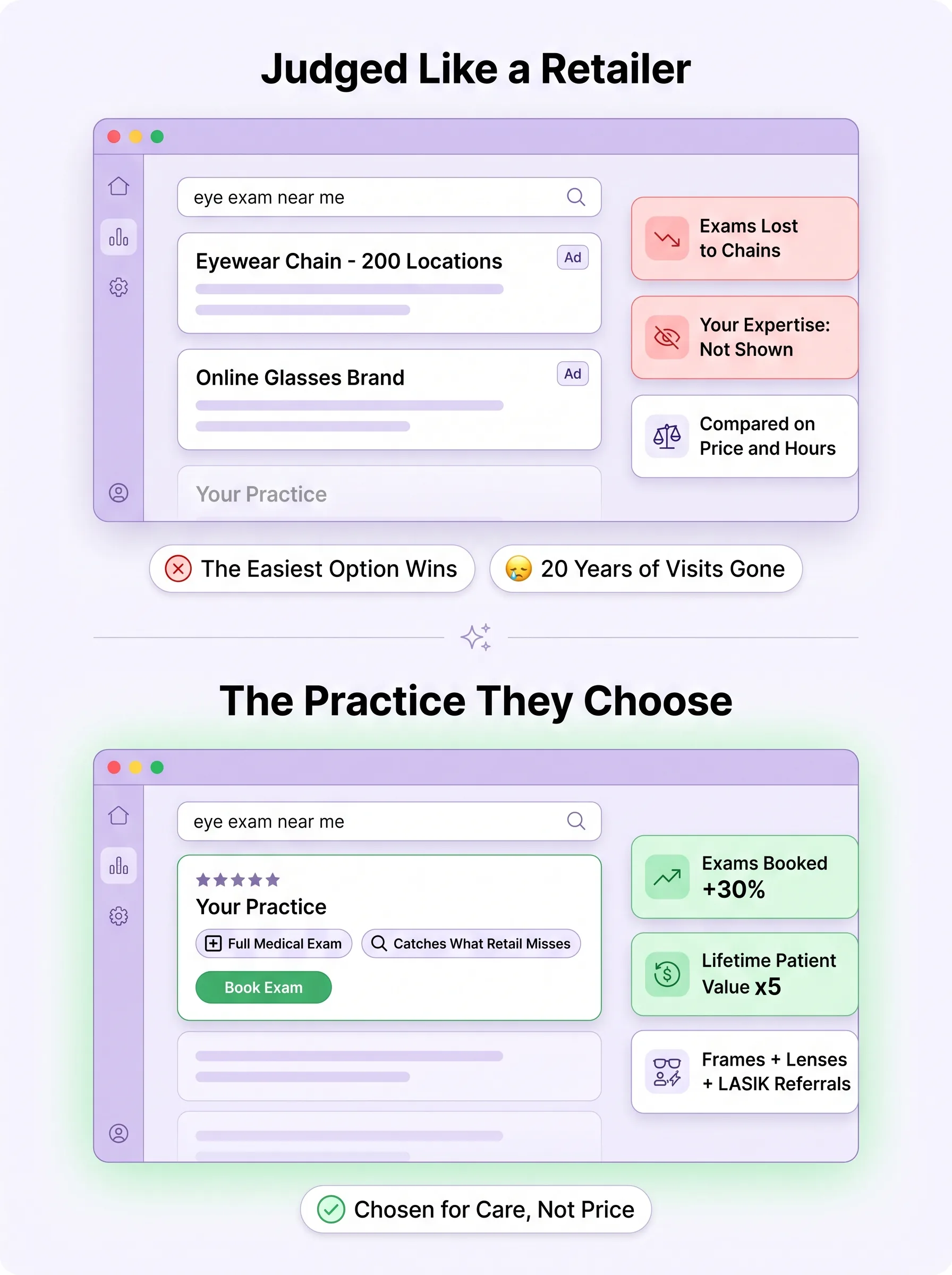
Illustrative comparison of retail-led eye-care search listings and a practice profile describing medical services. All figures are hypothetical examples.
Local search, AI visibility, reviews and paid reach, built on accounts registered in your name from day one, working for the clinical side and the optical side at once.

We map searches to the services your practice actually provides. Optometry and ophthalmology need different pages, referral paths and enquiry measures. Explore eye care SEO.

Your reviews, your clinical credibility and your pages answer the comparison a retailer cannot win. Distance and price are their argument. Yours is that someone is actually looking.

The site is built to book the exam, and the recall path keeps the patient coming back. In eye care the first visit is the cheapest part of a very long relationship.
Most practice owners hire an agency the way they hire a contractor: a referral, a decent-looking website, a confident call. That is how you end up twelve months later with a nicer homepage and the same gaps in the exam schedule.
Here is what to actually check before you sign anything.
Your Google Ads account, your Meta account, your Google Business listing, your website hosting. Ask whose name each one is in on day one. If the answer is the agency, your visibility is rented, and the ad history and review record you paid to build leave with them.
You are not primarily competing with the independent practice across town, you are competing with national optical chains and online eyewear brands that outspend you by orders of magnitude. Any agency whose plan is to bid on the same broad keywords will lose that auction with your money. The winning ground is local intent, clinical credibility and the conditions a retail exam does not handle.
An eye care practice runs on annual return visits. If the agency's entire model is buying new patients every month while your recall list sits untouched in the practice management system, you are paying full price for growth you already own. Ask them directly what they do with the existing patient base.
Before you sign, ask what happens to your ad accounts, your website files, your Google Business ownership, your reviews and your content if you stop working together. If any of it stays behind, you were not building an asset. You were renting one.
Who legally owns your ad accounts, your Google Business listing and your website files today?
If the answer is the agency, you do not have a partner, you have a landlord. Ask before you sign, not when you try to leave. Someone who has paid that invoice and watched the budget vanish knows what that question is worth.
If Google, Meta or your website login sits in the agency's name, they hold your visibility. Leave and you restart from zero, without the ad history or the review record you paid to build.
If the site and the campaigns only speak retail, the clinical work is invisible in search. That is the higher value half of the practice, and it is the half a chain cannot copy.
A real agency builds everything in your name, shows the raw platform spend with nothing marked up, publishes its price, and lets you walk away with every login intact.
I trained as a maxillofacial surgeon, moved into orthodontics, and co-founded a three-clinic group in Paris. I then spent time inside Publicis Health learning how medical marketing actually works at scale.
While running the clinics I hired an agency. I paid them more than 20,000 EUR over a year. They owned my Google and Meta ad accounts, not me. They spent a fraction of the budget, kept the rest, and delivered one patient, who came in for a cleaning, while I was selling orthodontic treatment. I only found out when I pulled the account myself and read the raw numbers.
That is why Forge exists. I read every audit personally. A specialist team runs the day to day. Every account we build stays in the client's name from the first day, because I know precisely what it costs when it does not.

Most eye care marketing agencies sit between $3,000 and $6,000 a month and will not show you that number until you are already on a call. Here it is upfront.
My team works to the deliverables and review process agreed in the written proposal. No minimum-term commitment. Scope, fees and terms are confirmed in writing. Search positions, patient or booking counts, revenue and a fixed results timeline are not guaranteed.
Practitioner exclusivity: one practitioner per city, with the specialty and territory confirmed in writing. Nationwide exclusivity may be considered for selected specialties.
The first 90 days
A free audit maps the searches you are missing, clinical and optical, and where patients drop out. No call, no pitch, in your inbox within 24 hours, read by a physician.
Priorities are set by the visits you actually want more of, with the medical work given its own ground instead of being buried under frames. You approve it before anything goes live.
Site rebuilt or corrected, condition and procedure pages structured, local presence live, ads running in your own ad account. Everything registered to you from day one.
Booked exams and procedure enquiries reported by channel. Ad spend shown in full, nothing marked up. You know what moved and what comes next.
An eye care marketing agency runs the channels that fill the exam schedule and feed the procedure side: local SEO, your Google Business Profile, paid search, review generation, and a website built to book. In a practice that is both clinical and retail, the job is to make the medical work visible rather than letting the whole practice read online as a glasses shop.
Longevity in a community and visibility to a stranger searching are two different assets. Google ranks page relevance, review volume and recency, local data consistency and site authority, none of which accumulate from thirty years of good care. A practice can be the best known name among existing patients and still be absent from every search a new one makes.
Honest local SEO takes six to twelve months before it produces a steady lift in booked exams, and paid search can produce them within weeks. Running both early usually makes sense: ads fill the schedule while the organic foundation is built underneath, then the balance shifts as the free traffic takes over.
Managed eye care marketing starts at €1,200 per month at Forge for strategy, execution and reporting, with ad spend paid directly by you to the platform and never marked up. What sits above that floor depends on market competitiveness and whether you are pushing procedures like LASIK alongside routine exams. The more useful figure is the lifetime value of a patient who returns annually for twenty years.
You do not beat a chain on budget, you beat it on local intent and clinical depth. That means owning the map results in your immediate area, building a review profile a rotating-staff chain location cannot match, and publishing real content on the conditions a fifteen-minute retail exam does not handle. Competing on price against an online eyewear brand is a losing position; competing on what a clinician actually catches is not.
Yes, they need separate pages and usually separate campaigns, because the searches are different. Someone looking for an eye exam near them and someone researching dry eye treatment or cataract surgery are at different stages with different intent. A single page covering everything ranks for the retail term and misses the clinical ones, which are the higher value half of the practice.
The most common mistake is letting the whole practice present online as an optical retailer because that is what the website template was built for. The result is that the medical work, which is what distinguishes you and what pays best, is invisible in search. The second most common is buying new patients monthly while the recall list is never worked.
Reviews are a direct ranking factor in the local map results and the main trust signal for a patient choosing between three names they do not know. Recency matters as much as volume, so a practice with a long history of old reviews can be outranked by a newer one with steady recent activity. A consistent review flow is a visibility strategy, not just reputation management.
AI assistants now name two or three practices when asked where to get an eye exam or who treats a specific condition in a city, drawing on structured content, review signals and content depth. Practices with thin sites and no condition-level content are omitted entirely. The work is not different from good SEO, but being absent there means losing the fastest growing part of patient research.
Confirm that every account, your ad accounts, your Google Business Profile, your analytics and your website files, sits in your name from day one rather than the agency's. Ask to see raw platform spend rather than a dashboard, ask how they separate the clinical side from the optical side, and ask what happens to everything if you leave.
The free Forge Visibility Snapshot shows which searches you are missing, where patients drop out, and what to fix first. No call, no pitch, read by a physician.