Reputation Management for Doctors, Without Buying a Single Review
A review flow on your own Google profile, nothing bought and nothing filtered. From €1,200 a month, published here before you talk to anyone.
A review flow on your own Google profile, nothing bought and nothing filtered. From €1,200 a month, published here before you talk to anyone.
Two things read your reviews. The patient comparing three names on a Sunday evening, and the algorithm deciding which three names she sees in the first place.
Practices tend to treat reviews as reputation, something to worry about when one goes badly. In local search they are closer to inventory: count and recency are direct ranking signals in the map block, which is where most patients click before they reach any website.
So a thin profile costs you twice. You appear lower, and the fewer people who do see you are less likely to call.
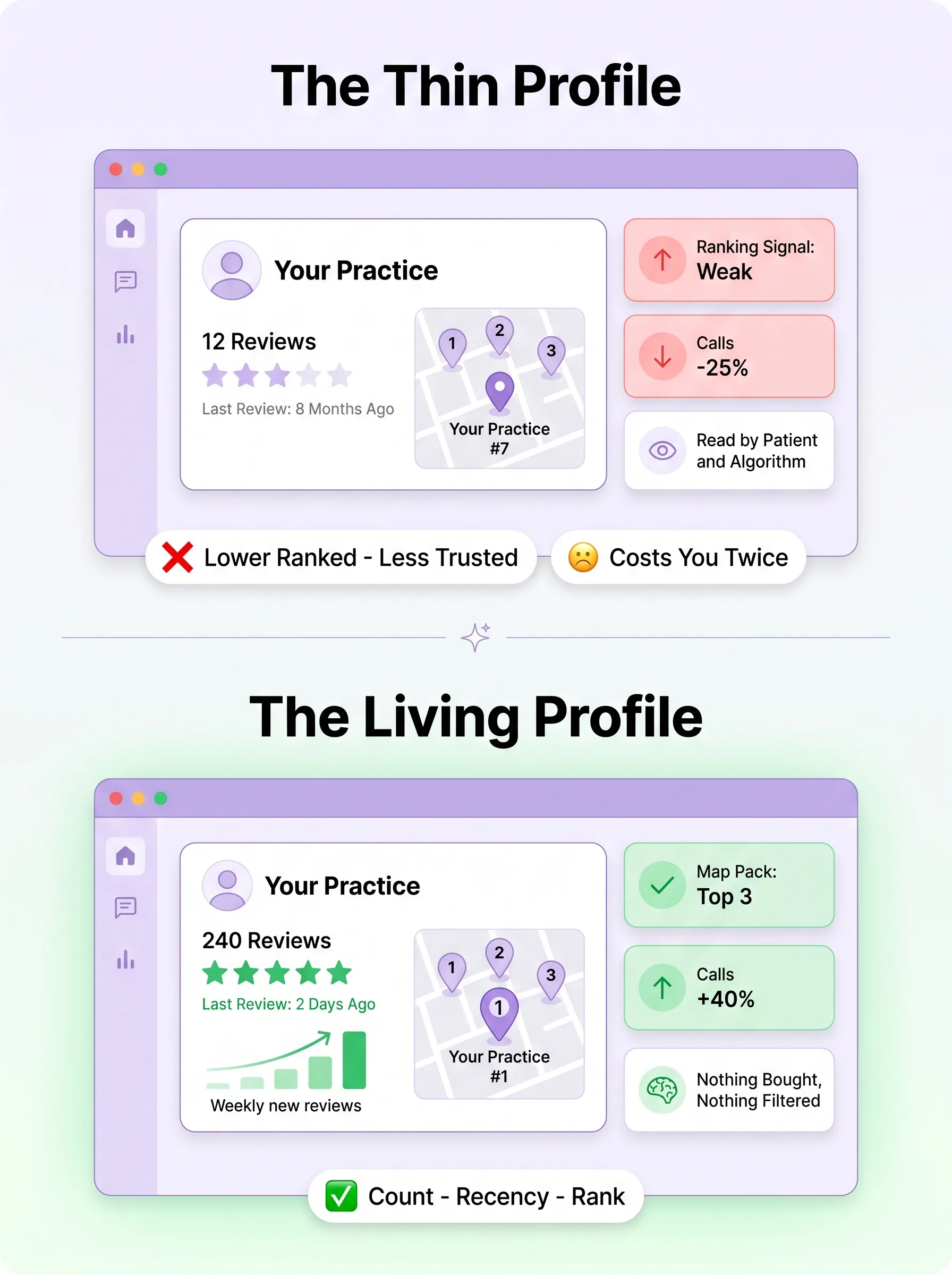
Illustrative comparison of sparse and fuller review profiles. Review counts and search positions are hypothetical examples.
The profile stays in your name, the requests go out systematically, and every review is real. Nothing here survives an audit badly.

Two hundred reviews from four years ago lose to sixty from this quarter. The local algorithm reads freshness, and so does the patient scrolling your profile.

The difference between a practice with forty reviews and one with four hundred is rarely the care. It is whether someone asks, at the right moment, every single time.

A profile with no negative review reads as filtered. One handled calmly, in public, without a word about the patient's care, often converts better than silence.
There is no clever technique here, and anything that sounds clever is usually the thing that gets a profile penalised. Four habits account for the whole difference.
Not the happy ones, everyone. Filtering who gets asked is against platform policy and it is also how a profile ends up reading like a brochure. The request works while the visit is fresh, which in practice means it belongs in the checkout routine rather than in a monthly campaign.
Recency is a signal. A practice that collected two hundred reviews three years ago and stopped is weaker in the algorithm than one adding six a month today. Whatever system you use has to survive a busy week, or it will quietly stop.
Purchased reviews get removed in waves, and when forty disappear at once the ranking they earned goes with them. Incentives break platform policy even when the review is genuine. The only durable version of this is real patients, asked properly.
Where exactly do these reviews come from, and who writes them?
If the answer involves anything other than your own patients being asked at the right moment, walk away. Bought reviews get removed in waves, and a profile that loses forty reviews overnight also loses the ranking they earned.
Nobody controls how many patients write. A guaranteed volume means either buying them or filtering who gets asked, and both get profiles penalised in waves.
If the requests, the history and the replies are locked in a tool you rent, leaving means losing the system that produced them. Ask what you keep on the way out.
A real partner builds the asking into your routine, replies properly to the difficult ones, and leaves the Google profile and the data with you.
I trained as a maxillofacial surgeon, moved into orthodontics, and co-founded a three-clinic group in Paris. I then spent time inside Publicis Health learning how medical marketing actually works at scale.
While running the clinics I hired an agency. I paid them more than 20,000 EUR over a year. They owned my Google and Meta ad accounts, not me. They spent a fraction of the budget, kept the rest, and delivered one patient, who came in for a cleaning, while I was selling orthodontic treatment. I only found out when I pulled the account myself and read the raw numbers.
That is why Forge exists. I read every audit personally. A specialist team runs the day to day. Every account and profile we build stays in the client's name from the first day, because I know precisely what it costs when it does not.

Most reputation platforms charge per location on top of an agency fee and lock the data inside their tool. Here is the flat number instead.
My team works to the deliverables and review process agreed in the written proposal. No minimum-term commitment. Scope, fees and terms are confirmed in writing. Search positions, patient or booking counts, revenue and a fixed results timeline are not guaranteed.
Practitioner exclusivity: one practitioner per city, with the specialty and territory confirmed in writing. Nationwide exclusivity may be considered for selected specialties.
The first 90 days
A free audit compares your count, your recency and your rating against the practices ranking above you in the map results. No call, no pitch, read by a physician.
A request that fits into how your front desk already works, at the moment the visit ends. If it needs someone to remember it, it will not survive a busy week.
Google profile corrected, individual doctor profiles built, replies handled on the difficult ones. Volume and recency both start climbing.
Not a vanity count. Where you sit against the two or three names competing for the same map results, month after month.
Both, and the ranking effect is the one practices underestimate. Review count and recency are direct signals in the local map results, the block most patients click first. So reviews decide whether you appear at all, and then decide whether the person who saw you calls.
More than whoever else appears in the map results for your city, and a steady flow rather than a fixed target. In most local markets that means being visibly ahead of the two or three practices you compete with, and adding new ones every month rather than reaching a number and stopping.
While the patient is still in the building, or within a few hours of leaving. Ask a week later and the moment has gone. The practices with strong profiles are almost never the ones with better care, they are the ones where asking is part of the checkout routine rather than an occasional campaign.
Only if it breaks platform policy: it is fake, it is abusive, it names another business, or it comes from someone who was never a patient. Being unfair is not grounds for removal. The realistic strategy is a public reply and enough recent reviews that one outlier stops mattering.
Publicly, briefly, and without ever confirming that the person was a patient or discussing any detail of their care. Acknowledge the frustration, give a way to reach the practice directly, and stop. The reply is not written for the reviewer, it is written for the next fifty people who read it.
No, and it is one of the fastest ways to have reviews removed and a profile penalised. Asking every patient is fine and encouraged; paying for the answer, or asking only the happy ones, is not. The line is simple: you can ask, you cannot buy or filter.
Google first and by a wide margin, because it feeds the map results. After that it depends on specialty: the health directories that rank in your own city are the ones worth maintaining, and you find them by searching your specialty plus your city and reading who appears above you.
Both, and the individual matters more than most groups realise. The practice profile drives the map ranking, but patients choosing a surgeon or a specialist search a person by name before booking. A group with a strong practice profile and empty individual profiles loses that final comparison.
Yes. Assistants draw on the same public signals as search, and review depth is one of the few things that lets them distinguish between practices that otherwise look identical. A thin profile keeps you out of the shortlist entirely, which is worse than ranking below someone.
That the Google profile stays in your name, that reviews come only from real patients asked at the right moment, that nobody is filtering who gets asked, and that the review data is exportable rather than locked in a platform you would lose access to.
The free Forge Visibility Snapshot compares your review count and recency against the practices ranking above you locally. No call, no pitch, read by a physician.