Medical PPC That Buys Consults, Not Clicks
Ads that run in your own account, with the raw spend shown and nothing marked up. From €1,200 a month, published here before you talk to anyone.

Ads that run in your own account, with the raw spend shown and nothing marked up. From €1,200 a month, published here before you talk to anyone.
Paid ads are the only channel that starts working the week you switch it on. That is exactly why they get abused: results appear fast enough that nobody looks too closely at what produced them.
A broad campaign sends your money to people reading about a symptom at midnight. A homepage as a landing page makes the visitor hunt for what the ad promised. Tracking that stops at a form fill lets everyone celebrate leads that never became appointments.
And on top of it, most agencies take a percentage of your spend, so the more of your budget disappears into the wrong clicks, the more they earn.
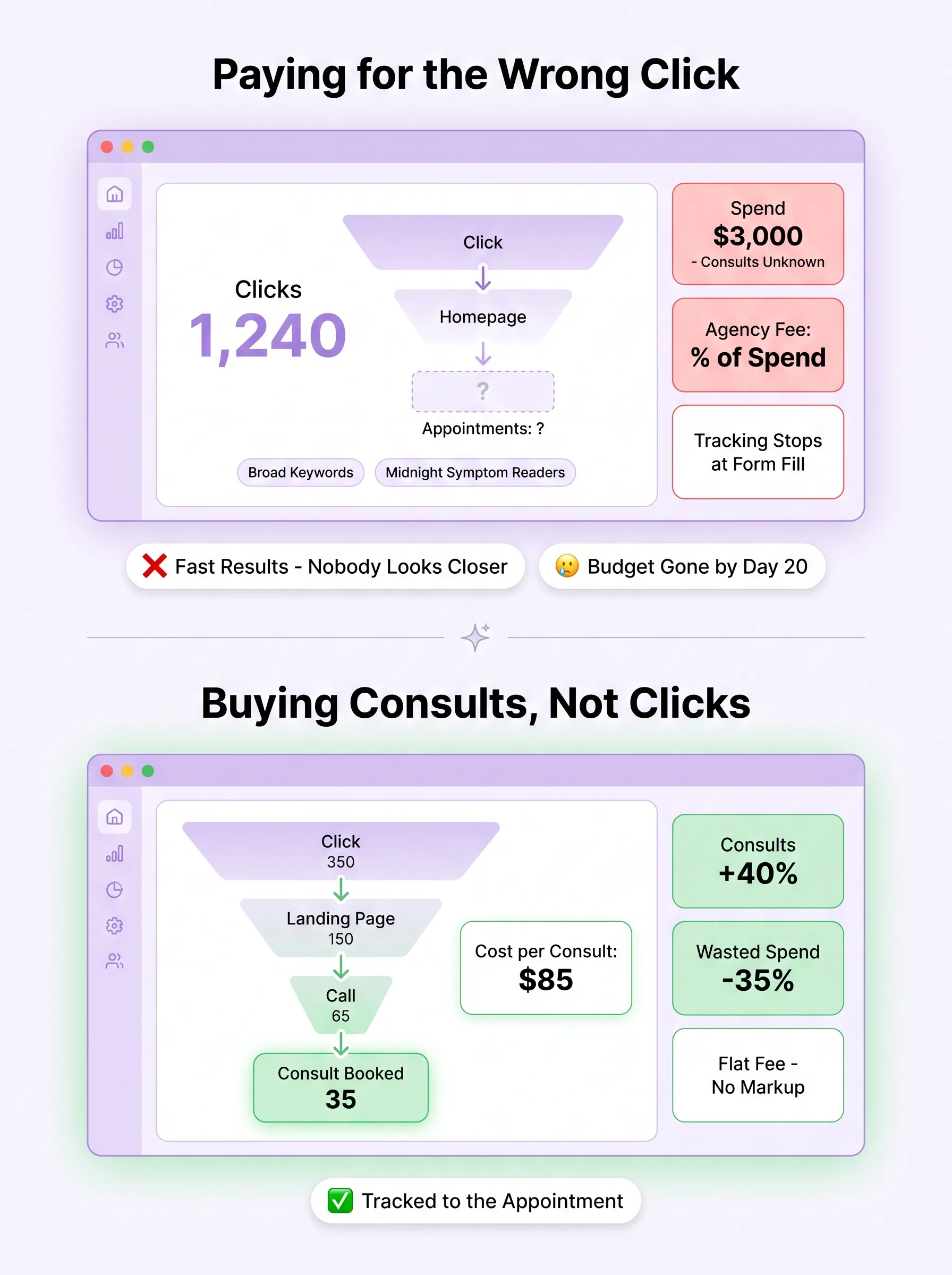
Illustrative comparison of click reporting and a tracked enquiry-to-consultation funnel. Costs and conversion figures are hypothetical examples.
The ad account is yours, the card is yours, the platform invoice comes to you. Forge manages it and takes a fee for the management, never a cut of the media.
Someone searching for a specific procedure in your city is worth ten times someone reading about a symptom. Broad campaigns spend most of the budget on the second group.

The ad promised one thing. If the page it opens is your homepage, she has to find that thing herself, and most people do not. One ad, one page, one answer.

Clicks and form fills are not results. The number that matters is cost per booked appointment, and it is knowable if the tracking is set up before the spend starts.
The mechanics are not complicated. Four decisions account for almost all of the difference between an account that pays for itself and one that quietly does not.
Someone typing a procedure plus your city is ready. Someone typing a symptom is reading. Both cost money, only one books. A tightly built account spends on the first and adds the second only once the first is saturated.
An ad about one procedure should open a page about that procedure. Sending paid traffic to a homepage means the visitor does the work of finding her answer, and most of them do not. Same traffic, same cost, several times the conversions.
A percentage of spend rewards spending more of your money. A flat fee does not. It is the single structural difference that determines whose interest the account is being run in, and it is worth asking about before anything else.
Health targeting is restricted, before and after imagery is routinely rejected on Meta, and patient data must never reach an ad platform. None of it blocks a good campaign. All of it costs weeks if the person running your account is learning it on your budget.
Show me the raw platform export: what went to the auction, and what went to you?
A dashboard can show anything. The platform export cannot. If an agency hesitates to hand you the raw spend, the gap between what you paid and what reached the auction is the reason. Ask on day one, not after a year.
The more of your budget goes out the door, the more they earn. That conflict sits at the centre of every recommendation they will ever make about scaling.
Leave and you lose the conversion history the account learned from, which means the next agency starts from zero with your money. Ask on day one whose name is on it.
A real partner charges for the management, lets the platform bill you directly, and hands over the unedited spend report whenever you want to check it.
I trained as a maxillofacial surgeon, moved into orthodontics, and co-founded a three-clinic group in Paris. I then spent time inside Publicis Health learning how medical marketing actually works at scale.
While running the clinics I hired an agency. I paid them more than 20,000 EUR over a year. They owned my Google and Meta ad accounts, not me. They spent a fraction of the budget, kept the rest, and delivered one patient, who came in for a cleaning, while I was selling orthodontic treatment. I only found out when I pulled the account myself and read the raw numbers.
That is why the ad account stays in your name here, why the fee is flat rather than a share of your spend, and why the raw platform export is yours whenever you ask for it.

Most agencies charge a percentage of your ad spend, which rewards them for spending more. Here is a flat number instead.
My team works to the deliverables and review process agreed in the written proposal. No minimum-term commitment. Scope, fees and terms are confirmed in writing. Search positions, patient or booking counts, revenue and a fixed results timeline are not guaranteed.
Practitioner exclusivity: one practitioner per city, with the specialty and territory confirmed in writing. Nationwide exclusivity may be considered for selected specialties.
The first 90 days
A free audit of the existing account: which searches took the budget, what an enquiry actually cost, what was never tracked. No call, no pitch, read by a physician.
Conversions wired to booked appointments and qualified calls, landing pages built per campaign. Nothing scales until the measurement is real.
Campaigns launch narrow on the procedures you want, then widen as the data arrives. Six to eight weeks before an account is genuinely optimised.
What you spent, what it produced, what it cost per booked appointment. Full platform export any time you want to check it yourself.
Speed and control. Ads put you in front of patients searching today rather than in six months, and they let you choose which procedure you want more of this month. What they cannot do is compound: the day the spend stops, the enquiries stop, which is why they work best as the fast half of a plan that also builds search.
Enough to gather data before you judge it, which in most local markets means a few thousand a month for at least two months. Below that, the account never collects enough conversions to optimise, and you end up paying for a learning phase that never finishes.
The first enquiries arrive within days. A campaign that is actually tuned takes six to eight weeks, because that is how long it takes to accumulate enough conversions to cut the searches that waste money. Judging a campaign in week two is how good accounts get killed early.
Google for anything a patient actively searches for, because the intent is already there. Meta for procedures people do not search for but respond to when they see them, mostly elective and aesthetic work. Running Meta for urgent care or Google for impulse aesthetics is the usual way budgets get burned.
Because the visitor has to do the work the ad was supposed to do. She clicked on a specific procedure and landed on a page about the whole practice, so she has to hunt for her answer. A dedicated landing page usually converts several times better on the same traffic, at the same cost per click.
Platforms restrict health-related targeting, particularly anything inferring a condition, and Meta rejects most before and after imagery. You also cannot pipe patient details from a form into an ad platform. None of it prevents good campaigns, but an agency discovering these rules on your budget will lose you two months.
A flat management fee, not a percentage of spend. A percentage means the agency earns more by spending more of your money, which is a conflict sitting at the centre of the relationship. At Forge the fee is flat and the media goes directly from you to the platform.
It depends entirely on what the patient is worth to you, which is why any agency quoting a benchmark without asking about your case mix is guessing. Work backwards: what a booked case contributes, what proportion of enquiries become cases, and what you can therefore afford to pay for an enquiry.
Usually yes, but smaller and more targeted. Search covers the terms you now rank for, and ads keep the procedures where competition is fiercest or where you want volume this quarter. What changes is the ratio, and the fact that your cost per patient falls as the organic base grows.
That the ad account is in your name and the card is yours, that the fee is flat rather than a percentage of spend, that you can see the raw platform export whenever you want, and that conversion tracking reaches a booked appointment rather than stopping at a form fill.
The free Forge Visibility Snapshot shows what your current campaigns pay per enquiry and where the budget leaks. No call, no pitch, read by a physician.