You are good at what you do. You should not have to fight this hard for patients. I have been in that chair. Every account stays in your name, from $1,200 a month, published before you talk to anyone.

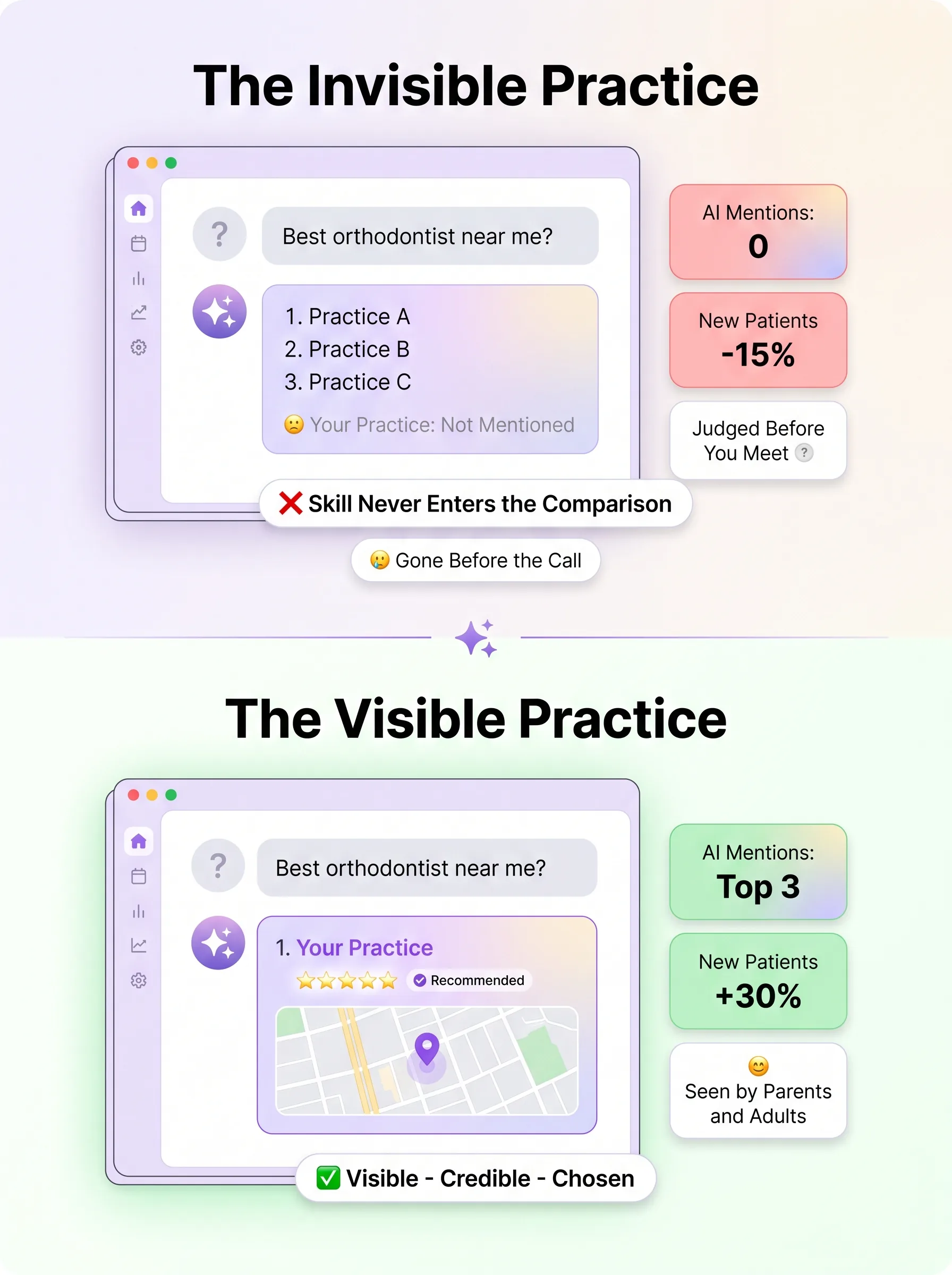
A parent types a search. An adult compares three practices side by side. Sometimes they ask an AI and it names two or three orthodontists in your city. If your name is not there, that patient is gone before you ever had a chance.
They read reviews, look at your site, and make a decision. Your clinical skill never enters that comparison. They cannot see it yet.
The practice that showed up and looked credible got the patient. The best clinician does not always win that moment. That is the problem nobody in marketing wants to say out loud.

Local search, AI visibility, reputation and paid reach, all on accounts that belong to you, never to an agency.

Parents and adults ready to start treatment find you before anyone else. Your practice shows up where they search, including the AI results that now shortlist practices in your city.

Reviews, content and credibility signals do the convincing before a patient ever calls. When they compare options online, you are the obvious choice, not a name they scroll past.

Your site turns interest into action. Paid ads catch patients ready to move now. Every channel is tracked so you know exactly where each new patient came from.
Most practitioners hire a marketing agency the way they hire a contractor. A referral, a polished website, a confident pitch. That is also how you end up paying for twelve months of work and receiving one patient who came in for a cleaning.
Here is what to actually check before you sign anything.
Any agency can build a dashboard that shows impressive numbers. Ask for the platform-level export: what went into the ad auction, what the agency kept, and what each patient click actually cost. If they hesitate, that hesitation is your answer.
Open Google Business and look at the ownership field. If an agency email is listed as the primary owner and not yours, you do not control your own reviews, your own photos, or your own listing. You are renting visibility you paid to build.
Search visibility for an orthodontic practice does not move in thirty days. Any agency promising meaningful organic results inside three months is either misleading you or does not understand how it works. A realistic timeline is six to twelve months minimum. Paid ads show movement faster, and a good agency is honest about which lever does what.
Before you sign, ask what happens to your ad accounts, your website files, your Google Business ownership, your review history and your content if you stop working together. If any of those stay with the agency, you are not building an asset. You are renting one.

Who legally owns your ad accounts, your Google Business listing, and your website assets right now?
If the answer is the agency, you do not have a marketing partner. You have a landlord. The person who has signed that invoice and watched the budget disappear knows exactly why that question matters.
A custom dashboard metric is not proof of anything. If they cannot show you how many patients walked through your door and which channel sent them, the score is covering for a lack of real results.
An account manager who has never run a practice does not know how a parent chooses an orthodontist, what convinces a nervous adult to book, or what a real consultation is worth to you. Templates built for every specialty fit none of them well.
A real agency shows you the cost upfront, hands every account to you from day one, and can show you the raw ad spend with nothing hidden. If you leave, you take everything with you.
I trained as a maxillofacial surgeon, moved into orthodontics, and co-founded a three-clinic group in Paris. I was not a marketer. I was an orthodontist who needed patients, so I hired an agency the way most practitioners do: a referral, a decent pitch, a signed contract.
Over the following year I paid them more than 20,000 EUR. They owned my Google and Meta ad accounts, not me. They spent a fraction of the budget and kept the rest. I received one patient, who came in for a cleaning, while I was running an orthodontic practice. I found out only when I pulled the account myself and looked at the raw numbers.
I spent the next period learning everything I should have asked before signing. I studied medical marketing inside Publicis Health, applied it to my own clinics, and eventually built Forge. I read every audit personally. Every account and asset sits in the client's name from the first day, because I know exactly what it costs when that is not true.

Most orthodontic marketing agencies sit between $3,000 and $6,000 a month and will not show you the number until you are already on a call. Here it is.
I sign this personally. My team keeps working until you see real results. We do not take the money and go quiet. Month to month means you stay because it works, not because a contract forces you. Paid ads can show movement in weeks. Honest search visibility takes months, often six to twelve. I will never promise you a patient count, because what a booked patient decides in your chair is yours, not mine.
Territorial exclusivity: one practice per area per treatment. When yours is taken, your competitor cannot buy it.
The first 90 days
A free audit maps every gap in your online visibility. No call, no pitch. The diagnosis lands in your inbox within 24 hours, read by a physician.
Priorities are set by what moves patients fastest for your specific situation. You see the plan and approve it before anything goes live.
Your site is rebuilt or corrected, your local presence goes live, and paid ads reach parents and adults already searching. Momentum builds from the first week.
Real numbers show which channel each patient came from. The plan adjusts every month so the patients keep coming and the guessing stops.
An orthodontic marketing agency builds and manages the digital systems that put your practice in front of patients already searching for braces or clear aligner treatment, then converts that attention into booked consults. The work spans local SEO, paid ads, your Google Business Profile and your website, run together as one system rather than disconnected tactics.
Yes, a practice can have a full waiting room from referrals and still rank on page three for every high-intent local search. Reputation and visibility are separate problems. A parent searching for an Invisalign provider in your zip code has no idea your patients love you unless your site, your map listing and your reviews all signal authority to Google at the same moment.
Honest SEO for an orthodontic practice typically takes six to twelve months to produce a measurable lift in organic search traffic and inbound inquiries. Paid search can surface leads within weeks, which is why I usually recommend running both: ads buy you time while the organic foundation is being built.
Managed orthodontic marketing starts at around $1,200 per month at Forge, and the right number depends on market size and how many channels you are running at once. What I would caution against is a price point so low that SEO and ads are handled by one generalist with no orthodontic context, because that work tends to produce traffic with no qualified intent behind it.
Each treatment category needs its own dedicated page, because a parent searching for phase-one interceptive treatment and a teenager searching for Invisalign Teen are two distinct searches with different intent signals. A single catch-all services page competes for none of them effectively, while separate pages give Google a clear target and give the patient a reason to stay.
The most common mistake is running paid ads to a homepage or a generic contact page instead of a treatment-specific landing page built to capture a single intent. You pay for the click either way, but the first scenario leaks most of those inquiries before they convert. The ad and the destination page need to answer the same question the searcher just typed.
AI assistants now recommend specific orthodontic practices in conversational answers, drawing on structured data, review signals and content depth rather than page rank alone. Practices with thin websites and few reviews are being omitted from those answers entirely. The optimization work is not fundamentally different, but ignoring it means losing ground in a channel growing faster than traditional search.
Each location needs its own Google Business Profile, its own location page and its own review generation strategy, because Google evaluates local relevance at the individual address level rather than the brand level. A group running one central profile for four offices is effectively letting three of them compete with no local signal at all.
The metrics that matter are tracked inbound calls and form submissions by source, cost per qualified inquiry, and month-over-month movement in ranking for your priority treatment terms in your local market. Total site visitors and social impressions tell you almost nothing about whether the right people are finding you. Every account Forge manages sits in the client's name so you always own that data.
Prioritize whoever can show you ranking and inquiry data from orthodontic practices in comparable markets, not a portfolio of general dental work. Beyond that, confirm that every account, your ad spend, your analytics, your Google Business Profile, stays in your name from day one. An agency that holds those assets owns your visibility, and that is a structural risk regardless of how the relationship is going.
How 50+ practices took back control of their own visibility. Apply one of these five moves and the effect shows up fast. We handle the rest when you are ready. Rank for the treatments that actually pay in your area. Depend less on directories and paid ads. Build visibility that still works next year.

The patients you want are out there making decisions right now. A free audit shows you precisely where you lose them online and what to fix first. Then, if you want it, we do the work for you.