

A wrong address shown to a patient driving in from across town cost you a booking you never knew you lost.
A stale address, a mismatched phone number, or a ghost listing from a practice you left years ago can quietly send patients to whoever shows up correctly. Checking what your listing actually says, and whether it matches everywhere else your name appears online, is where the problem usually hides.
A patient searches "dentist near me" during a lunchtime break between meetings. Your listing appears. She clicks. The address shows a location you vacated two years ago. She books elsewhere. That one data mismatch cost you a consultation you never knew you lost.
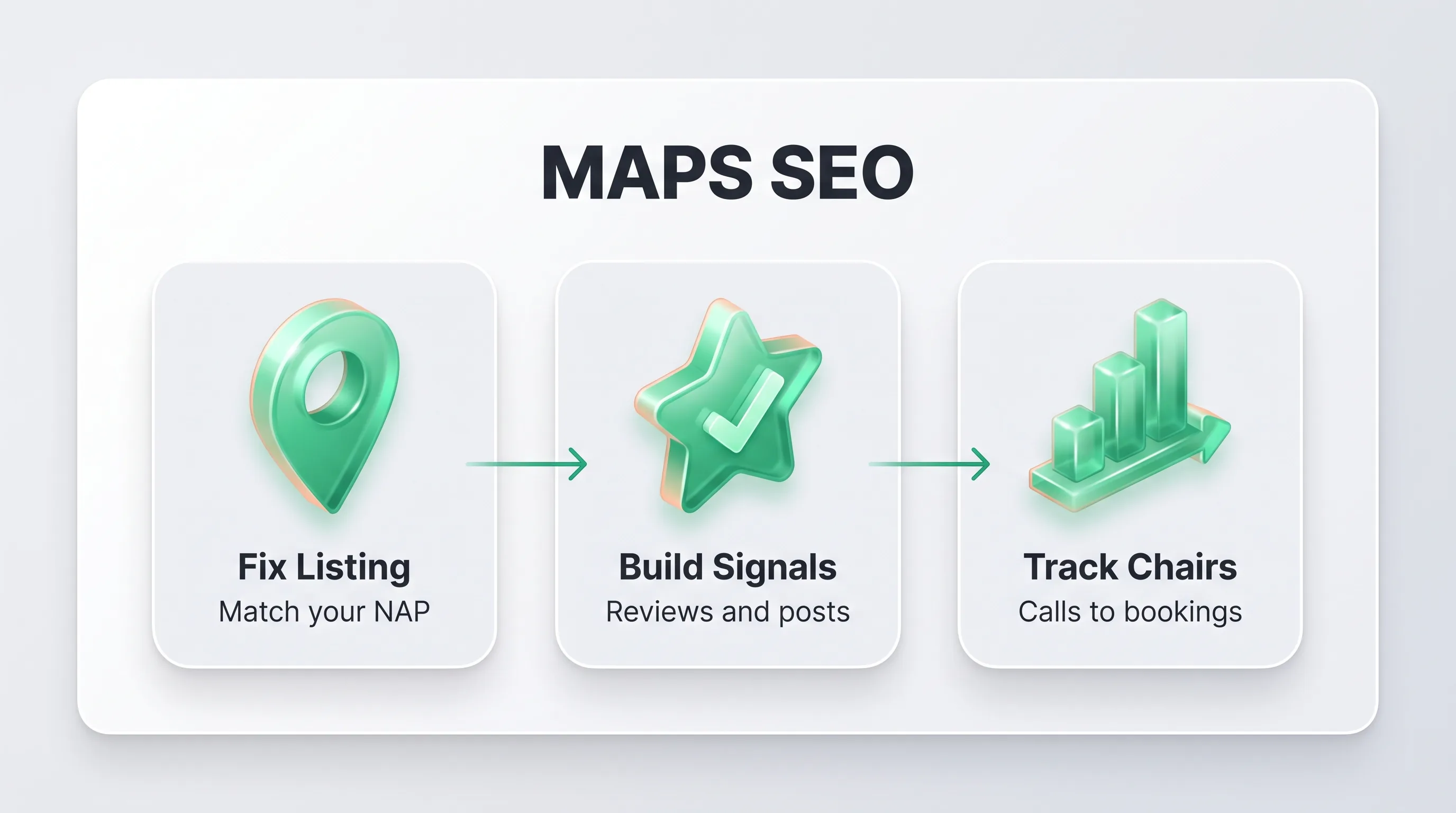
Your Google Business Profile, the listing that places you in the Map Pack when a patient searches nearby, must reflect the practice as it exists today: the correct address, the active phone number, the hours including any late slots. Completeness matters too. Google weighs how fully a profile is filled in when deciding which three practices to surface, so an empty services field or a missing appointment link quietly suppresses you. A solid dental SEO foundation starts here, before any other channel gets attention.
Set your primary category to Dentist. Then add only the secondary categories that genuinely describe what you do: Cosmetic Dentist if you place veneers, Orthodontist if you align teeth, Pediatric Dentist if you treat children. Each category you add tells Google which searches you qualify for. Adding irrelevant ones dilutes that signal.
List individual services with short descriptions that match the language a patient actually types: implants, Invisalign, whitening, not "restorative care." Photos do similar work. A clear image of your consultation room and your team signals an active, real practice. Google scans photo recency as part of profile activity, so a single upload from years ago reads as neglect. The SEO keywords patients use to find these services should map directly to what you name them here.
Practices that have moved, merged, or added a practitioner often carry ghost listings: old addresses still live on Maps, a departed associate still has an active profile tied to your suite. Each duplicate splits the review count and citation signals Google uses to rank you. Two listings with 40 reviews each perform worse than one listing with 80.
Search your practice name and address in Maps. If a duplicate appears, use the "Suggest an edit" path or the Business Profile support channel to request a merge or removal. Practitioner profiles for dentists who no longer work with you need the same audit. This is not a one-time task. A quarterly check takes ten minutes and prevents months of suppressed ranking. For any practice with an older history, duplicates are the single most overlooked blocker in the whole maps workflow.
Google cross-references your practice information across directories, your website footer, Yelp, Healthgrades, and Zocdoc before deciding how much to trust your listing. A discrepancy as small as "Suite 100" in one place and "#100" in another sends a conflicting signal. Small inconsistencies accumulate into a measurable ranking drag.
Audit your NAP, meaning name, address, and phone, across every directory where your practice appears. Correct the outliers one by one, starting with the highest-traffic directories. Once those match, maintain them: a phone number change or a shift to slightly different hours needs to propagate everywhere within days, not months. If you want to understand how this fits into a wider visibility plan, local SEO for dentists covers the full scope beyond the map listing itself.
Review velocity matters as much as star rating. A practice that collects two or three reviews a week outranks one that got forty reviews eighteen months ago and nothing since. Google reads recency as evidence that the practice is active and patients are genuinely showing up.
The mechanism that works in real clinics is simple: a brief SMS sent within a couple of hours of the appointment, while the visit is still fresh. Ask the patient to mention the treatment by name. Google scans review text for keywords and uses it to determine which searches your listing is relevant for. Respond to every review, positive or critical, within 48 hours. That response habit signals to Google that the listing is actively managed, which feeds the same prominence score that review count builds.
Someone weighing a composite bonding case searches your name before calling. They land on your profile and find a Q and A with unanswered questions from 2023 and no recent activity. That gap reads as a practice that does not pay attention.
Post a short update once or twice a month: a seasonal reminder about check-ups, a note that a new appointment slot opened, a brief answer to the question patients ask most at the front desk. In the Q and A section, seed the questions yourself and answer them clearly. "Do you offer Saturday appointments?" and "What does an implant consultation involve?" are the kinds of questions that decide whether a patient calls or moves on. This content keeps your profile active and puts the answer in front of the patient before they have to ask. A broader SEO strategy for your practice can integrate these profile signals with your site content for a compounding effect.
Your Google Business Profile dashboard shows calls initiated from the listing, direction requests, and website clicks. These numbers tell you whether the listing is generating real patient interest or just passive impressions. Map views can climb steadily for months while actual calls stay flat. The most common culprit is a phone number that silently reverted to an old tracking line after a website rebuild. Visibility without contact is wasted traffic.
Track those three metrics monthly alongside the simpler question: how many new patients this month named Google Maps or "found us online" at booking? That correlation, between profile interactions and chair arrivals, tells you whether the listing converts or just ranks. If calls rise but bookings do not, the next step is the front desk response time and booking friction, which belongs to a website SEO audit rather than the profile itself.
Rising impressions with a flat schedule point to one of three problems: the listing attracts the wrong patient type, the phone goes unanswered or the callback is too slow, or the website the patient lands on after clicking fails to convert the interest into a booking.
Check your categories and service descriptions first. A profile optimized for emergency dental searches will attract emergency walk-ins, not the implant or Invisalign consultations that fill a schedule with high-value cases. Align the profile language to the procedures you actually want. Then check response speed. A patient who calls at midday and reaches voicemail has often booked elsewhere by the time your team returns the call. For practices at this stage, a sustained local marketing plan ties the map work to the broader patient acquisition system so the two reinforce each other rather than working in isolation.
Every adjustment to your Maps listing either moves a patient closer to calling you or sends them to the practice that answered the question they were already asking.
We review your pages, search visibility and enquiry path, then show you what to fix first.
.svg)