Plastic surgery marketing
Plastic Surgery Marketing Agency Run by a Physician
Every account stays in your name, not ours. Built by a physician who signed the invoice and got burned. From €1,200 a month, published here before you talk to anyone.

Every account stays in your name, not ours. Built by a physician who signed the invoice and got burned. From €1,200 a month, published here before you talk to anyone.
A woman considering a rhinoplasty does not decide in an afternoon. She looks for six weeks, sometimes six months. She reads reviews, studies before and after galleries, watches videos, asks an AI which surgeons in her city are worth considering, and builds a shortlist of three names.
Your surgical judgment is not in that shortlist. It cannot be. She has never met you. What she sees is a website, a set of photos, a review count, and whether your name came up at all when she searched.
By the time she books a consult, the comparison is already over. The surgeon who showed up, looked credible and answered her questions before she asked them got the appointment. That is the part of the practice nobody trained you for.
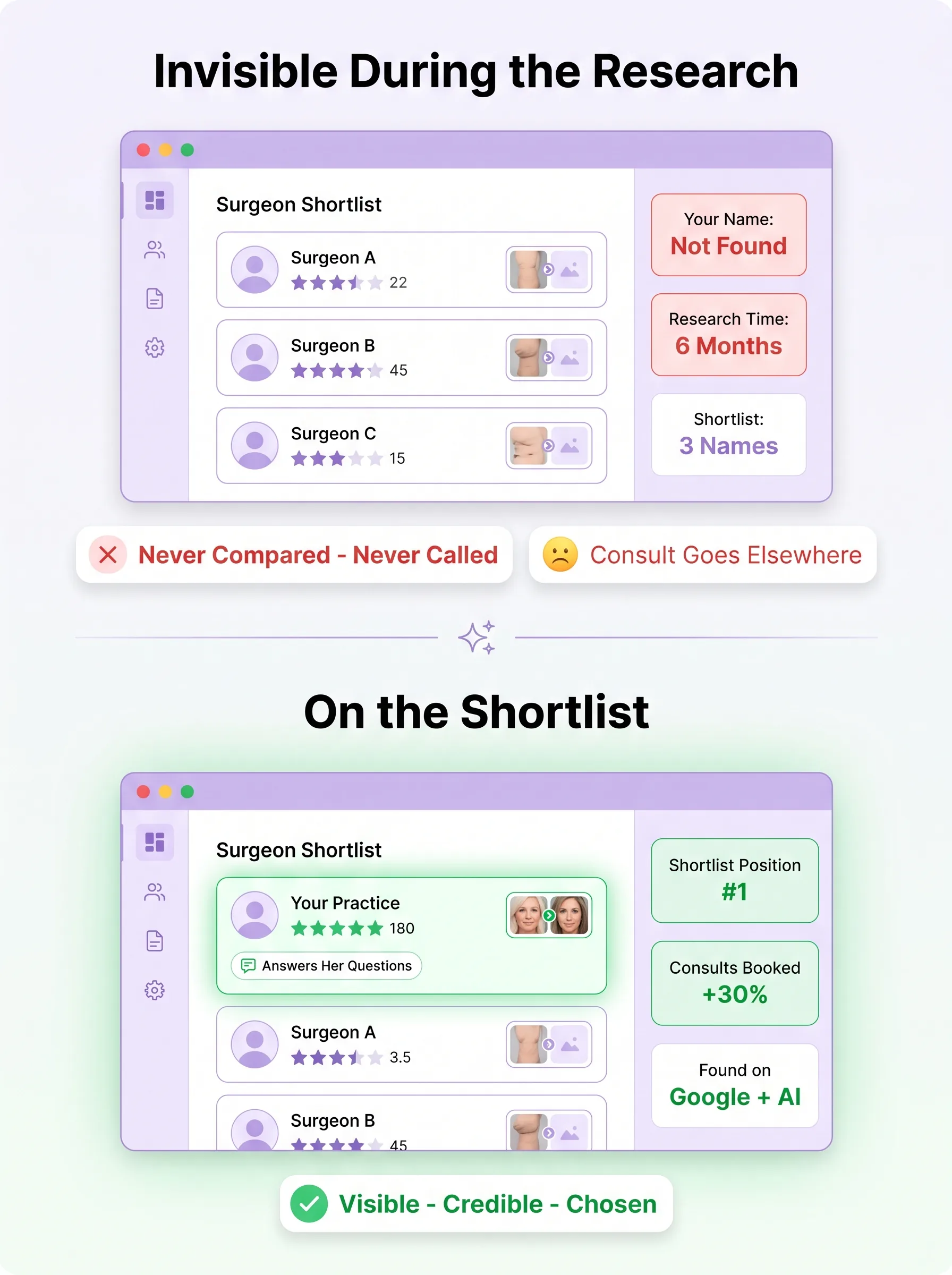
Illustrative comparison of an absent surgeon and a fuller profile on a patient shortlist. Rankings and percentages are hypothetical examples.
Local search, AI visibility, your gallery, your reviews and your paid reach, all built on accounts registered in your name from day one.
Your practice surfaces for the procedure searches that matter, not just for your own name. That includes the AI answers that now shortlist two or three surgeons per city.

Your gallery, your reviews and your procedure pages do the convincing during the long comparison window, so you are the obvious choice when she finally picks up the phone.

Your site is built to turn a months-long researcher into a booked consult. Paid ads reach the ones ready now. Every enquiry is tracked to the channel that produced it.
Most surgeons hire an agency the way they hire a contractor: a referral, a polished website, a confident call. That is how you end up twelve months and $50,000 later with a prettier site and the same consult calendar.
Here is what to actually check before you sign anything.
Your Meta ad account, your Google Ads account, your Google Business listing, your website hosting, your gallery images. Ask whose name each one is in on day one. If the answer is the agency, your visibility is rented. You stop paying, it leaves with them, and the review history and ad learning data go too.
Meta restricts body and appearance targeting, and before and after imagery is routinely rejected or throttled. An agency that has never run aesthetics campaigns will burn two months learning this on your budget. Ask them directly what their approach is when a before and after ad is disapproved, and listen for whether the answer sounds lived or theoretical.
Anyone who tells you SEO moves in thirty days is selling you something. In competitive aesthetic markets, honest local and procedure SEO takes six to twelve months to show. Paid ads can move in weeks. An agency that blurs the two is either confused or hoping you will not notice which lever produced what.
Patients are already asking ChatGPT and Google's AI answers which surgeon in their city does the best rhinoplasty. Those answers pull from structured content, review depth and authority signals. If your agency has no view on how you appear there, that is a gap that costs consults in the next twelve months, not in five years.
Before you sign, ask what happens to your ad accounts, your site files, your Google Business ownership, your review history and your content if you stop working together. If any of those stay behind, you were not building an asset. You were renting one.
Who legally owns your ad accounts, your Google Business listing and your website files today?
If the answer is the agency, you do not have a partner, you have a landlord. Ask before you sign, not when you try to leave. Someone who has paid that invoice and watched the budget vanish knows exactly what that question is worth.
If Meta, Google or your website login sits in the agency's name, they hold your visibility. Leave and you restart from zero, without the ad history or the review record you paid to build.
A guaranteed count of rhinoplasties in ninety days is a sales line, not a guarantee. No agency controls what a patient decides in your consultation room. Treat that promise as a warning, not a reassurance.
A real agency builds everything in your name, shows the raw platform spend with nothing marked up, publishes its price, and lets you walk away with every login intact.
I trained as a maxillofacial surgeon, moved into orthodontics, and co-founded a three-clinic group in Paris. I then spent time inside Publicis Health learning how medical marketing actually works at scale.
While running the clinics I hired an agency. I paid them more than 20,000 EUR over a year. They owned my Google and Meta ad accounts, not me. They spent a fraction of the budget, kept the rest, and delivered one patient, who came in for a cleaning, while I was selling orthodontic treatment. I only found out when I pulled the account myself and read the raw numbers.
That is why Forge exists. I read every audit personally. A specialist team runs the day to day. Every account we build stays in the client's name from the first day, because I know precisely what it costs when it does not.

Most plastic surgery marketing agencies sit between $3,000 and $6,000 a month and will not show you that number until you are already on a call. Here it is upfront.
My team works to the deliverables and review process agreed in the written proposal. No minimum-term commitment. Scope, fees and terms are confirmed in writing. Search positions, patient or booking counts, revenue and a fixed results timeline are not guaranteed.
Practitioner exclusivity: one practitioner per city, with the specialty and territory confirmed in writing. Nationwide exclusivity may be considered for selected specialties.
The first 90 days
A free audit maps every procedure search you are missing and every point where a researching patient drops out. No call, no pitch, in your inbox within 24 hours, read by a physician.
Priorities are set by the cases you actually want more of, not a generic checklist. You see the plan and approve it before anything goes live.
Site rebuilt or corrected, procedure pages and gallery structured, local presence live, ads running in your own ad account. Everything registered to you from day one.
Rankings, calls and booked consults reported in plain language. Ad spend shown in full, nothing hidden or marked up. You know what moved and what comes next.
A plastic surgery marketing agency runs the channels that put your practice in front of patients researching a specific procedure, then turns that attention into booked consultations. In practice that means procedure-level SEO, your Google Business Profile, paid search and social, gallery and review strategy, and a website built to convert a long comparison into an appointment.
Surgical reputation among colleagues and visibility to a stranger searching online are two unrelated things. Search engines rank signals: procedure page relevance, site authority, review volume and recency, and consistent local data. None of that accumulates from clinical excellence, and a strong referral network can mask the problem for years until the referrals slow.
Honest SEO in an aesthetic market takes six to twelve months before rankings translate into a consistent flow of consults. Paid search can produce enquiries within weeks, which is why running both early usually makes sense: ads buy time while the organic foundation is built. Anyone quoting faster organic results is selling something I would not buy.
Managed plastic surgery marketing starts at €1,200 per month at Forge for strategy, execution and reporting, with media spend paid directly by you to the platform and never marked up. The more useful question than the monthly fee is what one additional booked procedure is worth to you, because that number tells you what the work has to produce to pay for itself.
Yes, each procedure needs its own page, because Google ranks pages rather than websites and a patient searching for a rhinoplasty is not the same person as one searching for a tummy tuck. A single procedures page splits authority across everything you offer and ranks well for none of it, while a dedicated page can carry the specific photos, recovery detail and pricing context that particular patient is looking for.
The most common mistake is spending on ads before the website can convert the traffic they buy. A $4,000 monthly ad budget pointed at a slow site with a thin gallery and a contact form mostly funds Google and Meta, not your calendar. Fix the conversion layer first, then scale the spend that feeds it.
Before and after imagery is your strongest proof and your biggest advertising constraint at the same time. Meta restricts body and appearance targeting and frequently rejects that imagery in paid placements, so the galleries usually have to do their work on your own site and in organic search rather than in ads. Consent documentation and consistent presentation matter as much as the photos themselves.
Reviews are a direct ranking factor in the local map results and the single strongest trust signal during a comparison that can last months. For high-ticket elective procedures, a thin or stale review profile disqualifies a practice before a patient ever reaches the website. A steady flow of authentic reviews is a visibility strategy, not just a reputation exercise.
AI assistants now name two or three surgeons when asked about a procedure in a given city, drawing on structured content, review signals and content depth rather than page rank alone. Practices with thin websites and few reviews are omitted from those answers entirely. The underlying work is not different from good SEO, but being absent from that layer means losing visibility in the fastest growing part of patient research.
Confirm that every account, your ad accounts, your Google Business Profile, your analytics, your website files, sits in your name from day one rather than the agency's. Ask to see raw platform spend reports rather than a dashboard, ask who on the team has run aesthetics campaigns specifically, and ask what happens to everything if you leave. At Forge the price is public, the terms are month to month, and nothing is ever held on your behalf.
The free Forge Visibility Snapshot shows you where you disappear during the comparison, which procedure searches you are missing, and what to fix first. No call, no pitch, read by a physician.