

She landed on your implants page and left because the price was buried.
A patient with two competitor sites already open in other tabs will close yours in seconds if she cannot find the cost and the next step. The leak is usually not how many people find you, it is what your page does once they arrive.
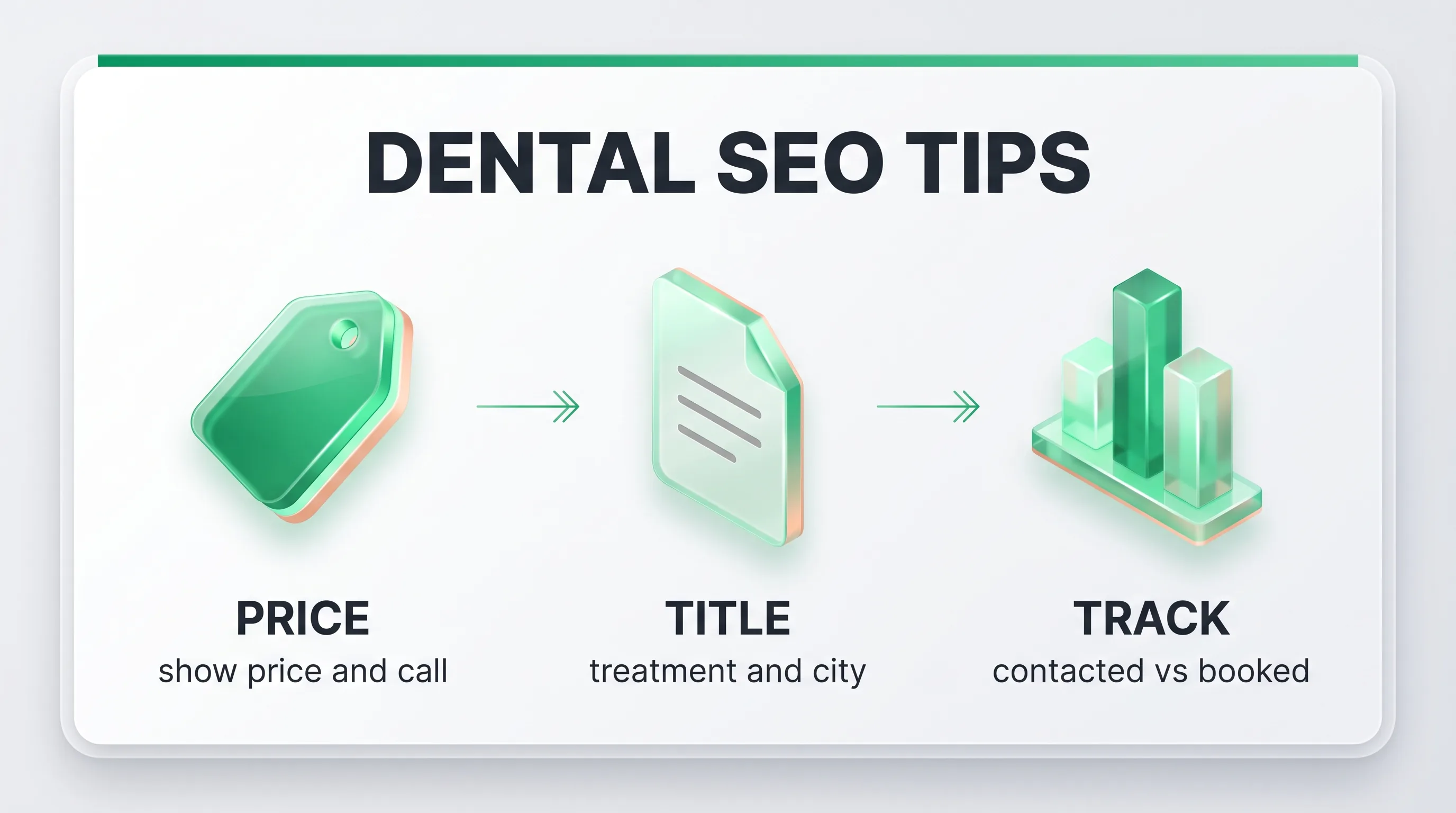
A patient searching "dental implants in [city]" right after finishing dinner is not browsing. She has already weighed the procedure, checked two competitors, and is looking for one page that convinces her to call. If your site sends her to a generic services list, she leaves. That click was not a ranking failure. It was a page failure.
The fix is a dedicated page per high-value treatment: implants, Invisalign, composite bonding, whatever your chair time actually runs on. Each page needs the treatment name and your city in the title tag, a clear mechanism explained in plain language, and a phone number above the fold. This is where dental SEO earns its keep: not by driving more traffic, but by making sure the traffic you already have reaches a page built to convert it.
If you are unsure which pages to prioritize, look at your most profitable treatments and map one page to each. Spreading one page across six procedures dilutes its relevance signal. One page, one treatment, one city. Start there.
Most dental websites do not need more pages. They need their existing pages to stop wasting the authority they already have. A title tag like "Welcome to Our Practice" tells Google nothing and earns nothing. Replace it with "Dental Implants in [City] | [Practice Name]" and the page immediately competes on the right query.
The same logic runs through headings. Your H1 should name the treatment and the location. Your H2s should answer the questions patients actually type, things like cost range, recovery time, and candidacy. Choosing the right terms to anchor each page is its own discipline; dental SEO keywords covers that mapping in detail. For now, verify that every service page has a unique title, a single focused H1, and treatment details written for the patient who is already considering booking, not just learning what the procedure is.
Over 75% of local mobile searches result in an offline visit within 24 hours, according to multiple sources. If your page loads slowly on a phone, that stat works against you, not for you. Compress large clinic photos, enable HTTPS if you have not already, and run your site through Google PageSpeed Insights to see where the slowdown lives.
Then check the next step. A patient on a phone should see a tap-to-call button without scrolling. If your contact link opens a form that takes four fields to submit on a small screen, you have broken the conversion at the last metre. Fix the technical floor first. Rank improvements mean little when the page itself stops the call.
Think about what the patient sees when she lands on your implants page. She wants to know whether she is a candidate, roughly what it costs, and how to take the next step. If the page makes her hunt for any of those three things, she closes the tab. One page, one patient question, one clear action. That is the entire conversion architecture for a service page.
The action matters as much as the answer. "Contact us" is passive. "Book a free implant consultation" names what happens next and removes ambiguity. Pair each page's answer with a specific, low-friction call to action, and the page does more work than any amount of additional content would.
A patient weighing composite veneers or clear aligners is making a considered, reflected decision, often worth several thousand pounds or dollars. She will not commit based on ranking position alone. She needs evidence that your practice delivers what it promises. Before-and-after cases with a brief clinical note, named practitioners with real credentials, and steady recent reviews all move her from browsing to booking.
Reviews in particular carry dual weight: they influence the patient and they feed local ranking signals. Consistent monthly reviews outperform a one-time burst, and responding to each one signals an active practice. For the broader system connecting reviews, citations, and map presence, local SEO for dentists covers that infrastructure without overlap with what you are fixing here.
Here is the diagnostic most practitioners skip. When SEO appears not to be working, ask three questions: Are you ranking? Are you getting inquiries? Are those inquiries converting to appointments? The ranking may be fine. The page may get clicks but no calls. The calls may come in and the front desk may not follow up promptly.
A patient messages at 8pm ready to ask about Invisalign. Your team reads it at 9am. By then she has already booked with the practice down the block. That is a response-time problem, not a ranking problem. Separate these three stages before you spend on more content or links. If ranking is the gap, fix the page. If inquiry is the gap, fix the call to action and the trust signals. If conversion is the gap, fix the response speed and the front desk script. Dental SEO strategy that skips this diagnostic optimizes the wrong stage.
Dental SEO usually stalls for one of three reasons: technical errors keep the right pages from being seen, two pages compete for the same search, or traffic lands on a page that gives no reason to call. All three look identical in a ranking report, which is why ordering more content rarely solves the problem.
When a practice reports dental SEO not working, the fastest path forward is a short diagnostic pass before any new work is commissioned.
Fixing SEO errors for dental practices is usually an afternoon of attention rather than a rebuild. Consolidating a duplicate page, compressing oversized operatory photography, and repairing a dead booking link recover ground that slipped away without anyone noticing.
Dental SEO help is worth bringing in when the diagnosis points somewhere the team cannot reach on its own: site architecture, structured data, or the authority a competitive treatment term demands. When the diagnosis points at the front desk instead, outside support will not close that gap.
Ranking higher for dental searches rarely calls for a new website. It usually means clearing what holds the existing pages back: two URLs chasing the same treatment, copy describing a procedure the practice no longer delivers that way, and several changes made at once so nothing can be attributed.
Google SEO for dentists rewards pages that stay current. A treatment page written well and never touched again decays quietly, slipping a few positions at a time as competitors publish stronger copy. Read your top service pages on a set schedule, update procedure detail that has changed, replace photos showing retired equipment, and revise the title tag when stronger listings move in around you.
Cannibalization is the other quiet loss. An overview page and a treatment page fighting over the same phrase leave Google to choose between them, often landing on the weaker one. Consolidate the pair, or give each a distinct slice of intent so the category page names the treatments and each treatment page goes deep on one.
SEO for dental practices also moves at the speed of approvals. Name one person who signs off on clinical language and one who reviews what went live each month. Drafts waiting in a shared folder cost more ground than most algorithm changes.
Capacity belongs in this sequence. Pushing several service lines at once tends to produce inquiries for a treatment nobody has chair time to see, and those inquiries go cold. If a page with clean foundations and a real treatment-plus-city match still refuses to move, the constraint is usually authority: credible links pointing at it, or broader topical coverage across the site.
The instinct is always to do everything at once. That approach does not work. Thirty days is enough time to fix the pages that carry most of your revenue potential, nothing more.
In the first 30 days, focus on three things. First, audit every high-value service page: title tag, H1, a clear treatment explanation, and a visible call to action. Second, confirm your site loads in under three seconds on mobile and that HTTPS is active. Third, check that your phone number is consistent across your website and key directories, because NAP discrepancies quietly suppress local rankings. That is a finite list. It is also the list that moves the needle fastest for a solo owner or a small team managing this alongside a full clinical schedule. If the scope grows beyond that, dental SEO services exist precisely to carry the ongoing execution.
Once the floor is fixed, maintenance beats expansion. Pick one day per month, block 30 minutes, and run the same short checklist: any new broken links, any page that dropped in clicks, any review that needs a response, any service page whose call to action stopped working after a site update. Small issues compound quietly. A broken booking button on your implants page can sit undetected for weeks while high-intent visitors leave without contacting you.
That monthly pass also tells you when the work has outgrown what internal bandwidth can handle. At that point, the question shifts from which tips to apply to who should apply them, and choosing a dental SEO company becomes the more useful read. Keep the plan tight, keep the cadence real, and the compounding works in your favour rather than against you.
Fix the pages patients land on, close the response gaps that lose them, and the ranking work you have already done starts paying out.
We review your pages, search visibility and enquiry path, then show you what to fix first.
.svg)