A site built to book, with the files and the domain in your name. $1,400 a month, published here before you talk to anyone. This is one part of healthcare marketing for a private practice.

A patient finds you at nine in the evening, on a phone, on mobile data. She has two other practices open in other tabs. She is looking for one thing: whether you do the procedure she needs and how she books it.
Your site takes six seconds to load, opens on a photo of the building, and puts the phone number in the footer. She closes the tab. Nothing about that decision involved your clinical ability.
Every other channel you pay for sends visitors to this page. A site that does not convert makes search more expensive, makes ads more expensive, and makes every review you earned worth less.
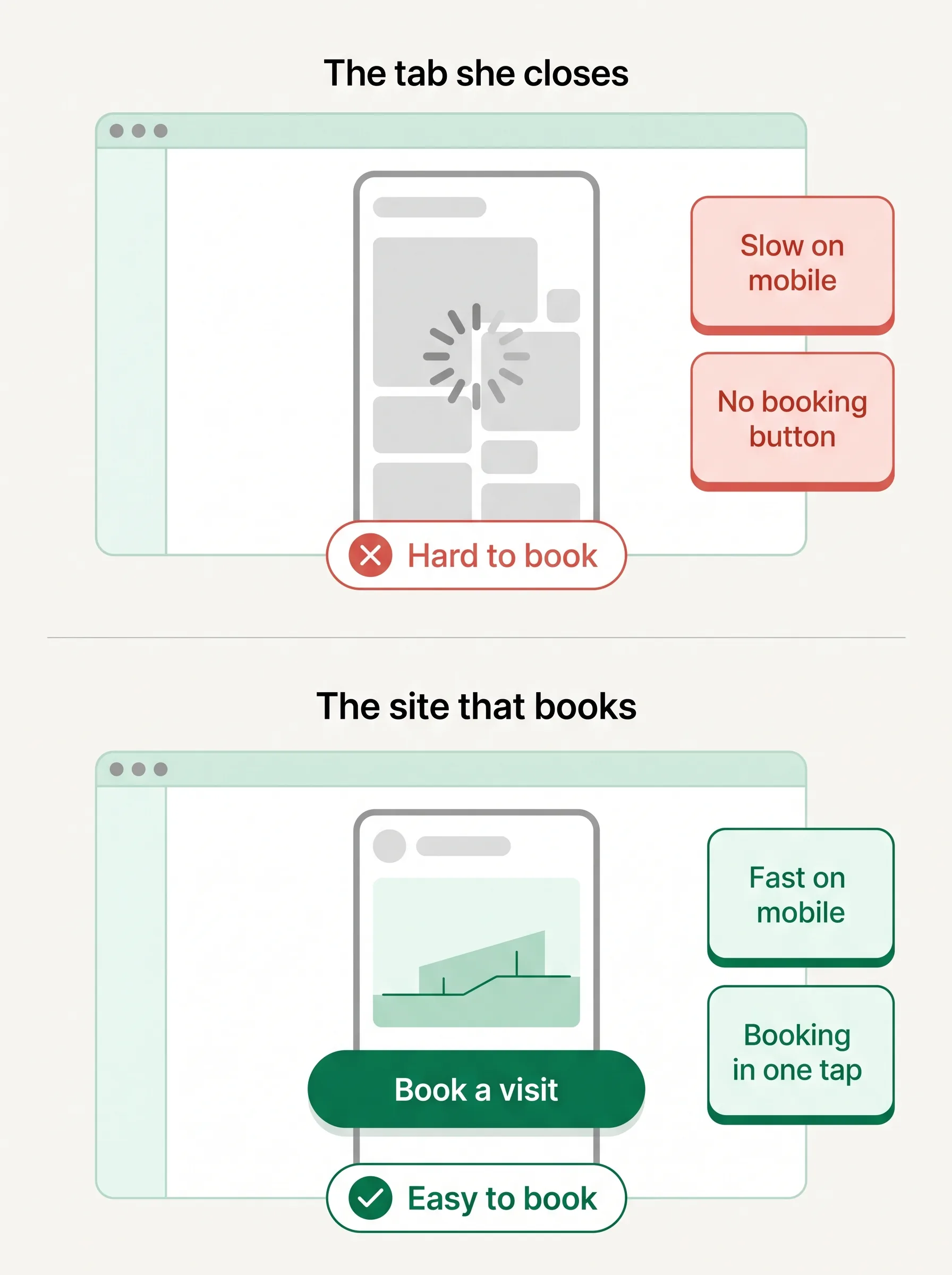
Every page has one job: turn a stranger who found you into a booked appointment. And the hosting, the domain and the files stay registered to you.

Most patients arrive on a phone, on mobile data, often in the evening. A site that takes five seconds has already lost half of them before it renders.

She came for one procedure. A page that covers everything answers nothing, and it ranks for nothing either. One page, one treatment, one decision.

A phone number in the footer is not a call to action. Booking has to be visible at every scroll depth and take fewer steps than closing the tab.
A healthcare site is not a portfolio piece. It has one job, and every decision either serves it or gets in its way.
Most visits are mobile and most of them happen outside opening hours. Every second of load time costs a share of them before a single word is read. Heavy sliders, video backgrounds and stock photography are the usual culprits, and none of them books an appointment.
She came for one procedure. That page has to carry what it involves, what it costs or what it depends on, the recovery, and the proof. A combined services page answers nobody's question and ranks for nothing.
Any form collecting health information needs a compliant provider, and patient details must never be piped into analytics or advertising platforms. It is not difficult, but a generalist agency has never had to think about it.
The most expensive mistake in a rebuild is changing URLs without mapping redirects. Years of accumulated ranking can disappear in a week. Ask how redirects will be handled before the new site goes live, not after the traffic drops.
How many enquiries does the current site produce, and where do they drop out?
If a web agency cannot answer that before proposing a redesign, they are selling you a look, not a result. A practice site is measured in booked appointments, and the number exists before the rebuild as well as after.
If nobody measured the enquiries before the rebuild, nobody will be able to prove the rebuild worked. You are buying a look, not a result.
A site you cannot take with you is a rental. The price of that arrangement only becomes visible the day you want to change provider.
A real partner protects the rankings you already have, registers everything to you, and keeps updating the site instead of handing over a brochure that decays.
I trained as a maxillofacial surgeon, moved into orthodontics, and co-founded a three-clinic group in Paris. I then spent time inside Publicis Health learning how medical marketing actually works at scale.
While running the clinics I hired an agency. I paid them more than 20,000 EUR over a year. They owned my Google and Meta ad accounts, not me. They spent a fraction of the budget, kept the rest, and delivered one patient, who came in for a cleaning, while I was selling orthodontic treatment. I only found out when I pulled the account myself and read the raw numbers.
That is why Forge exists. I read every audit personally. A specialist team runs the day to day. Every account we build stays in the client's name from the first day, because I know precisely what it costs when it does not.

Here is our price, and what five US agencies publish for theirs.
One price. No minimum-term commitment
Scope, fees and terms confirmed in a written proposal
Starts with a free diagnostic of your practice.
A site rebuilt around booked appointments, not around a look
One page per treatment, written for the search that pays
Redirects mapped so existing rankings survive the rebuild
Compliant forms, with patient data kept out of ad platforms
Ongoing changes included, so the site does not decay after launch
The domain, the hosting and the files are in your name from day one. The proposal defines the website work and any additional costs.
My team works to the deliverables and review process agreed in the written proposal. No minimum-term commitment. Scope, fees and terms are confirmed in writing. Search positions, patient or booking counts, revenue and a fixed results timeline are not guaranteed.
Practitioner exclusivity: one practitioner per city, with the specialty and territory confirmed in writing. Nationwide exclusivity may be considered for selected specialties.
Compare
Published prices from US healthcare marketing agencies, next to ours. Where an agency does not publish a number, we say so.

Prices as published on each agency's website on October 2, 2026: Gargle, Lasso MD, Circulation Dental, OrthodontistSEO.com, Officite. "Not stated" means we did not find it on that page. Prices change; check each site before deciding.
The first 90 days
Load time on mobile, enquiries by page, where visitors drop out. A free audit, no call and no pitch, read by a physician.
One page per treatment, the booking path decided, the redirect map written before anything is touched. You approve it before the build starts.
The site goes live on your own domain and hosting, with every old URL redirected so the search visibility you already earned survives.
Enquiries reported by page, changes made as you need them. A practice site is never finished, which is why it should not be sold as a one-off project.
The visitor is usually anxious, on a phone, comparing you against two other names, and looking for one specific thing. That changes everything: the speed, the structure by treatment rather than by department, the proof she needs before trusting you, and the fact that the outcome is a booked appointment rather than a purchase.
Look at three numbers: how long it takes to load on a phone on mobile data, how many enquiries it produced last month, and whether you can tell which page they came from. If any of the three is unavailable, the site is not instrumented, which usually means nobody has been optimising it either.
Forge's ongoing service costs $1,400 per month. The written proposal defines the website work, fees and terms. A site that is never updated after launch decays into the same brochure you replaced.
Four to eight weeks for a practice site, and the timeline is usually driven by how quickly the practice can supply photos, staff bios and approvals rather than by build time. Rebuilds that drag past three months are almost always waiting on the client, not the developer.
It can, and this is where most practices get hurt. If the URLs change and nobody maps redirects from the old pages to the new ones, years of ranking disappear overnight. Ask specifically how redirects are handled before the site goes live, not after traffic drops.
Yes. Google ranks pages rather than websites, and a patient searching for one procedure will not read a combined services page looking for her answer. Separate pages rank better and convert better, for the same reason: each one is about one thing.
Both, and the phone still wins for most practices. Online booking captures the evening visitor who will not call, but a visible phone number captures the one who wants reassurance now. Removing either one costs you a segment of patients, and only tracking will tell you which is bigger for you.
Any form that collects health information needs to be handled properly, which usually means a compliant form provider rather than a default one, and it means not piping patient details into analytics or ad platforms. It is not complicated, but it is the kind of detail a generalist web agency has never had to think about.
You do, or you should. The domain, the hosting account and the files must be in your name from day one. A site you cannot take with you is a rental, and the moment you want to change provider you discover the real price of that arrangement.
Ask what the current site produces in enquiries, how redirects will be handled, who owns the domain and hosting afterwards, and what happens when you need a change in six months. An agency that answers those four clearly is thinking about your practice rather than its portfolio.
The free Forge Visibility Snapshot shows where visitors drop out, what your site loads like on a phone, and what to fix first. No call, no pitch, read by a physician.
.svg)