Start with the med spa you actually operate
Forge’s med spa SEO service helps owners and marketing teams organize search work around their actual treatments, providers, locations and inquiry routes. The aim of the first conversation is to identify a useful scope: what needs investigation, what your team can verify and who will implement the agreed changes.
Start with a free diagnostic. Ongoing services are from €1,200 per month, with no minimum-term commitment. Scope, fees and terms are confirmed in a written proposal. This page explains the working approach; it does not promise a fixed number of pages, rankings or appointments for the starting fee.
A single-location med spa, a group opening another office and an established business with a fragmented website need different work. Bring the current website, real service menu and main business priority. We can then distinguish a local-information problem from a content gap, an implementation issue or an inquiry route that needs investigation.
Choose the work that fits the problem
The scope matrix below is a decision aid, not a catalogue of guaranteed package inclusions. Each row starts with a situation the team can establish and ends with a deliverable that can be reviewed. The proposal identifies which rows apply and who is responsible.
A project may need more than one row. It may also reveal that a prerequisite comes first: missing account access, an unconfirmed service or a page the business cannot yet approve. Recording that dependency makes the work concrete. It prevents content production from getting ahead of the service it describes.
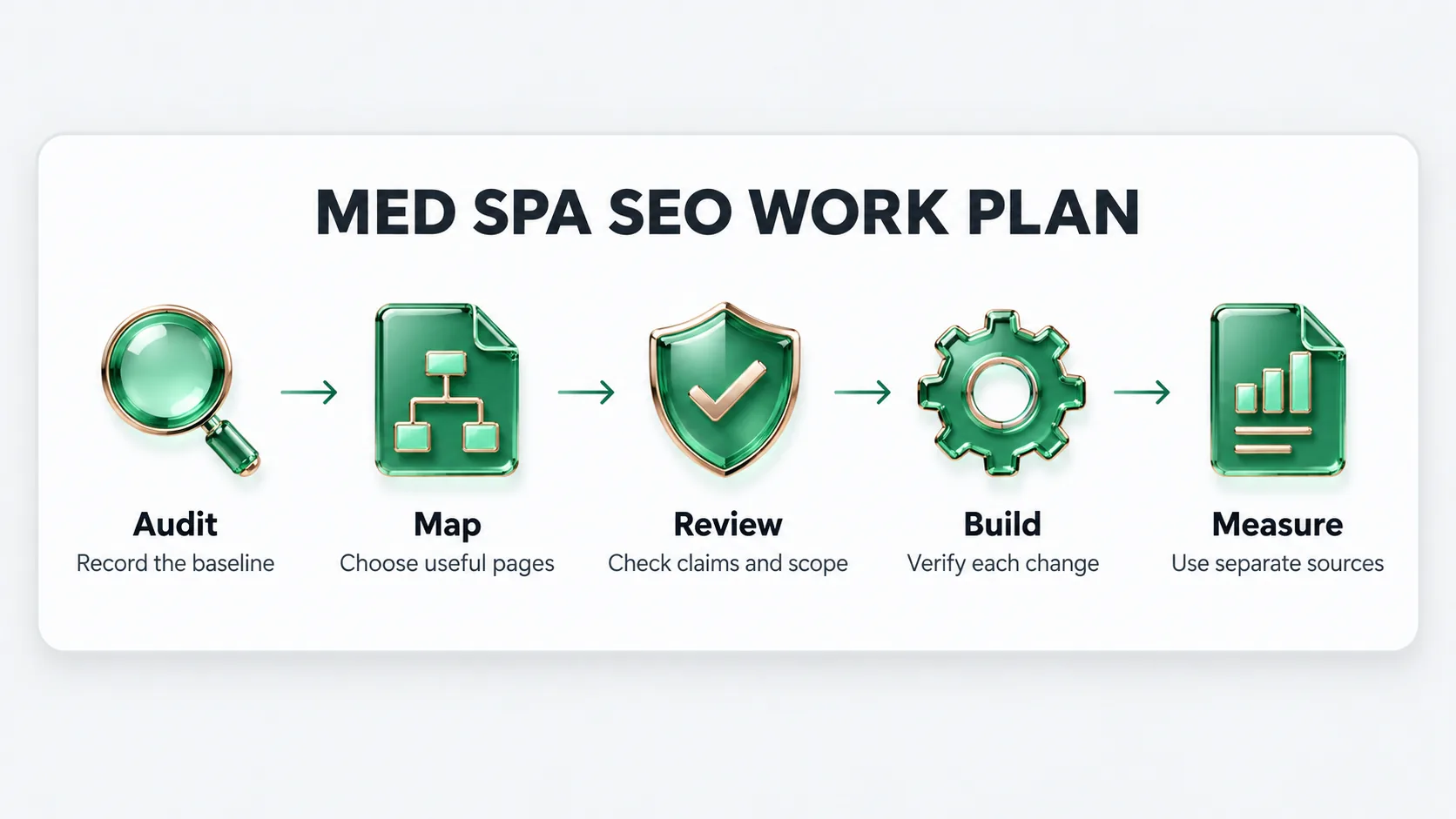
Work through five reviewable stages
1. Audit the starting point
Document the pages, public destinations and search observations relevant to the agreed question. Keep the date, source, market and settings. Distinguish a confirmed defect from a hypothesis, and identify any information the business needs to supply. The diagnostic is a starting review, not a prediction of a guaranteed ranking or revenue outcome.
2. Map useful page owners
Assign each important reader task to one proposed owner. A treatment overview, clinician biography, location page and existing-patient information page can support each other without repeating the same text. Improve an existing URL where it already owns the task; create another only when there is a separate need and enough verified substance. Mapping med spa SEO keywords to each page clarifies which one should own a given treatment topic.
3. Review claims and scope
The business supplies the facts about its services, qualifications, prices and availability. Its designated reviewer checks clinical wording and limitations. Forge can organize the brief, source trail and editorial questions, but marketing research does not authorize a treatment claim or establish suitability for an individual. Any legal or clinical sign-off needed for the business remains with its appropriate advisers.
4. Build and verify the agreed changes
The proposal should say whether Forge implements the changes or hands reviewed work to your existing team. Identify the actual URLs, retain the previous versions and test the updated content, mobile layout, links and next step. A draft delivered, an edit saved and a page published are different states. The change record should show which one has been reached.
5. Measure with separate sources
Record search visibility separately from contact actions and the business’s approved inquiry or appointment records. Use consistent time windows and make missing attribution explicit. A publication can be verified immediately; its effect on discovery and commercial outcomes needs later observation. End the report with the next supported action and its owner.
Agree responsibilities before production
A clear handoff matters as much as a useful brief. The table below describes responsibilities to settle in the proposal. It does not claim that every task is included in the starting fee or that Forge replaces the people who authorize care-related statements.
Access should be explicit and proportionate to the task. Keep the business able to identify its account owners and retrieve its delivered work. Paid advertising, a full website redesign, outside software or other services require an agreed scope; do not assume them from the word “SEO.”
See an illustrative first work package
Imagine a med spa has a real service menu and an existing website, but visitors cannot easily connect its priority treatments with the relevant location and consultation route. This is an illustrative planning example, not a Forge client case or a package available for a stated price.
- Confirm the current menu, location details and responsible reviewers.
- Inspect the existing owners for the selected service area and save the starting observations.
- Prepare a page map and one complete improvement brief as the pattern for the agreed scope.
- Review the factual wording and the next destination before implementation.
- Verify the changed pages, save the release record and agree the reporting definitions.
The useful output is a work package the business can inspect: which pages, which changes, which evidence and which responsibilities. Its size, implementation arrangements and review dates belong in the proposal. If the team cannot approve a factual statement or supply a functioning contact route, the affected page stays in preparation.
Our med spa marketing page describes the broader specialty context. This SEO engagement stays focused on the search and website work actually agreed for your business.
Understand evidence and expectations
Google’s guidance on hiring an SEO supports asking for clear explanations, relevant experience and realistic expectations. No provider can guarantee a first-place Google ranking. Ask Forge to explain its recommendation, its source and the work required, just as you would another provider.
A relevant case must retain its market, period, source and exact measure. Work for a different healthcare specialty may illustrate a process; it is not a demonstrated med spa outcome. This page does not invent a med spa client result, attendance rate or return on investment. If a proposed plan contains a forecast, its assumptions and limits should be shown separately from observed performance.
For local discovery, Google identifies relevance, distance and prominence as factors in its local ranking guidance. An accurate profile and coherent website are work your team can control. The position seen by every person searching from every location is not.
Compare med spa SEO proposals on scope, not headline price
Two proposals can make the same promise and describe very different work. Comparing them fairly means sending every provider the same factual brief, then recording what each one includes, who performs it and what stays with your team. A lower quoted fee that leaves implementation unassigned is not the same purchase as a fee that covers the work being done.
A short buying brief gives each provider identical context: your verified treatment menu, locations, website platform, current marketing support and the problem you want investigated. Name the people who can approve public clinical wording and who can implement technical changes. If you do not yet know whether the constraint is discovery, page quality or the inquiry route, say that rather than preselecting a quota of articles.
| Decision area | Question to ask | Evidence that helps |
|---|
| Starting diagnosis | Which problem will you test first? | Dated observations and the checks proposed |
| Content scope | Which existing URLs change, and why? | A page map with reader tasks and owners |
| Clinical wording | Who supplies and approves treatment facts? | A named reviewer and a source trail |
| Implementation | Who saves, tests and publishes changes? | A change list, backup and acceptance step |
| Measurement | Which source supports each reported figure? | A sample report with definitions and limits |
Resolve the important unknowns before ranking anything. A proposal that answers these rows in detail is easier to inspect, though detail alone does not prove the provider can deliver. Ask for a real work sample, clarify what the document leaves out, and confirm the people who will actually do the work. A separate guide on how to choose a healthcare marketing agency covers further questions worth raising before signing.
Keep ownership of accounts, content and access
Ownership decides what remains with the practice when an engagement ends. The domain, hosting, content management system, analytics, Search Console and Google Business Profile should sit in accounts the business holds, with any provider added as a user who can be removed. Delivered files, drafts and reporting records should be retrievable on request rather than stored where only the agency can reach them.
Ask for an access register and a handover list in writing, and confirm them before production starts rather than during a notice period. Rented page builders and licensed content are worth reading closely, since the words on a service page may not transfer when invoicing stops.
- Account register: every platform touched, the owner of record and who holds administrative rights
- Removal: how provider access is withdrawn and who at the practice can withdraw it
- Content: whether published pages, images and drafts remain usable after the engagement
- Handover: what is delivered on exit, in what format and within what process
- Territory: whether the provider works with other practices in your area, and how that is defined
Market exclusivity belongs in the same conversation. Some providers hold one practice per city, others work with several in a radius. Ask which applies, and have the specialty and territory confirmed in writing rather than inferred from a sales conversation. Forge works on one practitioner per city, with specialty and territory agreed in the proposal.
Flexible terms are useful, but the absence of a minimum commitment does not by itself explain how an engagement ends. Confirm notice, outstanding work and the handover procedure in the written proposal.
Request a free diagnostic and confirm the terms
Tell us which website and actual location you want reviewed, what the business provides and the decision you need help making. The initial diagnostic is free. There is no fixed delivery-time promise on this page; the next steps and responsibilities are agreed after the context is understood.
Ongoing services start from €1,200 per month, with no minimum-term commitment. The fee is in euros. Scope, fees and terms are confirmed in a written proposal. Clarify taxes, outside costs, notice, cancellation and any other unstated terms in that proposal before work starts.
Practitioner exclusivity is based on one practitioner per city, with specialty and territory confirmed in writing. A wider territory may be considered for selected specialties. Availability and any exception require agreement in the proposal; neither a city nor a national territory is automatically reserved by this page.
Request your free med spa diagnostic with your business URL and priorities. Keep patient identifiers and clinical information in your appropriate operational systems; they are not needed to begin this marketing inquiry.