Four channels, run as one system, on accounts registered in your name. $1,400 a month, published here before you talk to anyone.

Ask most practice owners what they spend on marketing and you get a number. Ask which part of it produced last month's new patients and the room goes quiet.
That is not carelessness. Nobody trained you for this, and the people selling it have every reason to keep the answer blurry. A dashboard full of impressions, a monthly report with no phone calls in it, and a channel mix nobody can explain.
The fix is not spending more. It is knowing which of four channels did what, on what timeline, and being able to stop the one that does nothing.
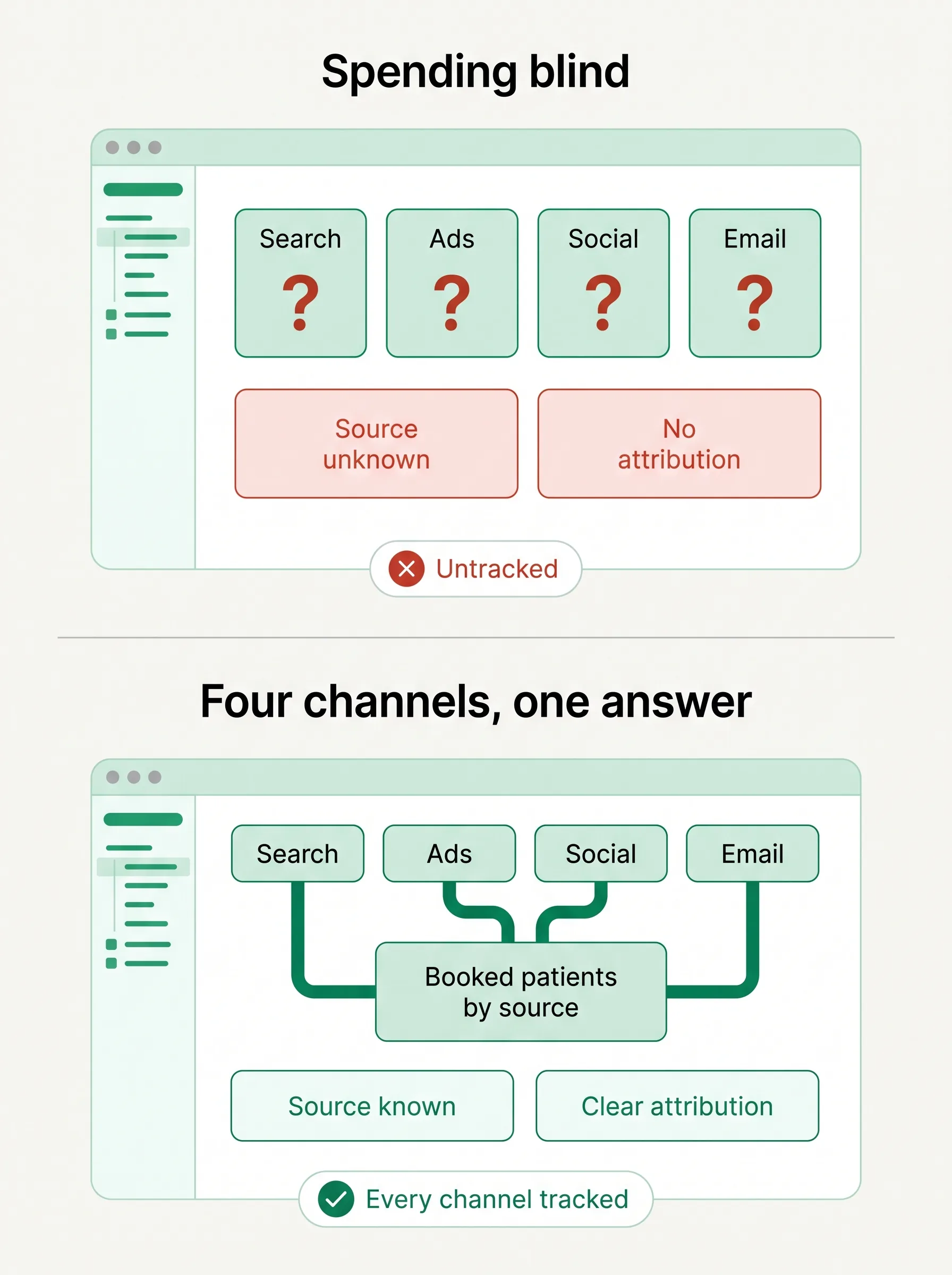
Search, paid ads, the website and reviews. Each does a different job on a different timeline, and every account stays yours from day one.

Local and treatment search takes six to twelve months to move patient volume, then keeps working without a monthly media bill. It is the cheapest patient you will ever acquire, and the slowest.

Ads produce enquiries within weeks, which is why they are worth running while search is built. They also stop the day you stop paying, which is why they are not a strategy on their own.

Every channel above sends a stranger to your site and your review profile. If those two do not answer her question, the money spent upstream is wasted twice over.
Healthcare marketing is sold as a bundle. It is four separate jobs with four different timelines, and confusing them is how budgets get wasted.
The slowest and the cheapest. Six to twelve months before rankings change patient volume, then it keeps producing without a monthly media bill. This is where your Google Business Profile, your treatment pages and your reviews do their work together.
The fastest and the most rented. Enquiries within weeks, gone the day you stop paying. Worth running while search is being built, and worth keeping for procedures with a short decision window. Not a strategy on its own, whatever the media agency tells you.
The multiplier. Every other channel sends a stranger here, so a site that does not convert makes all of them more expensive at once. Fix it first, then scale the spend that feeds it.
Tracking. If you cannot say which channel produced a booked patient, every decision after that is a guess, and the agency knows it. Reporting that ends at sessions and impressions is reporting designed not to be checked.
Who legally owns your ad accounts, your Google Business listing and your website files today?
If the answer is the agency, you do not have a partner, you have a landlord. Ask before you sign, not when you try to leave. Someone who has paid that invoice and watched the budget vanish knows what that question is worth.
Ads move in weeks, search takes six to twelve months. An agency that gives you a single answer for both is hiding which lever produced what, usually because ads are carrying everything.
Those numbers always go up and never prove anything. If the reporting cannot connect a channel to a phone call and a booked appointment, it was built not to be checked.
A real agency registers everything in your name from day one, shows raw platform spend with nothing marked up, and lets you leave with every login intact.
I trained as a maxillofacial surgeon, moved into orthodontics, and co-founded a three-clinic group in Paris. I then spent time inside Publicis Health learning how medical marketing actually works at scale.
While running the clinics I hired an agency. I paid them more than 20,000 EUR over a year. They owned my Google and Meta ad accounts, not me. They spent a fraction of the budget, kept the rest, and delivered one patient, who came in for a cleaning, while I was selling orthodontic treatment. I only found out when I pulled the account myself and read the raw numbers.
That is why Forge exists. I read every audit personally. A specialist team runs the day to day. Every account we build stays in the client's name from the first day, because I know precisely what it costs when it does not.

Here is our price, and the published prices of five US agencies next to it.
One price. No minimum-term commitment
Scope, fees and terms confirmed in a written proposal
Starts with a free diagnostic of your practice.
A website rebuilt to turn visitors into booked appointments
Local and treatment search built for the long term
Paid ads in your own accounts while search is built
A review flow that keeps working after the first month
Reporting that names the channel behind each booked patient
Every account in your name from day one. Media spend is yours, paid direct to the platform, never marked up.
My team works to the deliverables and review process agreed in the written proposal. No minimum-term commitment. Scope, fees and terms are confirmed in writing. Search positions, patient or booking counts, revenue and a fixed results timeline are not guaranteed.
Practitioner exclusivity: one practitioner per city, with the specialty and territory confirmed in writing. Nationwide exclusivity may be considered for selected specialties.
Compare
Published prices from US healthcare marketing agencies, next to ours. Where an agency does not publish a number, we say so.

Prices as published on each agency's website on October 2, 2026: Gargle, Lasso MD, Circulation Dental, OrthodontistSEO.com, Officite. "Not stated" means we did not find it on that page. Prices change; check each site before deciding.
The first 90 days
A free audit looks at all four channels and tells you where patients drop out. No call, no pitch, in your inbox within 24 hours, read by a physician.
The site first if it cannot convert, ads next if the schedule needs filling now, search underneath for the long term. You approve the order before anything goes live.
Site corrected, profile rebuilt, ads running in your own accounts, review flow switched on. Every account registered to you from day one.
Calls and booked appointments reported by source. Ad spend shown in full, nothing marked up. The channel that does nothing gets stopped.
Each service has its own page, with what it covers, what it costs and how progress is measured.
How search brings patients to the right page, and how to tell whether the work is moving.
Paid search that buys consultations, with the limits of ads stated plainly.
A site built around what patients compare before they book.
Reviews and profiles handled without buying a single review.
Four channels: search visibility including your Google Business Profile, paid ads, the website that receives everything, and the review profile that decides the comparison. Everything else sold under the name of healthcare marketing is either one of those four with a different label, or an activity that does not end in a booked patient.
The website, almost always. Every other channel sends a stranger to it, so a site that does not convert makes the rest more expensive rather than less. Once it converts, ads fill the schedule in weeks while search is built underneath for the long term.
Forge costs $1,400 per month, with ad spend paid directly by you to the platform and never marked up. The number that matters more than the fee is what one additional booked patient is worth in your case mix.
Paid ads produce enquiries within weeks. Honest search visibility takes six to twelve months to change patient volume. Anyone who gives you one number for both is either confused or hoping you will not ask which lever produced what.
Yes, in three ways that matter. The decision takes longer and involves more research, the advertising platforms restrict what you can say and who you can target, and the value of a patient is spread over years rather than one transaction. An agency that treats a practice like a local shop gets all three wrong.
Buying traffic before the site can convert it. A four thousand dollar monthly ad budget pointed at a slow or vague website mostly funds Google. The second most common is having no way to tell which channel produced a booked patient, which means every decision after that is a guess.
In-house works when someone owns it as a real job and stays long enough to learn the platforms. In practice most practices give it to a front-desk lead with no time, which produces a half-built Google profile and abandoned ads. The honest test is whether anyone will still be doing this in six months.
Tracked calls and form submissions by source, cost per qualified enquiry, and how many of those became booked appointments. Sessions, impressions and follower counts are not results. If the reporting cannot connect a channel to a phone call, nobody is measuring the only thing that pays.
Patients increasingly ask an assistant instead of scanning a page of links, and the assistant names two or three practices. Being absent from that shortlist is worse than ranking fifth. The work that gets you cited is the same work that ranks you, so it is a reason to do it properly rather than a new channel to buy.
That every account sits in your name from day one, that the price is public, that the terms are month to month, and that the reporting connects a channel to a booked patient. Ask what happens to everything if you leave. If the answer is vague, you have your answer.
The free Forge Visibility Snapshot shows which channel is leaking, which searches you are missing, and what to fix first. No call, no pitch, read by a physician.
.svg)