
Start with the practice you actually run, then agree on the page, local and reporting work needed to improve its organic search presence.

Forge organizes procedure pages, real consultation locations and reporting around verified practice information and named reviewers.
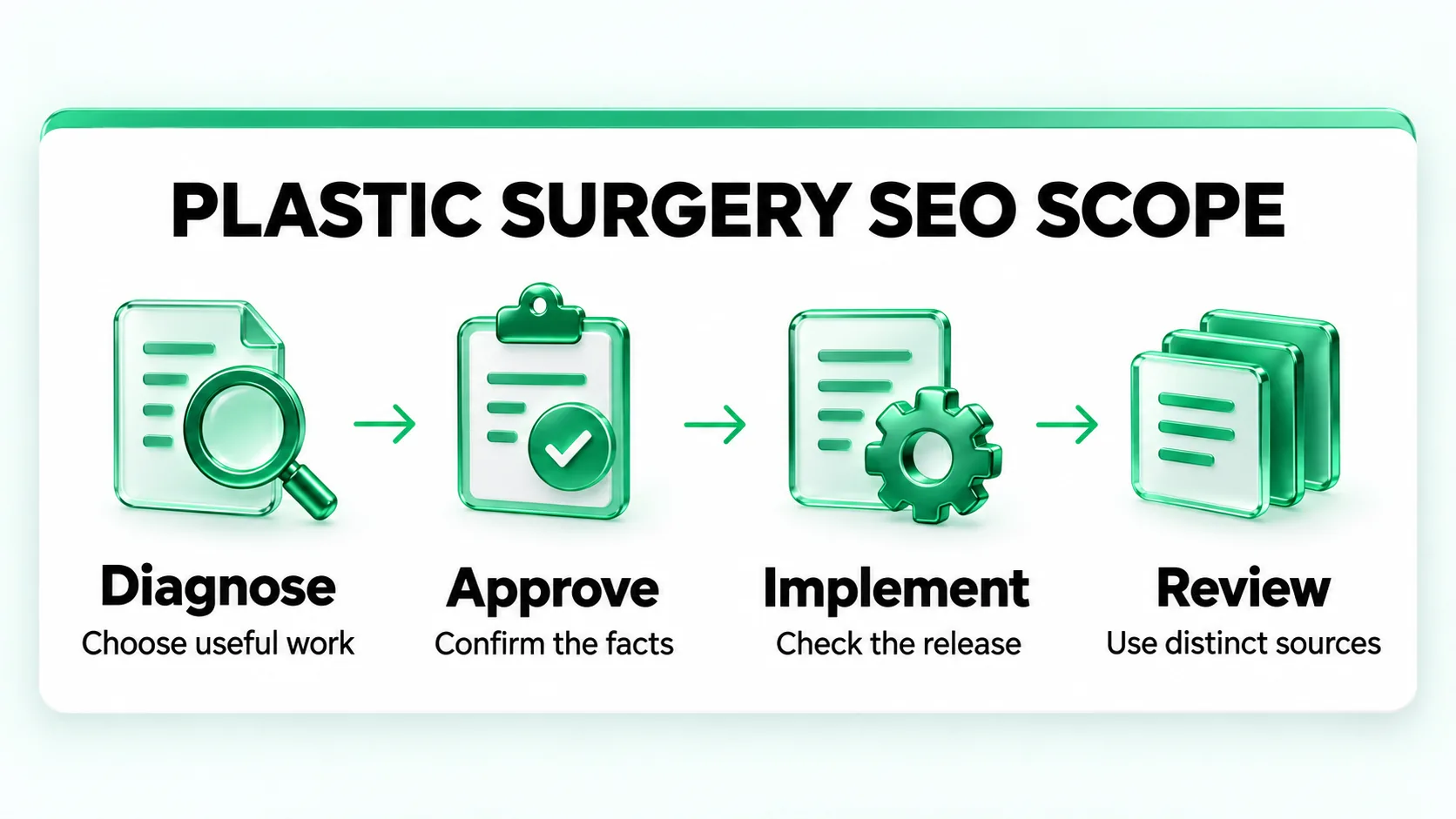
Forge helps plastic surgery practices organize and improve the pages, local information and measurement that support organic search. The starting point is the current practice: the surgeons, procedures and consultation locations you can verify, followed by a defined work package with named reviewers and implementation responsibilities.
This SEO service sits within Forge's plastic surgery marketing offering. It is relevant when procedure pages lack a clear purpose, office information has drifted across the site and listings, or the monthly report cannot distinguish search activity from reviewed inquiries.
A single-surgeon office revising its procedure pages needs a different scope from a group reconciling multiple consultation locations. We begin by identifying the issue, the information available and the people who can approve the changes.
Choose the first work package based on the current bottleneck. If a useful procedure page already exists, improving its facts and contact route may be more appropriate than commissioning another article on the same subject.
The written scope identifies what Forge will deliver, who implements each change and what the practice needs to review. Confirm website access, profile ownership and any developer dependencies before work is scheduled.
| Deliverable | Forge's work | Practice input and acceptance |
|---|---|---|
| Current-site diagnostic | Document observed issues, affected pages and a prioritized work package. | Confirm commercial priorities, actual services and available access. |
| Procedure-page brief and content | Define the reader task, owner URL, outline, supporting links and draft. | Named clinical reviewer approves medical explanations and provider facts. |
| Office and profile audit | Reconcile addresses, profiles, public information and correction owners. | Office team confirms the real locations and operating details. |
| Implementation and release checks | Apply agreed changes where access and scope permit; verify the resulting pages. | Approve the content and resolve work assigned to the practice or its developer. |
| Measurement and review | Report the agreed search view, work completed and next actions. | Confirm operational outcomes and approve the data-sharing boundary. |
External development, advertising spend, additional markets and work outside the agreed package should be identified in the proposal. A content brief and a live implementation are different deliverables; the scope makes clear which are included.
Illustrative scope: a fictional US practice has one consultation office, a complete surgeon biography and a procedure page that repeats the general services page. The first package could revise that existing page, reconcile its office link and check the inquiry route.
The writer receives the current URL, an approved procedure description, the clinical reviewer and a source checklist. The office manager confirms where consultations occur and what happens after an inquiry. The implementation check covers mobile layout, links, images, FAQ, metadata and the request confirmation.
The acceptance decision is concrete: the approved page is live, the correct office is linked and the contact path has been tested. Search and inquiry performance can then be reviewed against the agreed baseline. The work package does not require inventing a new city page or promising a number of procedures.
The surgeon or qualified reviewer approves treatment explanations, limitations and recovery information. Forge organizes and writes the material within that approved scope. Certification claims should identify the actual credential; the ABPS verification resource is available when ABPS certification is the statement being checked.
Patient images need the practice's approved permission and review process. The ASPS Connect photo guide illustrates why procedure matching and documented consent belong in an asset checklist. Generated images can illustrate a marketing concept; they cannot serve as evidence of a patient's surgical result.
For marketing proof, ask what was delivered, in which market, over what period and from which data source. A diagnosis of a website is not a completed growth campaign. We do not convert estimated search demand into patients, consultations or revenue.
The initial diagnostic is free. Ongoing Forge support is $1,400 per month, with no minimum-term commitment. The written proposal confirms the included work, implementation responsibilities, billing terms and any scope adjustments.
Forge's exclusivity principle is one practitioner per city. The proposal defines the covered specialty and territory, including any exceptions, before engagement. A multi-surgeon group or a practice with several locations needs that scope written explicitly.
Any delivery schedule follows the agreed work and review dependencies. Rankings, consultation volume and revenue are not guaranteed. Google's guide to choosing an SEO provider is a useful reference when comparing scope, communication and promises.
A procedure page brief gives a writer more than a keyword and a word count. It names the URL that owns the task, the visitor question the page answers, the procedure scope the surgeon confirms, the provider facts to verify, the material approved for use, the practical consultation details and the acceptance check before release.
State the visitor task in one sentence, such as understanding how this practice handles a consultation and deciding whether to contact the office. That is a more useful boundary for a writer than a ranking target, and it stops a page drifting into procedures the surgeon does not perform.
| Brief field | Working instruction | Evidence or approval needed |
|---|---|---|
| URL | Keep the current procedure URL when it already serves this task | Existing content, internal links, canonical setting and search data |
| Visitor question | Explain the consultation process and how to request it | The clinician's description and the current office process |
| Procedure scope | Describe what this surgeon offers, without extending it | Named surgeon approval of terminology and limitations |
| Provider information | Name the surgeon and state credentials precisely | Approved biography and a recorded certification check |
| Supporting material | Select relevant patient questions and approved images | Clinical review and documented image permission |
| Practical details | State where consultations occur and how requests are handled | Verified address, contact route and the actual office response |
| Acceptance check | Review the complete mobile page and the request confirmation | Named reviewer and a resolved publication issue list |
Attach the source beside each instruction. A note that the surgeon knows the answer is not a usable source record. A dated review note, an approved biography or a current office document lets the team settle disagreements without rebuilding the brief, and it keeps gaps open until the right person closes them rather than filling them with competitor wording or a generic AI completion.
Before commissioning anything new, review the procedure, surgeon and location pages together and name the single page responsible for each visitor question. Where a page already serves the task, improving it is usually more productive than adding another URL. A separate recovery or preparation article earns its place only when it answers a substantial, distinct question that clinical review can support.
Shared terminology needs the same judgment. Cosmetic and reconstructive care can be described by the services and questions involved. A shared procedure name does not automatically require separate URLs, and covering both contexts on one page does not automatically prevent it from ranking.
Once ownership is settled, the release decision is a short, repeatable check:
Publish a response-time commitment only when the practice has agreed to it and the office can support it. A general contact route remains usable as long as its purpose and confirmation are clear to the reader.
Share your website, actual consultation locations, priority services and the issue you want to resolve. That is enough to start defining the work; do not send patient records or photographs through the marketing contact form.
Request your free initial diagnostic to turn the current site issues into a specific, reviewable SEO work package.
We review your pages, search visibility and enquiry path, then show you what to fix first.
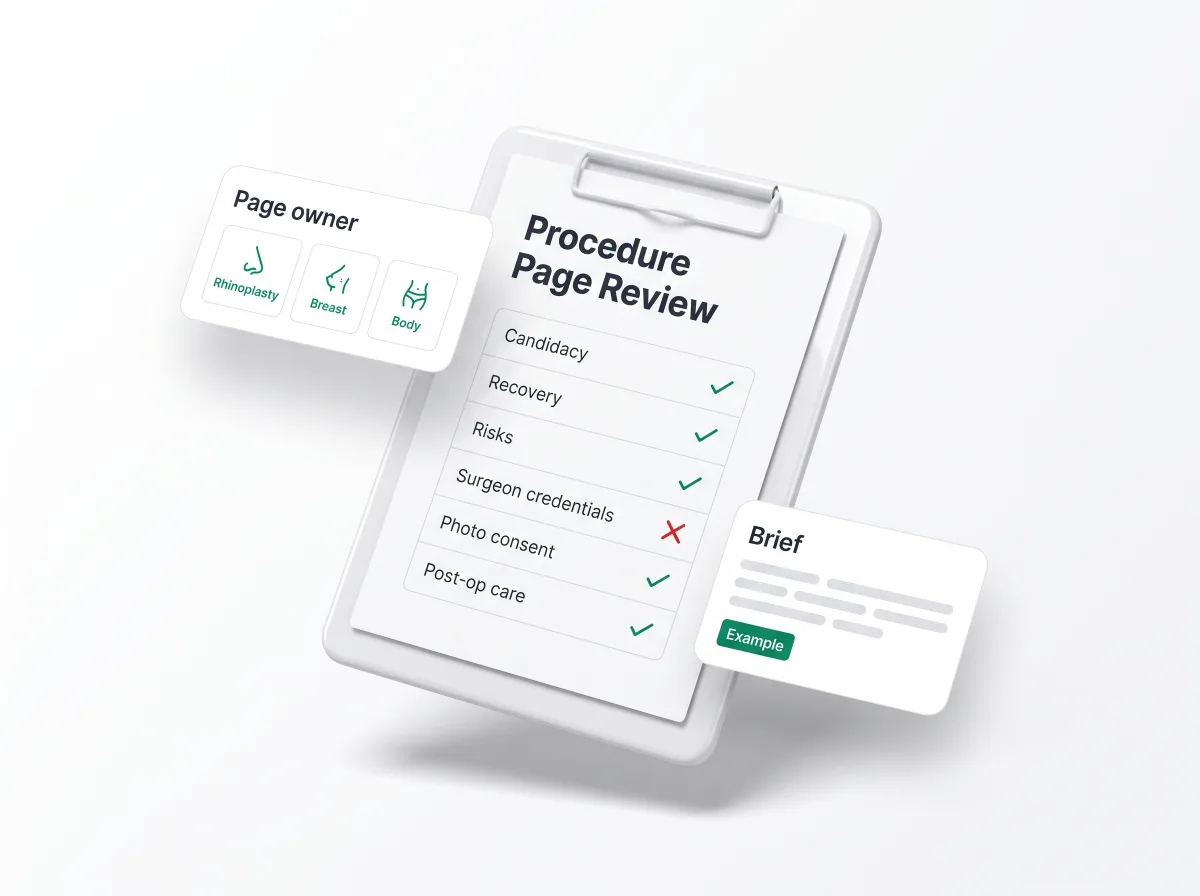
You have read how a procedure page brief works. We apply it to your own pages and show which questions on candidacy, recovery and risks remain unanswered.