Dental marketing
Dental Marketing Agency Run by a Dentist
Your rankings, reviews and ads sit on accounts in your name, not ours. Built by a physician who was the buyer. Starts at €1,200 a month, shown here before you talk to anyone.

Your rankings, reviews and ads sit on accounts in your name, not ours. Built by a physician who was the buyer. Starts at €1,200 a month, shown here before you talk to anyone.
A patient searches for Invisalign near them, reads three Google listings, checks the reviews, and sometimes asks an AI which practice to trust. By the time they pick up the phone, the decision is already made.
The practice that showed up first, looked credible, and had the better reviews got the call. Yours may not have.
The best clinician in the room does not always win that comparison online, and no amount of clinical skill changes what a patient sees before they ever dial.
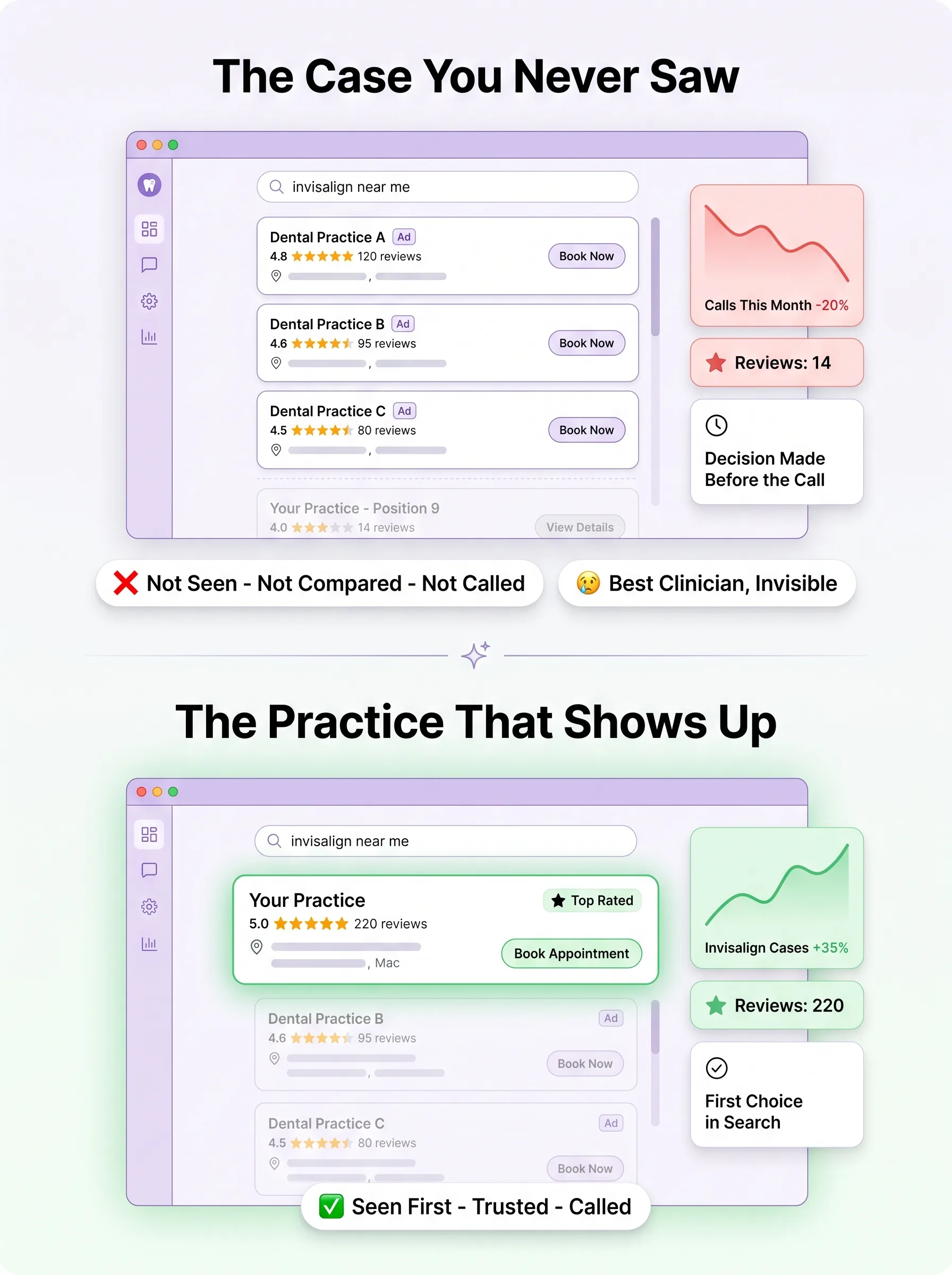
Illustrative comparison of a missing dental listing and a more complete search profile. Positions and figures are hypothetical examples.
We connect your website, search presence and enquiry tracking around the treatments your practice actually provides. Explore the dental marketing plan.

Your Google listing and local rankings are built to surface when patients search for Invisalign, not only when they already know you. The searches that matter are the ones you are currently missing.

Your reviews, your website, and your content are built to answer the comparison a patient runs before calling. When they weigh you against two others, yours is the clear choice.

Paid ads run in your own ad account. Every click is tracked to a call or a booked appointment. Nothing is rented from Forge, so nothing disappears if you leave.
Most dentists hire a marketing agency the way they hire a contractor: a referral, a decent-looking website, a confident call. That is how you end up paying for twelve months of work and getting one patient who came in for a cleaning.
Here is what to actually check before you sign anything.
Your Google Business listing, your Meta ad account, your website hosting: ask whose name they are in on day one. If the answer is the agency's, your visibility is rented. Leave and it goes with them. This is not a small print issue, it is the whole game.
Account managers who have never run a dental practice do not know what an Invisalign case is worth or why a patient hesitates. There is a real difference between someone who learned marketing in a classroom and someone who signed the invoice and watched the budget disappear.
Anyone who tells you SEO will move in thirty days is selling you something. In most competitive dental markets, honest local SEO takes six to twelve months to show in rankings. Paid ads move faster, often in weeks. An agency that conflates the two is either confused or hoping you will not notice.
Patients are already asking ChatGPT and Google's AI overviews which dentist offers Invisalign nearby. If your agency has no answer for how your practice appears in those results, that is a gap that will cost you cases in the next twelve months, not the next five years.
Some agencies point to practice management software data as proof of ROI. Ask what the connection actually tracks, and whether it captures the calls and enquiries that never made it into your schedule. Reporting that only counts closed appointments misses the patients you lost before they booked.
Who owns your ad account, your Google listing, and your website the day you sign?
The risk is not your clinical judgment, it is the marketing spend. The person who has signed an agency invoice and watched the budget disappear knows exactly what that question means. If the answer is the agency, walk away.
If Google, Meta or your website login sits in the agency's name, they hold your visibility hostage. Leave and you start from zero. This is the most common and most costly trap in dental marketing.
A promise of a fixed number of Invisalign patients in ninety days is not a guarantee, it is a sales line. No agency controls what a patient does after they click. Treat it as a red flag, not a reassurance.
A good agency builds everything in your name, shows you the real ad spend with nothing marked up, and lets you walk away on thirty days notice with every login intact. The price is public before any conversation starts.
I trained as a maxillofacial surgeon, moved into orthodontics and Invisalign, and co-founded a three-clinic orthodontics group in Paris. I then spent time inside Publicis Health learning how medical marketing actually works at scale.
While running the clinics, I hired a dental marketing agency. I paid them more than 20,000 EUR over a year. They owned my Google and Meta ad accounts, not me. They spent a fraction of the budget, kept the rest, and delivered one patient who came in for a cleaning while I was selling Invisalign. I found out only when I pulled the account myself.
That is why I built Forge. I review every audit personally. A specialist team runs the day-to-day. Every account we build stays in the client's name from the first day, because I know exactly what it costs when it does not.

Most dental marketing agencies sit between $3,000 and $6,000 a month and will not show you that until after the call. Here it is upfront.
My team works to the deliverables and review process agreed in the written proposal. No minimum-term commitment. Scope, fees and terms are confirmed in writing. Search positions, patient or booking counts, revenue and a fixed results timeline are not guaranteed.
Practitioner exclusivity: one practitioner per city, with the specialty and territory confirmed in writing. Nationwide exclusivity may be considered for selected specialties.
The first 90 days
The free Forge Visibility Snapshot audits your current online presence and maps exactly where competitors beat you in search, maps and AI results. One-on-one call with the team to walk through it.
Khourda reviews the audit and sets the order of work based on your market and your target cases. No generic checklist, a plan built around what your practice actually needs.
Website rebuilt or repaired, local SEO launched, ads live in your own ad account. Reviews and reputation system activated. Everything set up in your name from the first day.
Rankings, calls, and booked appointments reported in plain language. Ad spend shown in full, nothing hidden or marked up. You know what moved and what to do next.
A dental marketing agency manages the channels that put your practice in front of patients who are actively searching: local SEO, Google Business Profile, paid search, website conversion, and review volume. The goal is not activity for its own sake. It is a stranger finding you online, choosing you over the practice next door, and booking a consult.
Reputation inside your patient base and visibility on Google are entirely separate things. A practice can have a thirty-year referral network and still be invisible to anyone searching cold. Search engines rank signals: review count, page relevance, site authority, and local data consistency. None of those accrue automatically from clinical excellence.
Honest SEO takes months to move, often six to twelve before the rank gains translate into consistent new-patient volume. Paid search can surface results in weeks, which is why I usually recommend running both in parallel early on. Anyone quoting you faster organic timelines is selling you something I would not buy.
Managed dental marketing starts at €1,200 per month at Forge, which covers strategy, execution, and reporting as a retained service. What you spend above that floor depends on ad spend and the number of locations. The more useful question is not the monthly fee but what a new qualified patient is worth to your specific mix of cases.
Google ranks pages, not websites, so a single services page splits search authority across every treatment you offer and ranks well for none of them. A page built around implants, for example, captures patients searching specifically for implants rather than patients searching for a general dentist. That specificity is what turns organic traffic into a booked consult.
The most common mistake I see is spending on ads before the website can convert the traffic they generate. A $3,000 monthly ad budget pointed at a slow, vague, or mobile-broken site mostly funds Google, not your schedule. Fix the conversion layer first, then scale the spend that feeds it.
Review count and recency are direct ranking factors in Google's local pack, the map results most patients click first. Beyond rank, a thin review profile makes a practice invisible to patients who vet online before booking. Generating a steady flow of authentic reviews is a traffic strategy, not just a reputation exercise.
Confirm that every account, your ad accounts, your Google Business Profile, your analytics, sits in your name from day one, not the agency's. At Forge we operate month to month and never hold a client's assets. An agency that owns your accounts owns your leverage, and that is a structural problem regardless of how good the work is.
AI search assistants pull from the same structured signals that Google uses: authoritative content, strong local data, and review volume. Practices that rank well in traditional local search tend to surface in AI-generated answers too, but only if their content is specific enough to be cited. Thin or generic pages become even more invisible in an AI-mediated results layer.
Each location needs its own optimized Google Business Profile, its own local landing page, and its own review-building engine, all coordinated under one coherent brand. Without that structure, locations compete against each other in the same market or disappear entirely in local results. A group that treats all locations as one entity in marketing is leaving significant search coverage on the table.
The free Forge Visibility Snapshot tells you precisely where you are losing Invisalign cases online and what to do about it. No guessing, no wasted budget, just a clear picture and a clear next step.