
Build a useful search presence around your real offices and services, with clinical review, clear responsibilities and reporting that names its limits.

Review current coverage and public information, select the useful changes and agree who supplies, approves and implements them.
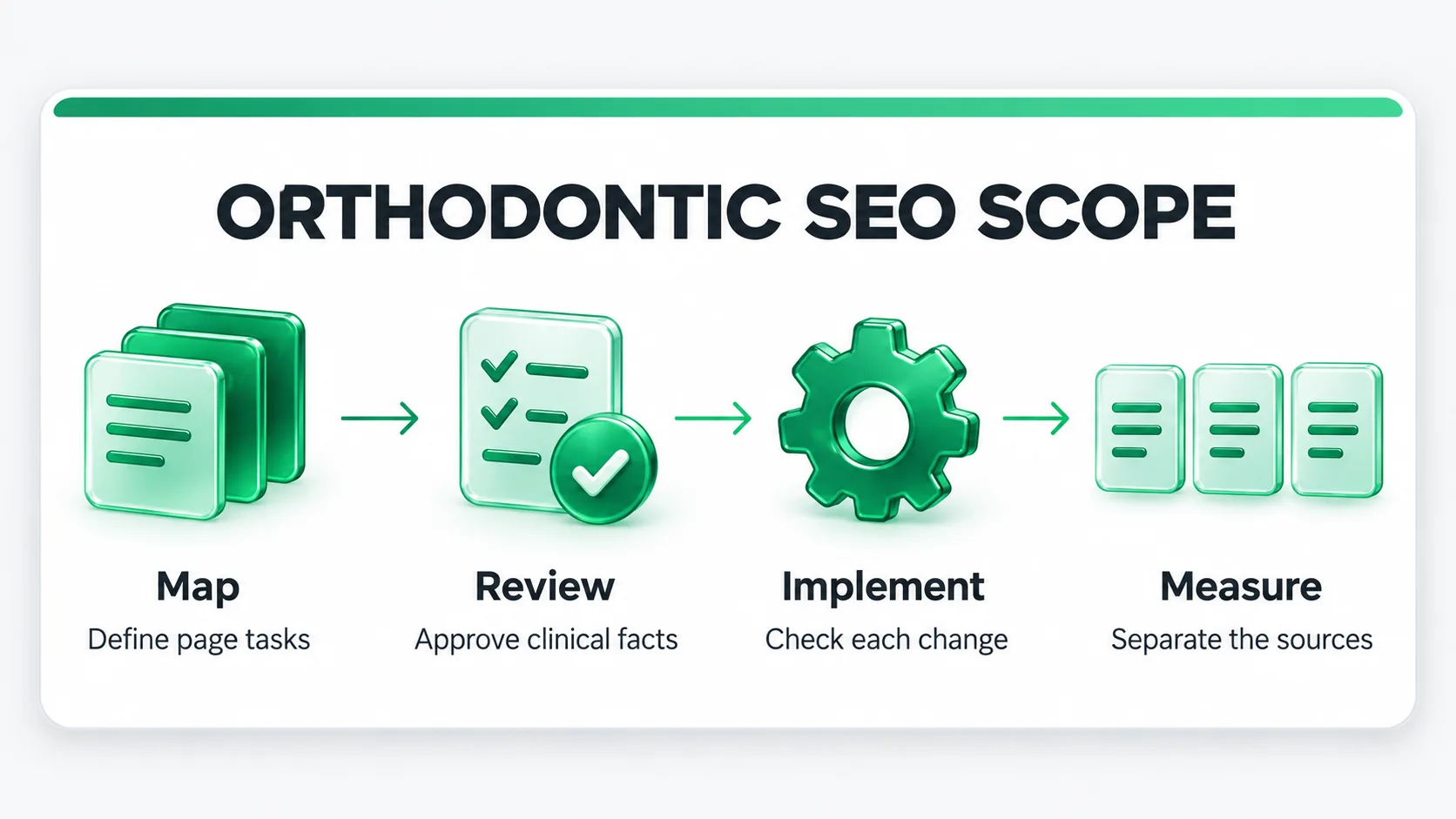
Forge helps orthodontic practices review their search presence, improve useful website pages and organize the work needed to keep information accurate. The scope starts with your actual services, offices, team and contact process. It should be clear who will supply the facts, approve clinical wording and implement the changes.
SEO can address how pages are found and how clearly they explain the practice. We distinguish search observations from inquiries, booked consultations and treatment starts when planning and reporting the work.
Use this service alongside the broader orthodontic marketing plan. If the immediate issue concerns another channel or the handling of incoming inquiries, the first diagnostic should identify that rather than automatically prescribe more articles.
| Practice situation | Work to consider | Information needed |
|---|---|---|
| One office with inconsistent public details | Profile and location-page review | Current address, hours, provider attendance and contact route |
| Treatment topics share an unclear page structure | Existing-page inventory and keyword-to-page map | Actual service menu and approved clinical scope |
| Several offices have similar or outdated pages | Location structure and responsibility review | Office-specific services, team and practical information |
| Reporting shows traffic without explaining inquiries | Measurement definitions and reporting review | Search sources and approved operational reporting |
These are possible scopes, not a list automatically included in every engagement. The proposal identifies the work, responsibilities and exclusions for your practice.
We review the current pages before proposing new URLs. The map connects search language to the information a visitor needs: a real office, an actual service, a provider, payment arrangements or the first-visit process. Related phrases can belong on one maintained page.
A new page needs a distinct purpose and verified material. We do not create a separate page for every appliance variation, age phrase or neighboring town by default. The practice's clinical reviewer confirms treatment descriptions, limitations and any explanation of the assessment process.
Provider credentials, memberships and brand-specific service claims are checked individually. The American Association of Orthodontists' guidance explains why accurate specialty information matters when selecting a provider. It does not replace verification of the clinician being described on your website.
Google's people-first content guidance supports a practical editorial standard: each page should answer its intended reader's question. A search phrase is a research input, not a reason to invent a service or a patient story.
Local work can include checking Business Profile details, eligible profile structure, office-page information and links to the appropriate destination. We use the practice's real locations and Google's current Business Profile guidelines when defining the work.
The website review follows the contact route through to its confirmation. A visitor should be able to tell whether they requested a consultation or booked a confirmed time. Any forms, phone setup or third-party booking changes need an agreed implementation owner and an appropriate test process.
The practice retains responsibility for clinical decisions and patient communication. Marketing reporting should not expose patient details through ordinary forms, URLs or unapproved analytics.
| Possible deliverable | Forge's role when included | Practice contribution | Reviewable result |
|---|---|---|---|
| Page and query map | Research existing coverage and propose owners | Confirm actual services and priorities | Named URLs, tasks and writing decisions |
| Page revision | Draft and implement the agreed changes | Approve clinical and commercial facts | Reviewed content and a checked public page |
| Local information audit | Compare profiles with office pages | Provide the current source of truth | Owned corrections with acceptance checks |
| Technical review | Investigate agreed indexing or page issues | Arrange appropriate platform access | Findings, fixes and verification evidence |
| Reporting review | Separate search measures and documented actions | Provide approved operational definitions | Source-labeled observations and next decisions |
Responsibility for implementation is explicit. If a change requires your existing developer, booking provider or internal team, the proposal should identify that dependency before delivery begins.
Illustrative scope, not a client case or fixed package: a hypothetical one-office practice wants to clarify its first-visit page and correct inconsistent opening hours. An initial work package could inventory those surfaces, confirm the facts with the office manager, revise the page with clinical review, implement the approved changes and verify the contact route.
The handover would name the changed URLs, the reviewer, the completion checks and the reporting baseline. It would not describe an inquiry increase without supporting evidence. Further content would be selected after reviewing the remaining gaps and the team's capacity.
Comparing orthodontic SEO providers works when each one responds to the same brief: the website, the actual offices, who currently owns the marketing accounts and the problem the practice wants solved. Ask each provider what it would inspect, what it would change and what the practice must supply. A proposal that lists services without naming deliverables leaves you comparing labels rather than work.
Content optimization can mean editing a page title or researching and rebuilding a full treatment page. Ask which one is quoted. The same questions below apply to Forge and to every other provider under consideration.
| Decision area | Question for the provider | Evidence to request |
|---|---|---|
| Deliverables | Which pages, profiles or reports will change? | Named work items and acceptance checks |
| Implementation | Who makes the CMS changes and verifies them? | Responsibilities, access and QA process |
| Clinical review | Who approves treatment and provider statements? | Named practice reviewer and revision route |
| Proof | What does each cited example actually demonstrate? | Market, dates, scope and metric definitions |
| Reporting | How are search observations separated from inquiries? | Sample report naming its sources and limits |
| Ownership | What access and materials stay with the practice? | Account roles and handover terms |
Read case studies at their real scope. A delivered website, a change in search visibility and an increase in attended consultations are different kinds of evidence. Ask whether a chart shows first-party records or a third-party estimate, and how inquiries, booked appointments and attended visits were defined. Experience from another specialty or country can still be relevant, provided it is described as what it is.
A delivery date is a commitment a provider can keep. A ranking position or a count of treatment starts depends on far more than delivery, so treat promises of a first-place ranking as a reason to ask harder questions rather than a reason to sign.
Search visibility is a step, not the result. Judge the work by the consult requests it can be traced to, the consultations that are attended and the treatment plans that start. Rankings and session counts cannot be banked. Tag inquiry forms and calls by source, ask at the consultation how the patient found the practice, and reconcile those records against starts on a regular cycle.
A short list of records makes that reconciliation possible:
When a treatment page is visible in search but produces no requests, more pages rarely fix it. The usual causes sit on the page: no indication of fees, no clear next step, or a booking route buried several taps deep. Rewrite before expanding, and add a page when a treatment the practice wants more of has none.
Attribution stays partial. A parent may hear the practice named by a referring dentist and then search for it, so the record should allow both to be true rather than forcing one label. Reporting is more useful when it names what it cannot separate.
At each reporting review, ask for a short decision log: what changed, what the data shows, what remains uncertain and what the team proposes next. That keeps a review useful even in periods when the evidence cannot yet support a claim about started cases.
The initial diagnostic is free. Ongoing Forge work is $1,400 per month, with no minimum-term commitment. The proposal defines the included work, any additional costs and the applicable terms for your practice.
For practitioner engagements, Forge's exclusivity principle is one practitioner per city. The written proposal defines the specialty, territory and any exceptions, so the actual scope of that commitment is clear.
We do not promise a first-place ranking, a fixed number of consultations or a result within 90 days. Google's SEO hiring guidance also advises buyers to question ranking guarantees. Delivery checkpoints and business outcomes are reviewed separately.
Request your free initial diagnostic with your website, office locations and the problem you want to resolve. The next step is to define a work package the practice can review and approve.
We review your pages, search visibility and enquiry path, then show you what to fix first.
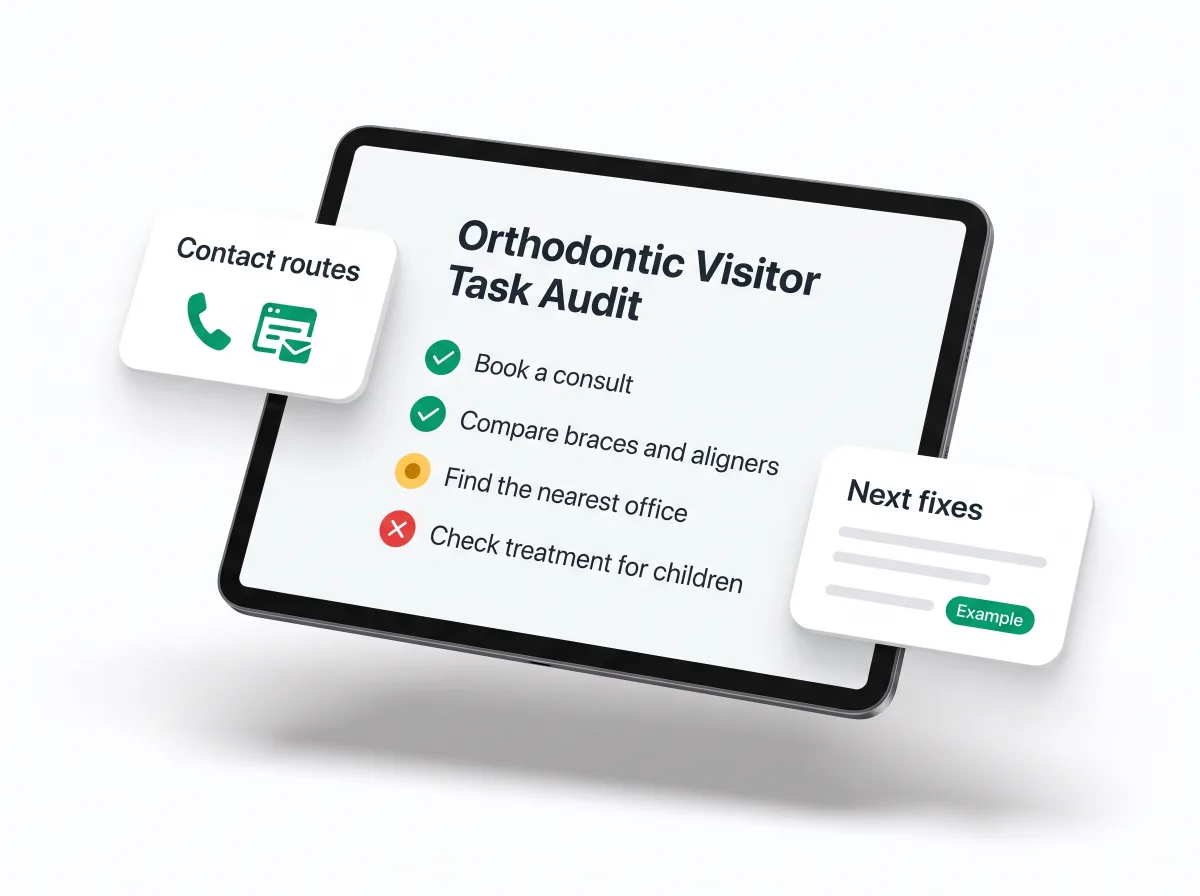
You have read how pages should follow real visitor tasks. We test your own site against the tasks parents and adult patients come to complete.
.svg)