Every account stays in your name, not ours. Built by a physician who signed the invoice and got burned. From €1,200 a month, published here before you talk to anyone.

Someone searches for Botox near them on a Thursday night. Three names come up, plus a franchise running ads on every one of them. She reads the reviews, checks the Instagram, compares a price she found on one site against a form she has to fill in on another.
She picks one. Maybe you, maybe not. But the real loss is not that first appointment. It is that she came once, liked it, and then drifted to whoever showed up in her feed three months later when the filler wore off.
A med spa lives on repeat treatment. Every client acquired and not retained is a cost you paid twice. Most agencies are still counting first-time bookings and calling it growth.
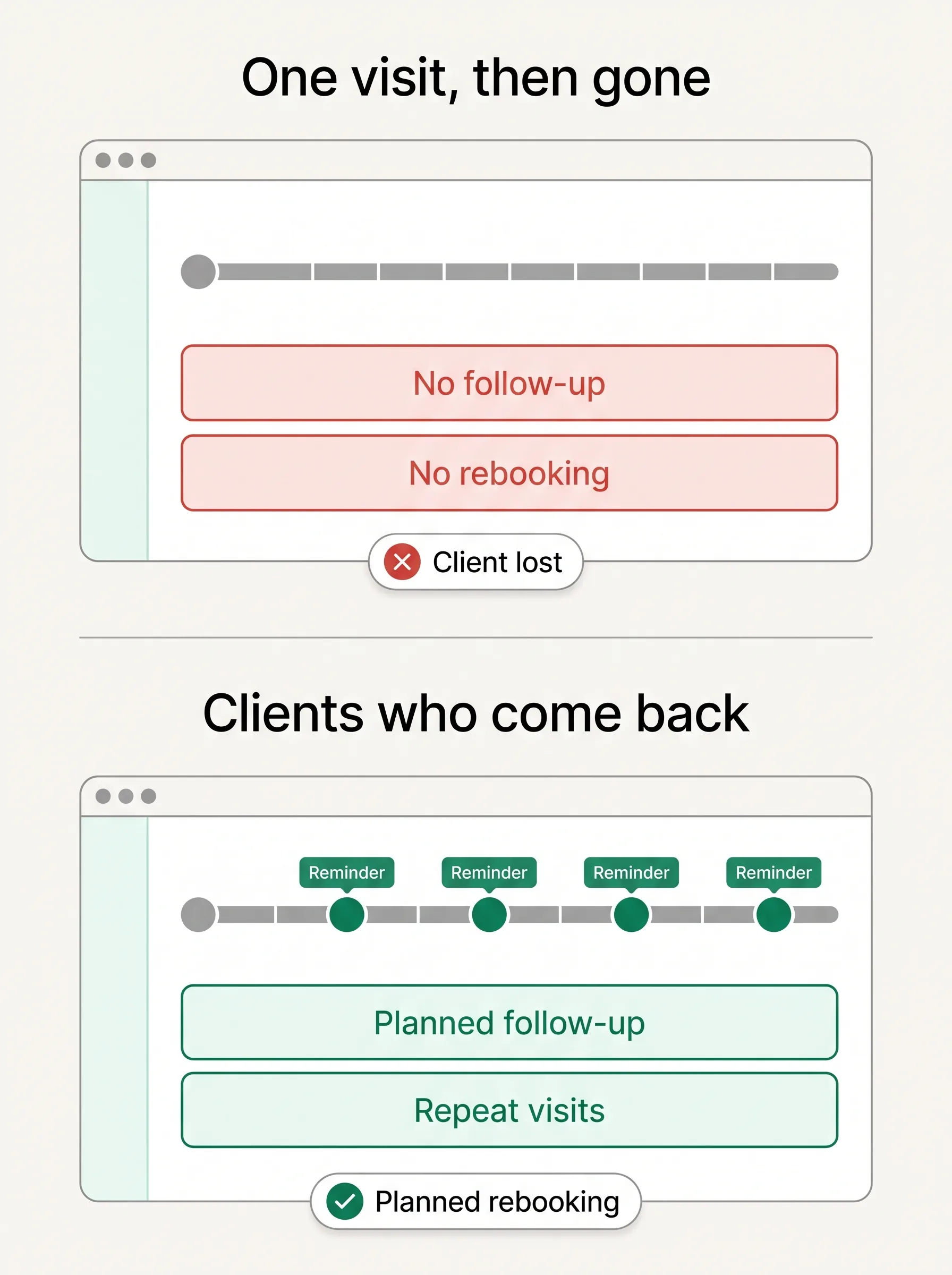
Local search, AI visibility, reviews, paid reach and the follow-up that brings clients back, all on accounts registered in your name from day one.

Your spa surfaces for the treatment searches that actually convert, Botox, filler, laser, body contouring, not only for your brand name. Including the AI answers that now shortlist providers by city.

Your reviews, your results and your pricing clarity answer the comparison before she calls. A chain can outspend you. It cannot be the local provider she trusts.

The work does not stop at the first booking. Reactivation, reviews and referral paths are built in, because the second and third visit are where a med spa actually makes money.
Most med spa owners hire an agency the way they hire a contractor: a referral, a slick deck, a confident call. That is how you end up twelve months later with a bigger Instagram following and the same empty Tuesdays.
Here is what to actually check before you sign anything.
Your Meta ad account, your Google Ads account, your Google Business listing, your website, your client email list. Ask whose name each one is in on day one. If the answer is the agency, you are renting your own visibility, and the audience data you paid to build leaves with them.
Meta restricts appearance and body targeting, and before and after imagery gets rejected or throttled constantly. An agency learning that on your budget will lose you two months. Ask them what they do when a treatment ad is disapproved, and listen for whether the answer sounds lived or rehearsed.
National chains outspend an independent spa on every treatment keyword. That does not mean you lose, it means you win differently: local intent, provider credibility, reviews, and the treatments the chain does not do well. An agency with no answer for this will simply bid against a company with fifty times your budget and hand you the invoice.
Paid ads can produce bookings within weeks. Honest local SEO takes six to twelve months to show. Anyone blurring the two is either confused or hoping you will not notice which lever produced what.
Before you sign, ask what happens to your ad accounts, your website files, your Google Business ownership, your reviews and your client list if you stop working together. If any of it stays behind, you were not building an asset. You were renting one.
Who legally owns your ad accounts, your Google Business listing and your client list today?
If the answer is the agency, you do not have a partner, you have a landlord. Ask before you sign, not when you try to leave. Someone who has paid that invoice and watched the budget vanish knows what that question is worth.
If Meta, Google or your client email list sits in the agency's name, they hold the audience you paid to build. Leave and you restart from zero, without the ad history or the client data.
New bookings are the easy half. If nobody is measuring how many clients came back for a second and third treatment, the agency is optimising the least profitable part of your business and calling it growth.
A real agency builds everything in your name, shows the raw platform spend with nothing marked up, publishes its price, and lets you walk away with every login and every contact intact.
I trained as a maxillofacial surgeon, moved into orthodontics, and co-founded a three-clinic group in Paris. I then spent time inside Publicis Health learning how medical marketing actually works at scale.
While running the clinics I hired an agency. I paid them more than 20,000 EUR over a year. They owned my Google and Meta ad accounts, not me. They spent a fraction of the budget, kept the rest, and delivered one patient, who came in for a cleaning, while I was selling orthodontic treatment. I only found out when I pulled the account myself and read the raw numbers.
That is why Forge exists. I read every audit personally. A specialist team runs the day to day. Every account we build stays in the client's name from the first day, because I know precisely what it costs when it does not.

Most med spa marketing agencies sit between $3,000 and $6,000 a month and will not show you that number until you are already on a call. Here it is upfront.
Starting price. No minimum-term commitment
Scope, fees and terms confirmed in a written proposal
Starts with a free diagnostic of your practice.
Treatment pages built to rank for the bookings you want more of
Local and AI search visibility against chains and franchises
Ads running in your own accounts, live within weeks
Review flow and reactivation so clients come back, not just in
Reporting that separates new clients from returning ones
Every account in your name from day one. Media spend is yours, paid direct to the platform, never marked up.
My team works to the deliverables and review process agreed in the written proposal. No minimum-term commitment. Scope, fees and terms are confirmed in writing. Search positions, patient or booking counts, revenue and a fixed results timeline are not guaranteed.
Practitioner exclusivity: one practitioner per city, with the specialty and territory confirmed in writing. Nationwide exclusivity may be considered for selected specialties.
The first 90 days
A free audit maps the treatment searches you are missing and the points where a client drops out. No call, no pitch, in your inbox within 24 hours, read by a physician.
Priorities are set by the treatments you actually want more of and the ones that bring clients back. You approve the plan before anything goes live.
Site rebuilt or corrected, treatment pages structured, local presence live, ads running in your own ad account, review flow switched on. Everything registered to you from day one.
Bookings reported by channel and by whether the client is new or coming back. Ad spend shown in full, nothing marked up. You see what moved and what comes next.
See how we approach Med spa SEO for your practice. It follows the same method as our medical SEO work. Read our healthcare marketing case studies to see the work and its limits.
A med spa marketing agency runs the channels that bring in treatment bookings and keep those clients coming back: local SEO, your Google Business Profile, paid search and social, review generation, and a website built to convert. The part that matters most, and that most agencies skip, is the retention work, because a med spa's profit lives in the second, fifth and tenth visit rather than the first.
Being busy and being findable are two different things. A spa can run at capacity on word of mouth and still be invisible to a stranger searching for laser hair removal in your city. Google ranks signals, treatment page relevance, review volume and recency, local data consistency and site authority, and none of those accumulate from having happy clients who never post about it.
Honest local SEO takes six to twelve months before it produces a steady flow of bookings, and paid ads can produce them within weeks. For most med spas the sensible order is ads first to fill the calendar while the organic foundation is built underneath, then a gradual shift as the free traffic takes over.
Managed med spa marketing starts at €1,200 per month at Forge for strategy, execution and reporting, with ad spend paid directly by you to the platform and never marked up. What you spend above that depends on how competitive your market is. The number that matters more is what a retained client is worth to you over three years, not what a first visit costs to acquire.
Yes, because Google ranks pages rather than websites, and someone searching for lip filler is not the same person as someone searching for CoolSculpting. A single treatments page splits your authority across everything and ranks for none of it. Separate pages also let you carry the pricing, downtime and expectation detail each treatment needs, which is exactly what turns a browser into a booking.
The most common mistake is buying new clients at full price every month while doing nothing to bring back the ones already treated. A discount promotion to a cold audience costs several times more than a well-timed message to someone whose filler is wearing off. Fix the retention layer first, then scale acquisition on top of it.
You do not beat a franchise on ad budget, you beat it on local intent, provider credibility and the treatments where their standardised model is weak. That means owning the map results in your immediate area, building a review profile no chain location can match, and being specific where their pages are generic. An agency that just bids against them on the same keywords will spend your budget losing an auction.
Reviews are both a direct ranking factor in the local map results and the deciding signal in a category where clients are choosing who to trust with their face. Volume and recency both matter, so a spa with two hundred reviews from three years ago is weaker than one with sixty from this quarter. A steady review flow is a traffic strategy, not just a reputation exercise.
Publishing prices filters out the people who were never going to book and builds trust with the ones who were, and it matches how clients actually search, since treatment plus price is one of the most common query patterns in this category. The risk of being undercut is real but usually overstated, because the client comparing purely on price was rarely going to be a retained client anyway.
Confirm that every account, your ad accounts, your Google Business Profile, your analytics, your website and your client list, sits in your name from day one rather than the agency's. Ask to see raw platform spend rather than a dashboard, ask how their reporting separates new from returning clients, and ask what happens to everything if you leave.
The free Forge Visibility Snapshot shows which treatment searches you are missing, where clients drop out, and what to fix first. No call, no pitch, read by a physician.
.svg)