
A five-star average built on reviews from three years ago barely registers with today's patients. What actually shifts a shortlist is how recently you were reviewed and how fast you respond when something goes wrong, not a bigger overall number.

A four-month gap in reviews costs you the shortlist before a patient reads your bio.
Patients scanning Google check your star average and how recently reviews arrived, not how many you have in total. A silent stretch of a few months reads as a practice that has gone quiet, and the patient moves on to whoever looks busier.
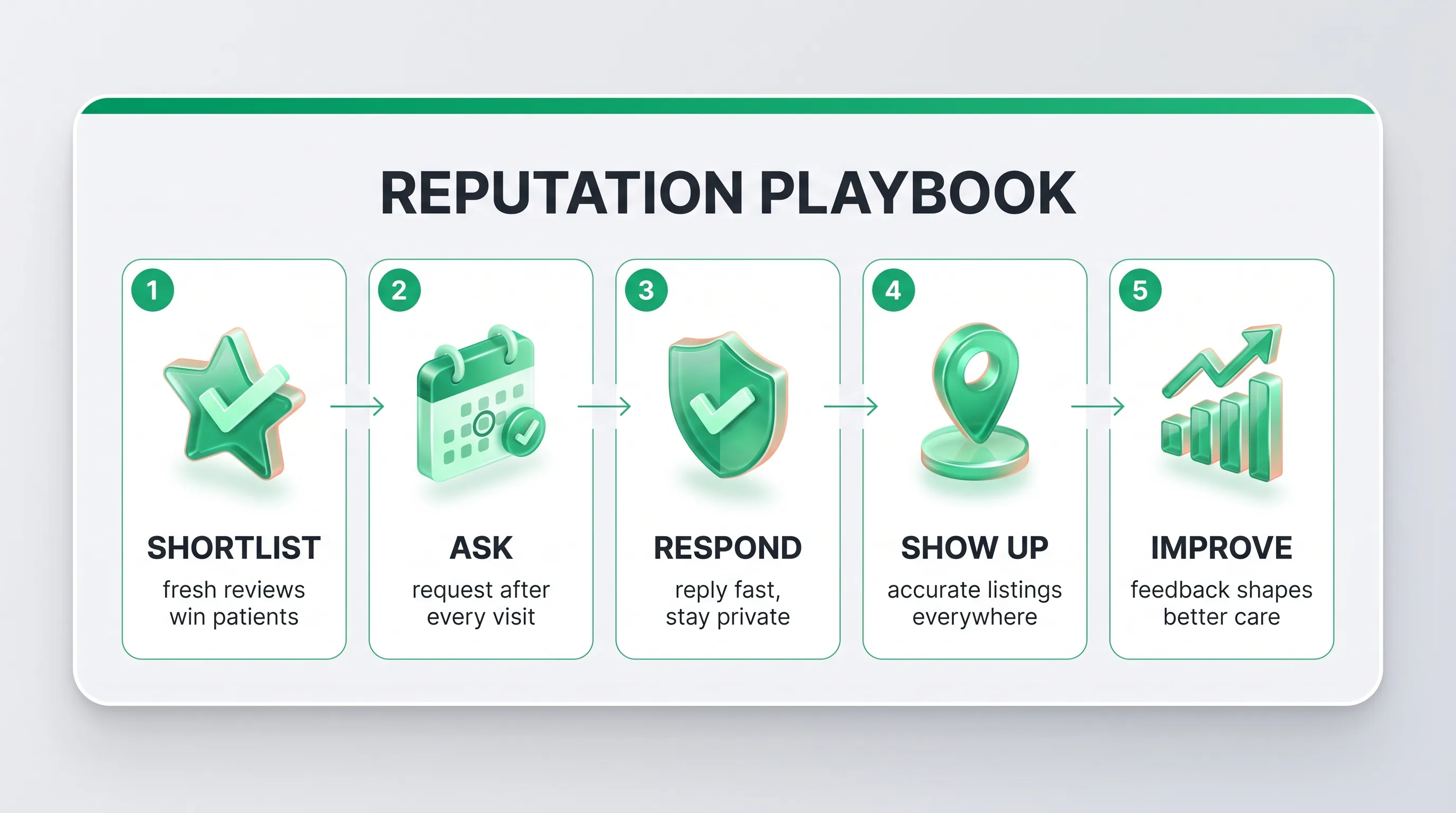
A patient comparing three practices on Google does not read every review. They scan the star average, count how many reviews appeared in the last few weeks, and move on. A practice with 200 reviews accumulated over six years but nothing posted in four months reads as stale, even if the clinical work is excellent. Recency signals activity, and activity signals a practice worth trusting with a booking.
This is where which dental growth priorities come first becomes a real decision: if your review volume has flatlined, no amount of website polish compensates when a prospective patient is scrolling that shortlist. Star rating and recent volume are the first filter, before your bio, before your photos, before your fee guide. A clear dental SEO strategy helps sequence that work so reputation and search efforts reinforce each other instead of competing for budget.
Not every appointment carries equal persuasion weight in the review a patient eventually writes. Patients who complete a course of Invisalign, receive a full-arch implant restoration, or finish an in-chair whitening series have a clear before-and-after to describe. That contrast produces detailed, specific reviews that carry real persuasion weight for the next patient weighing the same procedure. Routine scale-and-polish visits generate shorter reviews, but they generate them consistently because the volume of those appointments is high.
Dental reputation management works best when you match the ask to the moment: high-emotion completions for detailed narrative reviews, high-frequency hygiene visits for steady volume. Both matter, and neither replaces the other.
Hygiene appointments end with a clean mouth and a six-month recall card, not a dramatic clinical result. The patient left comfortable, which is exactly the sentiment worth capturing: easy, professional, no surprises. Your ask at checkout should reflect that. A simple verbal prompt from the hygienist, followed by a text message with a direct review link sent the same afternoon, matches the emotional temperature of the visit. The friction has to be near zero, because there is no strong feeling pushing the patient to write unprompted.
Crown and filling appointments carry a different register. The patient came in anxious, possibly after a delay, and left with a working tooth. That relief is a story. Here the ask lands better in a follow-up text the next morning, once any post-anaesthetic soreness has settled and the relief has had time to land. Asking at checkout, while the patient is still numb and gathering their coat, misses the window entirely.
A patient who has just had their Invisalign refiners delivered, or who saw their implant crown seated for the first time, is at the highest emotional peak they will reach in your chair. That moment passes quickly. If your review request arrives two weeks later, buried under other notifications, you are asking them to reconstruct a feeling that has already faded into ordinary life.
For cosmetic and implant completions, the ask belongs at the appointment itself: a verbal mention from you or your nurse, followed immediately by a text with a one-tap link before they reach their car. Invisalign patients have a slightly longer window because they share progress photos socially and stay emotionally engaged through treatment. A well-timed ask at the point of completing active treatment, not at retainer delivery, catches them while the transformation still feels new.
These cases also produce the reviews that carry the most weight for the next patient researching the same procedure. A specific account of what the implant process actually felt like, written by a real patient, does more to move a treatment plan signature than any before-and-after photo you post yourself. Building that flow deliberately is a core part of dental reputation management that too many offices leave to chance.
An emergency patient who walked in with acute pulpitis and left with a temporary dressing is not ready to write a thoughtful review at the front desk. They are relieved, possibly still shaky, and focused on getting home. Asking in that moment, or within an hour of leaving, produces either silence or a short, low-effort response that undersells the care they actually received.
Wait 48 to 72 hours. By then, the pain has gone, the patient has eaten a meal without wincing, and the gratitude is clear. A brief, personal text acknowledging the tough visit and asking how they are feeling opens a conversation. Most will reply positively, and a follow-on review request in that exchange lands as natural rather than transactional. Patients who came to you in genuine distress and left pain-free are among the most loyal reviewers you will ever have. The only mistake is asking too soon.
Every public response you write is read by people who are not the reviewer. They are prospective patients deciding whether your practice handles difficulty with professionalism. The moment a reply confirms that someone is a patient, or references any treatment detail, you have crossed into territory that privacy law in most jurisdictions explicitly prohibits, and more practically, you have handed a worried reader a reason to choose someone else.
The discipline is straightforward: thank the reviewer for their feedback, acknowledge that experiences like theirs matter to you, and invite them to contact the practice directly to resolve the concern. No clinical specifics. No confirmation of an appointment date. No defensive explanation of what the procedure involved. That information belongs in a private call, not a public thread.
A one-star review describing a billing dispute or a painful injection sits on your profile until you respond, and every prospective patient reading it is also reading your reply. Silence reads as indifference. A defensive reply reads as confirmation that the reviewer's frustration was justified. A calm, short response that names a specific person or direct line for the patient to contact closes the public loop without escalating it.
The goal of the public reply is not to win the argument. It is to demonstrate, to the silent majority reading it, that your practice takes concerns seriously and resolves them privately. That single well-handled negative review often builds more confidence than five generic positives sitting beside it.
Before a patient clicks your website link, they have already seen your star rating, your photo carousel, your hours, and how recently someone reviewed you, all inside the Google results page. Your Google Business Profile loads faster than your website, sits above organic results for branded searches, and shows the information a patient needs to decide whether to call. If that profile has outdated hours, no response to reviews, or photos that look like they were taken in 2018, the first impression is set before you get a chance to make a second one.
Claim and verify the profile if you have not. Add current photos of the clinical space and team. Set hours that match what a patient will hear when they call. Check the Q&A section: patients post questions there, and unanswered ones read as neglect.
A patient who finds your Healthgrades profile with a different phone number than your Google listing does not wonder which is correct. They move to the next practice. Consistency across directories is not a technical nicety; it is the difference between a call you receive and one that goes elsewhere.
Beyond NAP accuracy (name, address, phone), each directory has its own patient population. Yelp skews toward patients already comparison-shopping cosmetic and elective treatments. Healthgrades attracts patients who want clinical credentials and insurance acceptance confirmed before they contact you. Matching your service descriptions and accepted plans to what each platform's audience is actually checking removes a friction point that silently costs you appointments.
Ranking well in local search and converting that visibility into booked appointments are two separate problems. A practice can appear in the top three map results and still lose the shortlist comparison because the review profile shows a 3.8 average with no recent activity. The patient clicked, assessed, and left. The search work brought them to the door; the reputation profile decided whether they knocked. Strengthening local SEO for dentists increases how many patients reach that comparison stage in the first place.
If you are already investing in the search side of this work, understanding how review strength affects local search performance is worth reading before you separate the two budgets, because Google's ranking signals treat review recency and volume as active inputs, not passive decoration.
Your practice management reports show appointment volume and treatment acceptance. They do not show that three patients in the last month mentioned a 25-minute wait past their scheduled time, or that two reviewers described feeling rushed through a treatment explanation they did not fully follow. Reviews capture the patient's subjective experience at a level of detail that internal reporting rarely reaches.
Read your last 30 reviews as a set, not one by one. Group the language: what words repeat? If "wait" appears six times and "rushed" appears four times, you have a scheduling or handoff problem that no clinical upgrade will fix. That signal arrives free, unsolicited, and more candid than anything a post-visit survey typically returns, because the patient is writing for a public audience rather than completing a checkbox form they know you commissioned.
Velocity is the number of new reviews per month. If that number drops two months running, something upstream changed: a team member stopped asking, a follow-up SMS stopped sending, or a new booking system broke the post-appointment trigger. You will not catch it by checking your star average, because averages move slowly and mask the underlying flow problem.
Set a monthly check: count new reviews by platform, note the average across platforms, and compare new patient bookings against where those patients said they found you. When those three numbers move together, you are seeing your reputation program working in real time. When they diverge, you can isolate whether the shortfall is in review generation, platform visibility, or conversion once the patient lands on your profile. Tracking them separately is what makes the difference diagnosable rather than just disappointing.
Software that sends automatic post-appointment review requests can meaningfully lift volume, but it creates a false sense of progress if nobody owns what happens next. An automated request that fires for every appointment type regardless of visit context (including the emergency patient still in recovery, or the patient who left a complaint at checkout) does more harm than a manual ask done thoughtfully.
Before activating any automation, map three things: which appointment types trigger a request, who receives flagged negative replies, and which team member reviews the monthly numbers. Without clear routing and ownership, the tool runs quietly and the practice assumes the work is done. Dental reputation management is not a set-and-forget system; it is a practice habit that automation supports, not replaces.
Open your Google Business Profile today and count how many reviews arrived in the last 30 days.
We review your pages, search visibility and enquiry path, then show you what to fix first.
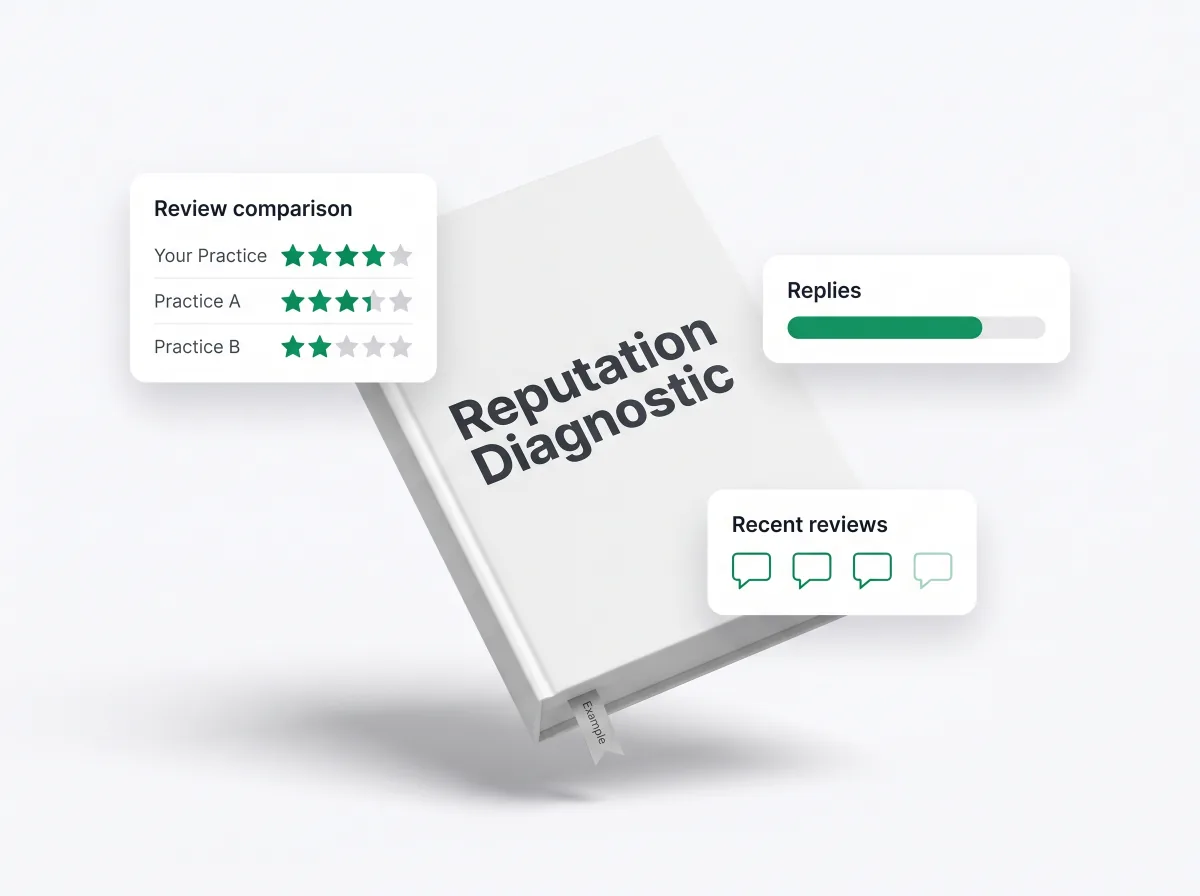
You have read how reviews shape which practice a patient calls first. We compare your Google profile with the practices patients also consider near you.
.svg)