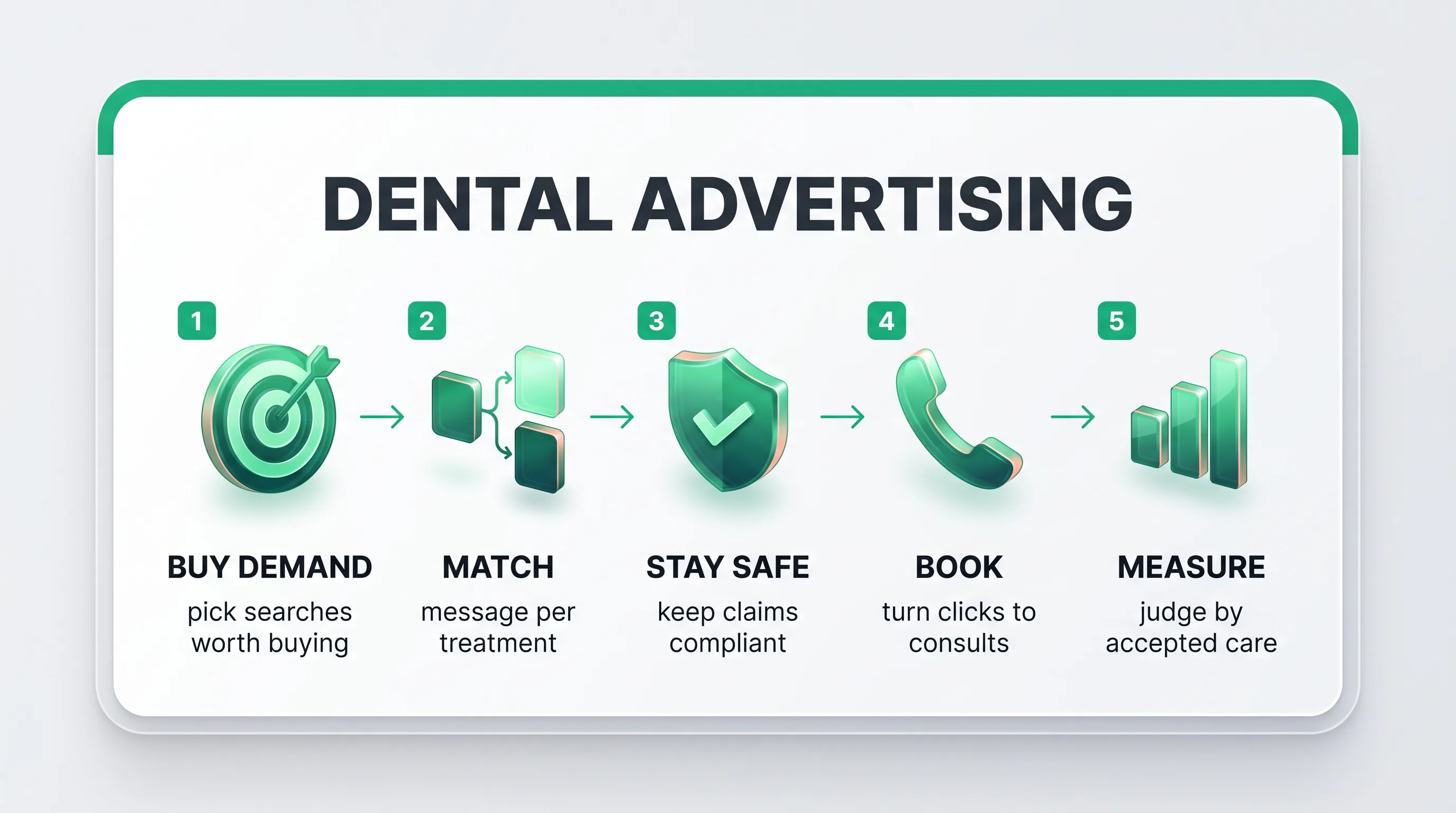
Choose the dental demand worth buying
Emergency exams and tooth pain searches need speed, not broad brand copy
A patient with a cracked molar at 7am is not comparing practices. She is calling the first number that answers. Emergency and acute pain searches convert on immediacy: same-day availability, a phone number that rings to a person, and a landing page that confirms you take walk-ins. Broad brand messaging about your philosophy of care lands flat in that moment. The ad headline should name the symptom and the solution in five words or fewer. The landing page should open on hours, address, and a click-to-call button before anything else. If your front desk cannot answer within two rings during peak search hours, the click you paid for walks to the next result. Speed is the product here, not storytelling.
Single implant, full arch, and Invisalign inquiries carry very different consult burdens
A single-implant inquiry usually means one missing tooth, a patient who has already been told implants are an option, and a consult that ends in a clear yes or a referral. Full-arch inquiries arrive with more complexity: missing records, prior denture history, bone density questions, and a patient who may have visited two or three other practices before calling you. Invisalign inquiries often come from patients comparing treatment length and the weekly chair time that clear aligner adjustments require against fixed brackets. These are not the same consult, and they should not run in the same campaign. Segmenting them lets you write copy that matches where each patient actually sits in their decision. Understanding which dental service lines to prioritize shapes which of these segments deserves budget first, because spreading spend equally across all three almost always under-serves the line your chair time most needs to fill.
A quick source and case mix pull shows whether ads should fill openings or support a new service line
Before any dental advertising budget moves, pull two numbers from your practice management system: where your last three months of new patients came from, and which treatment types they accepted. If your schedule carries plenty of hygiene recalls but the implant chair sits quiet two afternoons a week, paid search aimed at single-implant searches addresses a real gap. If you recently added a cone beam CT and want to grow full-arch volume, the case for a separate campaign is different from simply filling empty hygiene slots. This pull takes twenty minutes and it tells you whether ads are a demand problem or a capacity problem. Spending on awareness when the real issue is that existing inquiries do not convert is a diagnostic you want to run before any agency conversation, not after.
Match campaigns to real treatment decisions
Same day crown, root canal, and extraction searches need tighter next steps than general dentist ads
A patient searching for a same-day crown has already decided on the treatment. What she has not decided is which practice she can reach before her lunch hour ends. The ad and landing page for that search should confirm in-house milling capability, list same-day appointment availability, and present a booking form with no more than three fields. Root canal and extraction searches carry similar urgency but a different fear: these patients want reassurance that the procedure will not hurt more than the tooth already does. Sedation options and clear aftercare language belong on those landing pages. General dentist ads that serve all of these searches with one page lose the patient who needed a specific answer and got a brochure instead.
Veneers, whitening, and smile makeover ads should not promise the same outcome or timeline
Porcelain veneers require tooth preparation, shade matching, temporaries, and at minimum two appointments separated by a lab turnaround. Whitening, whether in-office or take-home, produces a result in one visit or a few weeks. A smile makeover involves treatment planning across multiple procedures and often a longer timeline depending on whether ortho or restorative work precedes the cosmetic stage. Ads that fold these three into a single "smile transformation" campaign create mismatched expectations before the patient arrives. Separate the messaging. Veneer ads should name the consultation step and set a realistic timeline. Whitening ads can speak to speed. Smile makeover copy should flag that a consult is the first step and a plan comes second. Patients who arrive with accurate expectations sign treatment plans at a measurably higher rate than those who arrive surprised.
Keep ad claims clinically safe
Credentials, specialist titles, and technology claims must say exactly what care you provide
If your practice includes a periodontist, the ad may say so. If it does not, "specialist care" in the headline creates a claim your credentials cannot support, and state dental board rules in most US jurisdictions treat that as misleading. Technology claims carry the same risk. "Laser dentistry" is fine if you use a dental laser for soft tissue work. "Pain-free dentistry" is a promise about a patient's subjective experience, and that promise can generate a complaint if one patient disagrees. Name the technology and what it does clinically ("soft tissue laser reduces healing time" clears the bar; "revolutionary laser technology" does not). The safest copy describes what you actually provide, not what you hope the patient will feel.
Before and after photos, financing language, and fee offers need clear limits and disclosures
Before and after images in dental advertising must represent actual patients from your own practice, must not be digitally altered beyond basic color correction, and should carry a disclosure that results vary. Most state dental boards and the ASA in the UK hold this standard consistently. Financing language is a second compliance point: "as low as X per month" requires the full APR, the term length, and qualifying conditions in the same ad or on the linked page, not buried in footer text. Fee offers tied to new patient exams need an expiry date and a statement of what is included. Leaving any of these disclosures out does not make the ad shorter; it makes it challengeable.
Turn clicks into booked consults
An implant inquiry submitted through a web form at 11am should reach someone with booking authority within the hour. If your form routes to a general inbox checked twice daily, the patient who submitted it has called another practice by the time anyone replies. Emergency calls routed to voicemail during lunch drop off entirely. Map your current call and form routing before you spend on ads: identify who picks up, when, and what they say when an implant inquiry comes in cold. If the answer is "whoever is at the front desk" without a script or a booking protocol, that is the first problem to solve. Paid traffic amplifies whatever your intake process already does, good or broken.
Sedation, insurance, and candidacy details belong only where they help the right patient book
Sedation options on an implant landing page serve a real purpose: many implant patients have deferred treatment for years because they are anxious about the surgical phase. A single clear sentence noting that IV sedation or oral sedation is available removes a barrier that would otherwise surface only at the consult. Insurance details work differently. A landing page that lists thirty accepted plans before explaining what the treatment involves buries the clinical message under an administrative one. State insurance acceptance where patients are most likely to hesitate, typically near the booking form, not in the opening paragraph. Candidacy details (bone volume, medical history, smoking) belong in a brief FAQ or a pre-consult page, not in the ad itself, where they narrow your audience before a trained clinician has assessed the case.
A patient who clicks a same-day crown ad and lands on a page that lists Saturday hygiene appointments but no crown availability on that day cancels the booking mentally before she hits the back button. Treatment-specific pages need to reflect the actual schedule: if milling runs Monday through Thursday, say so. If implant consults require a specific provider who works three days a week, the page should set that expectation. Mismatches between ad promise and page reality are the most common reason a well-funded dental advertising campaign produces clicks without consults. If your treatment pages are not yet built out to that level of specificity, the question of when a treatment needs its own organic page is worth settling before you drive paid traffic to a general services page. Working out a dental SEO strategy that sequences which pages get built first can prevent this mismatch before it costs bookings.
Choose ad channels by how the patient decides
Search advertising captures demand that already exists. Social advertising builds interest in elective work a patient has been postponing. Print and direct mail buy geographic precision and nothing else. Matching the channel to the way the decision actually gets made keeps spend off audiences who were never going to book the treatment being promoted.
Search is the floor for anything urgent or already decided: pain, a broken tooth, a replacement crown, a patient who has finished researching implants and wants a consult. It reaches intent at its peak, but it cannot manufacture demand where nobody is searching. Effective dental search engine marketing concentrates spend on these high-intent searches rather than spreading it across audiences with no immediate need.
Social does the opposite. A patient scrolling in the evening is not looking for a dentist, so the ad has to show a possibility first — a correction, an outcome, an option she did not know applied to her. Retargeting then carries her back when she is ready. That pattern suits aesthetic and elective care with long decision windows.
| Channel | Works hardest for | Main limitation |
|---|
| Search | Emergency, urgent restorative, ready-to-book consults | Capped by existing search volume |
| Social | Veneers, whitening, Invisalign, full arch awareness | Longer path from view to booking |
| Print and mail | New location launches, tight catchment areas | No cheap testing, no retargeting |
If mail runs alongside digital, give every piece its own phone number or landing URL. Without that, mail response quietly gets credited to whichever digital campaign happened to be live, and both budgets get judged on the wrong numbers.
Build each ad around one service, one patient, one next step
An ad that lists every service asks the reader to sort themselves. Most will not. A dental ad that converts names one procedure, speaks to one kind of patient, and offers one action. Everything else — the philosophy of care, the full service menu, the team page — belongs somewhere other than the ad.
The offer sits inside that same discipline. A complimentary consultation for high-value elective treatment is not a discount; it removes the risk of showing up without knowing what the work involves or whether the practitioner is a fit. Offers that pull tend to be specific and time-bounded, tied to one procedure and one season. Open-ended deals all year signals that nothing in particular is being offered.
Proof works the same way. Specificity is what makes a first visit feel safe:
- One attributed patient comment that names a real fear does more than a star rating
- Before-and-after imagery should be consented, unedited, and representative of typical work
- Show the practitioner who will actually do the treatment being advertised
Then close the gap between promise and destination. If the ad offers a smile assessment, the page it opens should repeat that offer in the headline, strip out unrelated navigation, and make booking the only obvious action. Sending elective ad traffic to a general homepage wastes the click after it has already been paid for.
Front desk alignment finishes the chain. When a caller says she saw the promotion, the team should know which promotion, what it includes, and how to book it without transferring her.
Judge ads by accepted care
Clicks and impressions tell you nothing a practitioner needs to know. The chain that matters runs from first contact to accepted treatment plan, and every break in that chain has a cause you can find. Calls that do not convert to booked consults usually mean a front desk intake problem or a mismatch between what the ad promised and what the caller was told. Booked consults that do not convert to accepted treatment usually mean the case presentation missed something the patient needed to hear, or the treatment plan arrived before the patient's question was answered. Track each stage separately, by service line. An emergency campaign and a full-arch campaign failing at different points in the same chain need different fixes, and aggregating them into a single "conversion rate" hides both problems.
Emergency, Invisalign, and full arch campaigns should be reviewed on different windows
Emergency campaigns produce bookings within days or they do not work. If a week of live emergency ads produces no calls, the problem is in the ad, the landing page, or the call routing, and it needs attention now, not at the monthly review. Invisalign campaigns operate on a longer patient decision cycle: a patient who clicks today may book a consult two or three weeks later after comparing options. Reviewing Invisalign ad performance at the two-week mark will misread the data and lead to premature changes. Full-arch campaigns run longer still because the patient's path from first inquiry to an accepted case often spans multiple consults. Setting the review window to match the treatment's natural decision pace keeps you from killing a campaign that was working.
A simple monthly report should show source, case type, show rate, and treatment acceptance
Four columns cover what a practice owner actually needs to evaluate paid dental advertising: where the patient came from, what treatment they inquired about, whether they showed for the consult, and whether they accepted a treatment plan. Show rate is the number practices most often skip, and the one they most need. A full-arch campaign with a strong booking rate but a forty percent no-show rate is not a marketing success; it is a scheduling problem that no amount of ad spend corrects. Treatment acceptance by source tells you whether the patients your ads attract are arriving informed enough to commit, or whether something in the ad copy is creating a gap between expectation and consultation reality. Pull those four numbers by service line at the end of each month and the next budget decision makes itself.
Open your practice management system now and count last month's full-arch consults against how many actually became paying patients, by source.