Every account stays in your name, not ours. Built by a physician who signed the invoice and got burned. From €1,200 a month, published here before you talk to anyone.

For twenty years the model worked. Primary care sent you the knees, the physios sent you the shoulders, and the phone rang without anyone in the practice thinking about marketing.
Then the hospital system bought the primary care groups, and those referrals started going to the employed surgeon inside the network. Nothing about your outcomes changed. The pipe just got redirected upstream, quietly, one acquisition at a time.
What is left is the patient who searches for themselves. She types her symptom, reads three surgeons, checks the reviews, and books directly. That patient is now the growth channel, and most orthopedic practices are invisible to her.
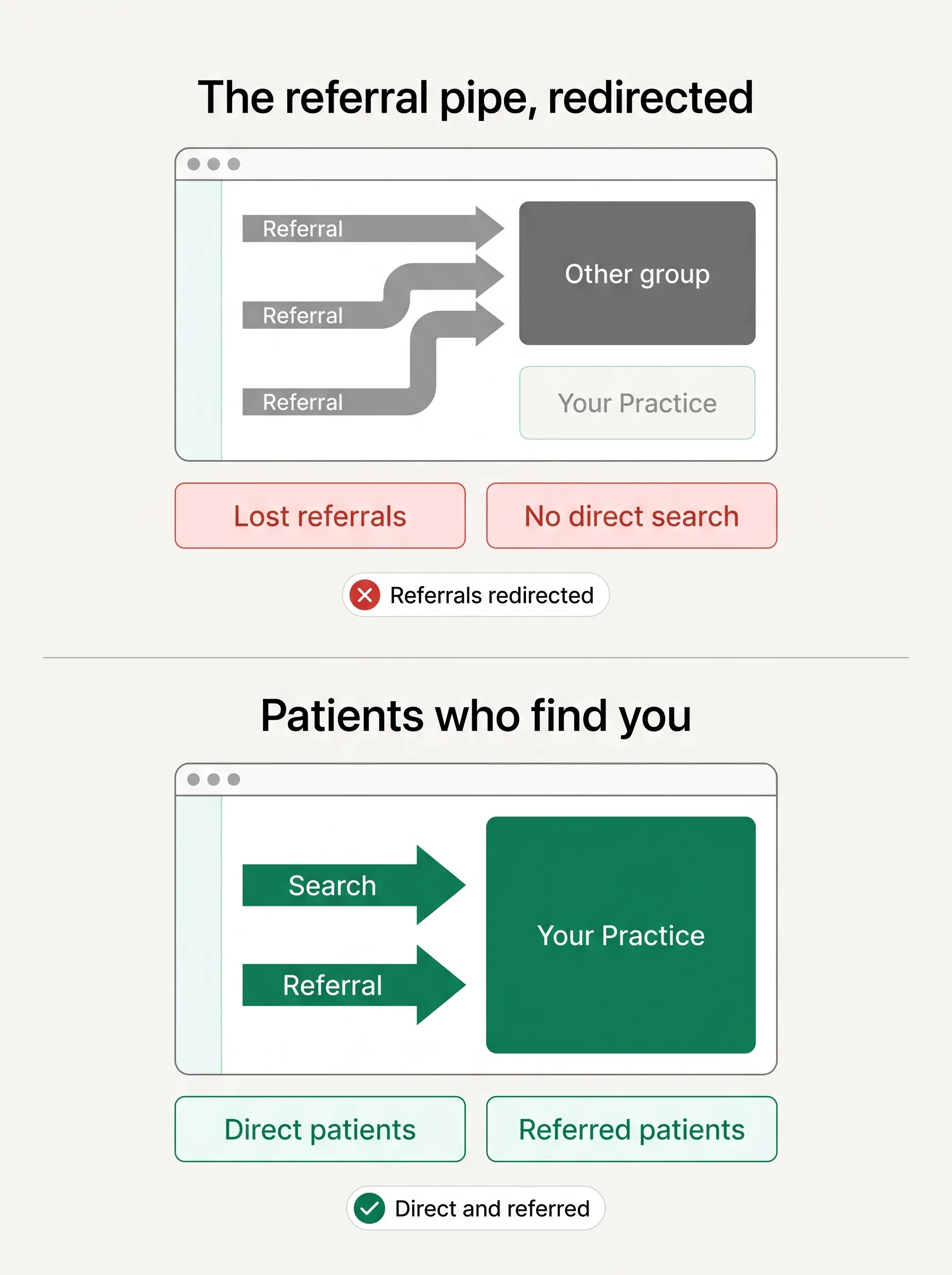
Local search, AI visibility, reviews and paid reach, built on accounts registered in your name from day one, aimed at the patient who refers herself.

Your practice surfaces for the symptom and procedure searches that lead to surgery, knee replacement, rotator cuff, hand, spine, sports injury, not just the practice name.

Your outcomes, your subspecialty focus and your reviews answer the comparison a hospital brand cannot personalise. A network has scale. It does not have your name on the operation.

The site is built to move a symptom search toward the right consult, and every enquiry is tracked to the channel that produced it rather than disappearing into a call log.
Most orthopedic groups hire an agency the way they hire a vendor: a referral, a corporate-looking deck, a confident call. Twelve months later the site looks cleaner, the referral volume is still falling, and nobody can tell you what the money bought.
Here is what to actually check before you sign anything.
Your Google Ads account, your Meta account, your Google Business listing, your website hosting, and each surgeon's individual profile. Ask whose name each one is in on day one. If the answer is the agency, your visibility is rented, and the ad history and review record you paid to build leave with them.
Most self-referred patients do not search for a total knee arthroplasty. They search for knee pain when climbing stairs. An agency that only targets procedure keywords is fishing at the end of the funnel and paying the highest possible price for it, while ignoring the searches that start the journey months earlier.
You are competing against systems that own the referral pipeline and outspend you on brand. That is not a bidding contest you win. It is won on subspecialty depth, individual surgeon credibility, local intent and direct booking. An agency without a specific answer here is planning to lose an auction with your budget.
Before you sign, ask what happens to your ad accounts, your website files, your Google Business ownership, your reviews and your surgeon profiles if you stop working together. If any of it stays behind, you were not building an asset. You were renting one.
Who legally owns your ad accounts, your Google Business listing and your website files today?
If the answer is the agency, you do not have a partner, you have a landlord. Ask before you sign, not when you try to leave. Someone who has paid that invoice and watched the budget vanish knows what that question is worth.
If Google, Meta or your website login sits in the agency's name, they hold your visibility. Leave and you restart from zero, without the ad history or the review record you paid to build.
Patients search a procedure and then choose a person. A group site with no real individual surgeon pages loses the final comparison to whoever put a name, a subspecialty and a review count in front of the patient.
A real agency builds everything in your name, shows the raw platform spend with nothing marked up, publishes its price, and lets you walk away with every login intact.
I trained as a maxillofacial surgeon, moved into orthodontics, and co-founded a three-clinic group in Paris. I then spent time inside Publicis Health learning how medical marketing actually works at scale.
While running the clinics I hired an agency. I paid them more than 20,000 EUR over a year. They owned my Google and Meta ad accounts, not me. They spent a fraction of the budget, kept the rest, and delivered one patient, who came in for a cleaning, while I was selling orthodontic treatment. I only found out when I pulled the account myself and read the raw numbers.
That is why Forge exists. I read every audit personally. A specialist team runs the day to day. Every account we build stays in the client's name from the first day, because I know precisely what it costs when it does not.

Most orthopedic marketing agencies sit between $3,000 and $6,000 a month and will not show you that number until you are already on a call. Here it is upfront.
Starting price. No minimum-term commitment
Scope, fees and terms confirmed in a written proposal
Starts with a free diagnostic of your practice.
Condition, procedure and surgeon pages built to rank separately
Symptom-stage content, not only the expensive procedure terms
Ads running in your own accounts, live within weeks
A direct channel that survives a referral network changing hands
Reporting by procedure and by surgeon, not just lead count
Every account in your name from day one. Media spend is yours, paid direct to the platform, never marked up.
My team works to the deliverables and review process agreed in the written proposal. No minimum-term commitment. Scope, fees and terms are confirmed in writing. Search positions, patient or booking counts, revenue and a fixed results timeline are not guaranteed.
Practitioner exclusivity: one practitioner per city, with the specialty and territory confirmed in writing. Nationwide exclusivity may be considered for selected specialties.
The first 90 days
A free audit maps the procedure and symptom searches you are missing and who is taking them locally. No call, no pitch, in your inbox within 24 hours, read by a physician.
Priorities are set by the cases each surgeon wants more of, with individual visibility planned alongside the group. You approve it before anything goes live.
Site rebuilt or corrected, condition and surgeon pages structured, local presence live, ads running in your own ad account. Everything registered to you from day one.
Enquiries reported by procedure and by surgeon. Ad spend shown in full, nothing marked up. You see what moved and what comes next.
See how we approach Orthopedic SEO for your practice. It follows the same method as our medical SEO work. Read our healthcare marketing case studies to see the work and its limits.
An orthopedic marketing agency builds the channel that does not depend on referrals: local SEO, procedure and symptom content, your Google Business Profile, individual surgeon visibility, reviews and paid search, all pointed at the patient who researches and books directly. In a market where hospital systems are buying the referral network, that direct channel is what keeps the surgical schedule under your control.
Because referral volume is an asset you do not own. When a hospital system acquires the primary care groups that send you patients, those referrals move to the employed surgeon inside the network, and nothing about your results changed. The practices that come through that transition are the ones that already had a direct-to-patient channel running before the pipe narrowed.
Both, on separate ground. Patients search for a procedure or a symptom, then choose a specific surgeon, so the group needs to rank for the clinical terms while each surgeon has a real page carrying subspecialty focus, training and reviews. A site that hides individual surgeons behind one brand loses the final comparison, which is the moment that actually decides where the case goes.
Honest local and condition-level SEO takes six to twelve months before it produces a steady flow of self-referred consults, while paid search can produce enquiries within weeks. For a practice watching referrals decline, the usual sequence is paid first to prove the channel exists, with the organic foundation built underneath so the cost per consult falls over time.
Managed orthopedic marketing starts at €1,200 per month at Forge for strategy, execution and reporting, with ad spend paid directly by you to the platform and never marked up. What sits above that depends on the number of surgeons and subspecialties you are making visible. The useful comparison is not the fee but the contribution of one additional surgical case per month.
Not on brand spend, which you will lose, but on subspecialty depth, individual surgeon credibility and local intent. A hospital system markets a name; a patient chooses a person who will operate on their knee. Owning the map results in your immediate area, publishing genuine content on the specific conditions you treat, and making each surgeon findable by name and specialty is ground a system's centralised marketing rarely covers well.
Both, at different stages. Procedure searches convert fastest but are the most expensive and the most contested, while symptom searches are where the patient actually begins, often months before surgery is on the table. A practice that only targets procedure terms is paying top price at the end of the funnel and ignoring the part where the relationship is won.
Reviews are a direct ranking factor in the local map results and the deciding signal for a patient choosing who will perform an operation on them. Volume and recency both count, and individual surgeon reviews matter as much as the practice profile because the choice is personal. A thin or dated review record quietly removes you from consideration before any consult happens.
AI assistants now name a small number of surgeons when asked who treats a specific condition in a city, drawing on structured content, review signals and content depth rather than page rank alone. Practices with thin sites and no condition-level content are omitted entirely. That matters especially in orthopedics, where patients often describe a symptom in plain language rather than naming a procedure.
Confirm that every account, your ad accounts, your Google Business Profile, your analytics, your website files and each surgeon's profile, sits in your name from day one rather than the agency's. Ask how they handle group and individual surgeon visibility together, ask whether they target symptom searches or only procedures, and ask what happens to everything if you leave.
The free Forge Visibility Snapshot shows which procedure and symptom searches you are missing, and who is taking them in your area. No call, no pitch, read by a physician.
.svg)