

She closed your tab in seconds because the booking path was buried.
A parent weighing her options once the house is finally quiet needs your age range, accepted insurance, and how to book before she scrolls once on her phone. When your site comes up first but those answers are hidden, she books the practice whose page gave them to her immediately.
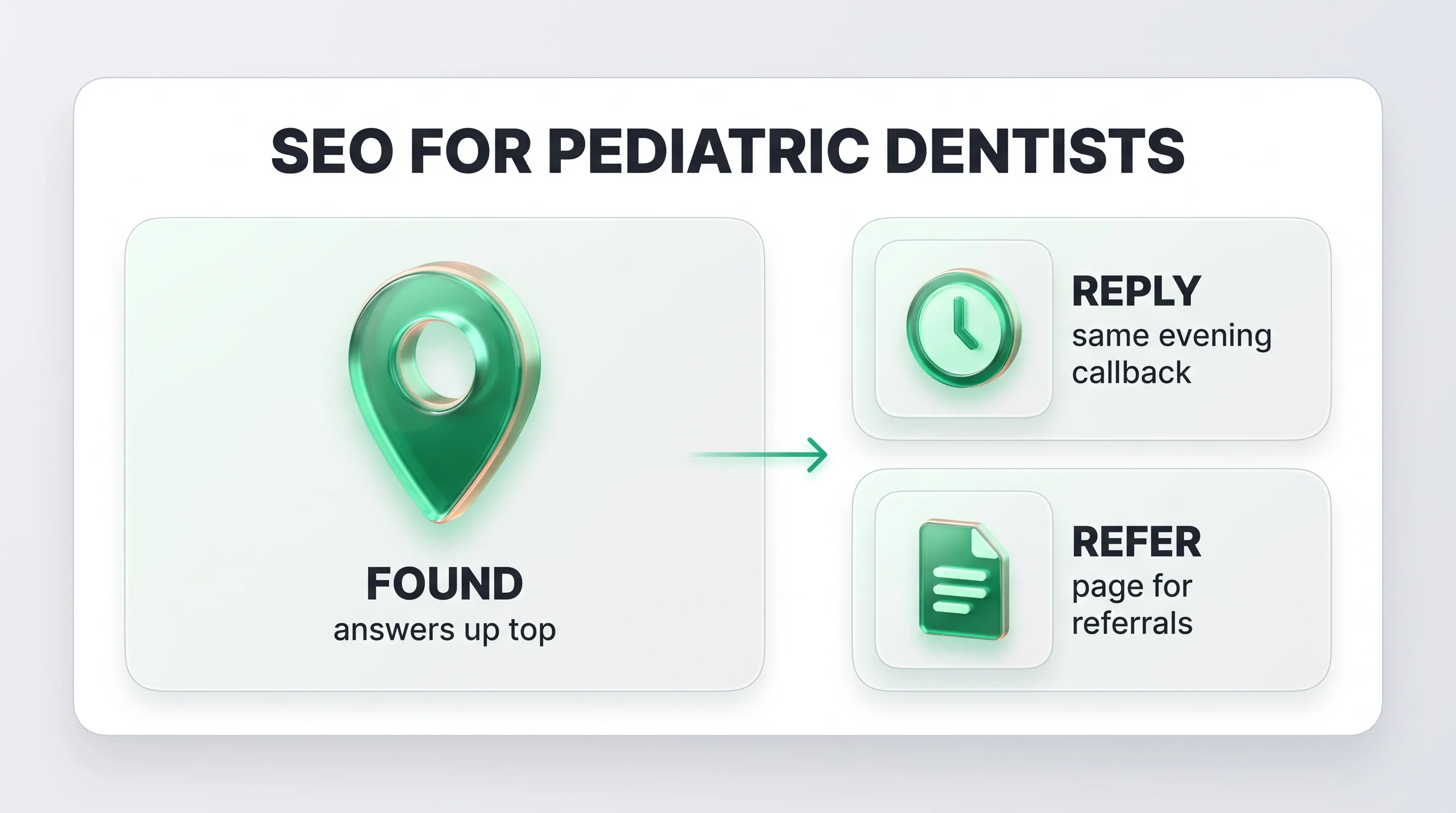
A parent opens her phone during her toddler's nap time, his first birthday just passed, and the pediatrician said it was time for a dental visit. She searches, lands on your site, and within eight seconds she needs to know: do you see children this young, where are you, and how do you book. If those answers are buried, she closes the tab. Dental SEO for a pediatric practice lives or dies on that eight-second test. Your homepage and service pages need age range, accepted payers, appointment hours, and a booking path visible without scrolling on a phone screen.
A page titled "Our Services" answers no parent's real question. A page titled "First Dental Visit for Babies and Toddlers" answers exactly what a parent types after the pediatrician's referral. Build around the moment: infant exams, sealants for school-age children, cavity prevention for teens, and first-visit preparation. Each page earns a search that a generic list cannot. The dental SEO keywords worth targeting here are visit-type and age-group phrases, not just broad treatment names.
Parents searching for a pediatric dentist are managing two anxieties at once: their child's fear and their own uncertainty about choosing well. Photos of the actual waiting room, the ceiling above the chair, the toys in the corner — those convert faster than stock images of smiling children. Pair them with a handful of parent reviews that mention a nervous child who left smiling. That combination is the proof a parent needs before she calls, and it fits on a phone screen without a word of explanation.
Pediatric practices attract three very different search audiences: parents, general dentists who refer complex cases, and occasionally hospital credentialing staff. If those audiences land on the same page, none of them find what they need quickly. A parent looking for a first visit and a colleague looking for your sedation credentials read differently and convert differently. Give referring clinicians their own page with procedure scope, referral protocol, and contact details. Keep your family-facing pages clean of clinical depth that raises more questions than it answers for a parent already hesitant. This separation sharpens your seo for pediatric dentists work by letting each page rank for the intent it was built to serve, not a blurred average of all three.
Most parents do not search "pediatric dentist" once and book. They search, read, hesitate, search again with a more specific question: "does my toddler need X-rays at the first visit," "how do I prepare a child who is scared of doctors," "what age do sealants start." Pages that answer those specific questions pull the parent back to your site at exactly the moment she is ready to decide. That is where broader pediatric dentist SEO strategy hands off to page-level intent: one clear question answered per page, one booking path at the bottom.
Families search by neighborhood more often than by city. A parent in the north part of a metro types her district name, not the city name. Work location terms into page copy where a sentence already calls for them — a sentence like "our office in [district] sees children from six months to eighteen years" reads naturally and captures that search. Forcing a city name into every heading reads as stuffed and signals nothing useful to the parent. For practices covering multiple neighborhoods, separate location pages serve families and search engines without diluting the main site. Your local dental SEO setup, including listings and map signals, supports those pages but belongs in its own operation.
Traffic is the wrong scoreboard for a pediatric practice. Organic sessions can climb for months while the schedule stays flat, and the usual culprit is payer mix: new inquiries come from families whose coverage the practice does not accept, and nobody connected the SEO report to the billing report. Track calls and form fills together, then match them to booked first visits, then filter by payer. That chain tells you whether SEO is bringing the right families. A dental SEO strategy built without that feedback loop optimizes for volume and misses fit entirely.
Rankings move before behavior does, sometimes by weeks. When a page climbs but bookings stay flat, check three things in order: the page's booking path on mobile, the response time to evening form submissions, and whether the page answers the payer question before the parent has to call and ask. A parent who submits a form at 8pm and hears nothing until the next afternoon has already called the practice that replied at 8:15. Speed of response closes more first visits than any ranking position. If your practice spans more than one location, multi-location dental SEO introduces a separate layer of page and intent management worth reviewing before you scale further.
When the right parent lands on the right page and books before doubt returns, SEO for pediatric dentists has done its job.
We review your pages, search visibility and enquiry path, then show you what to fix first.
.svg)