

Your treatment pages may be pulling the wrong patients before you even know it.
A keyword list built around high-volume searches instead of your best-paying treatments quietly fills your schedule with the wrong cases. Matching each page to the exact decision a patient is weighing, cost, timeline, next step, is what turns a Google search into case acceptance in the chair.
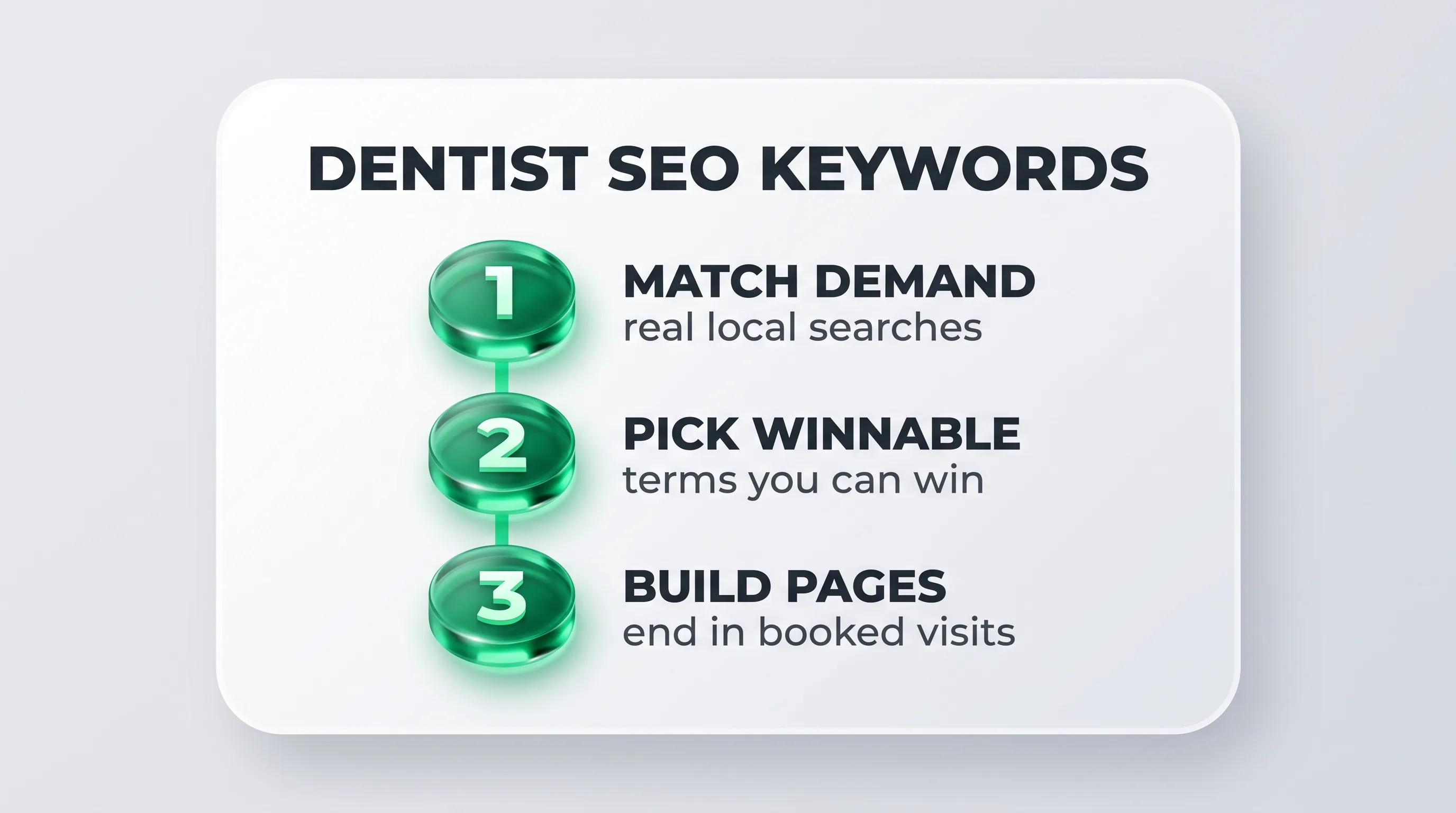
A patient sits in a consultation room Thursday afternoon, holding a printed quote for dental implants she pulled from three different practice websites. She typed four words to find those pages. Which words she used, and whether your page appeared, depended on a decision you made months earlier when you built your keyword list. Most practices build that list backwards: they start with every service and hunt for search volume. The sharper move is to start with the two or three treatments that carry your best case acceptance and work outward from there.
A solid dental SEO plan anchors keyword decisions to revenue, not to completeness. If full-arch implant cases, Invisalign starts, or composite bonding consults are what you actually want to fill, those treatments get their own targeted pages built around terms patients use when they are close to deciding. Everything else can wait.
Not every search is equal. "Dental implants cost [city]" comes from someone who has already decided they want the procedure and is now choosing a provider. "How long do dental implants last" comes from someone still weighing the idea. Both matter, but they belong on different pages with different calls to action. Mixing them on one page splits the signal Google uses to rank you and gives the patient a confusing answer.
Booking-intent terms belong on your core service pages, where the next step is a booking button. Comparison-intent terms suit a dedicated FAQ or pricing page. Early-research terms fit blog posts or explainer content. Sorting your list this way before you assign any term to a page saves you from rewriting pages six months later. It also reflects how dentist SEO basics work at the page level: one clear purpose per URL.
"Dental implants London" and "dentist near me" both carry local intent, but patients use them differently. Near-me searches happen on mobile, usually on the map. City-plus-treatment searches happen when someone is comparing options across several practices, often on a desktop. Adding a local modifier to every term on your list inflates it without helping you win more searches. The test is simple: would a real patient type that exact phrase, or are you adding the city name because it feels more specific?
For map-level visibility, terms like "dentist near me" are handled through your profile and citations, not your service pages. Your written content pages win on city-plus-treatment phrases. The two need separate treatment. For the map side of that distinction, local SEO for dentists covers the execution in full without duplicating what belongs here.
Search "Invisalign [your city]" right now and look at what ranks. If the first page holds three national orthodontic chains, a price comparison aggregator, and a sponsored directory, a new single-location practice page will not displace them on that exact phrase for months. That does not mean abandoning the term. It means checking whether a more specific variant, "Invisalign provider [neighbourhood]" or "Invisalign for adults [city]," shows a weaker field where a well-built page can appear within a realistic timeframe.
This check costs you ten minutes per term and prevents months of effort on pages that face structural competition you cannot currently overcome. Look at the domain authority of what ranks, whether local independent practices appear at all, and whether the results include informational pages mixed with service pages. A mixed result page often signals that Google is uncertain what the query needs: your clearly structured service page can break into that gap faster.
Two pages targeting "porcelain veneers [city]" will split your ranking signal between them. Google cannot reliably decide which one to show, so it often shows neither at full strength. One page, one primary term, one clear topic. Supporting phrases go inside that same page as secondary signals. A veneers page can naturally mention "smile makeover," "composite bonding alternative," and "cosmetic consultation" without those terms owning a separate URL. That structure protects your site from internal competition and makes on-page SEO fixes faster to apply when you audit later.
"Teeth whitening near me" draws high search volume. It also fills your schedule with single-appointment, lower-fee cases at the expense of consult slots that could go to implant or aligner patients. If your practice runs on a specific case mix to stay profitable, keyword choices that attract the wrong patient type cost you more than they produce. This is the part most competitors skip when they publish keyword lists: raw volume is a poor proxy for practice fit.
Before adding a high-volume term to your list, ask what the patient who types it is actually willing to invest in. "Emergency dentist" brings urgent, single-visit intent. "Dental implants cost" brings a patient actively budgeting a multi-thousand-dollar treatment. Both are valid, but they serve very different goals. A keyword list that ignores case acceptance drives traffic that your front desk cannot convert. If expanding into new treatment areas changes your target terms, your broader SEO strategy needs to reflect that shift at the same time.
Good keywords for a dentist are the phrases attached to the treatments the practice wants more of, written the way patients type them. They fall into a handful of intent groups — emergency, cosmetic, implants, local, and routine care — and each group belongs on a different type of page. Grouping them this way gives every phrase an owner page.
| Intent group | Example dentist keywords | Page type that should target it |
|---|---|---|
| Emergency | emergency dentist open now, toothache dentist [city], same-day dental appointment | Dedicated emergency page with the phone number above the fold |
| Cosmetic | teeth whitening [city], composite bonding cost, veneers [city] | One service page per cosmetic treatment |
| Implants | dental implants [city], teeth implants cost, implants vs bridge | Implant service page, with comparison terms on supporting content |
| Local | dentist near me, family dentist [neighborhood], dentist accepting new patients [city] | Google Business Profile and the location page for that office |
| Routine check-ups | dental checkup near me, hygienist appointment [city], kids dental checkup | New patient page or homepage, rather than a standalone page |
Dentist keywords only earn a place on the list when the practice can deliver what the searcher wants. A page built around implant phrases while implants are referred out attracts inquiries the front desk has to hand away, and payer language works the same way: ranking for coverage the practice does not accept frustrates every visitor who lands there.
A dental keywords list built from top dental keywords alone stays short, generic, and crowded out by directories, manufacturer sites, and national chains that a single-location practice cannot displace.
Most searched dental keywords are still worth reading as vocabulary research rather than as targets, because they show the words patients actually type: teeth implants, false teeth, crooked teeth, tooth pain. Those rarely match the clinical names printed on a service menu.
Keywords for dentists work best when that plain wording maps cleanly to one procedure the practice performs. The test is intent, not terminology — if a phrase pulls in people looking for something adjacent, it stays off the list.
SEO keywords for dentists do different jobs depending on where they live. Commercial phrases tied to a treatment belong on service pages. Questions, comparisons, and cost curiosity belong on blog posts. Phrases the site cannot reach yet, but that still bring ready patients, belong in paid search, where visibility is bought rather than earned.
Blog terms are the ones search engines answer with articles: comparisons between treatments, aftercare questions, how a procedure is sequenced, what happens at a first visit. A post that targets the same commercial phrase as an existing service page splits the signal between them, so keep posts on the question variants and point them back at the page that sells the treatment.
Paid search is where the broad, heavily contested head terms make sense, along with urgent phrases where the patient calls whichever listing they see first. Because every click carries a cost, the filters tighten:
Whichever channel a term runs in, the test stays the same: which phrases produced a booked visit, not which produced impressions. Search Console shows the queries a page receives; the practice management software shows which inquiries turned into appointments. Crossing the two turns the list into a record of production rather than traffic.
A patient searching "dental implants [city]" has already cleared the awareness stage. She wants to know if your practice is the right fit and what happens next. If the page she lands on opens with a paragraph about the history of implant dentistry, you have lost her. The keyword cluster tells you the decision she is weighing: match the page to that decision, not to a general overview. Lead with the outcome she is considering, address cost and timeline before she has to ask, and make the booking step visible without her scrolling.
Practices that specialise in a distinct audience, like families or children, face the same logic at a narrower scale. The right term for a general implant page is not the right term for a specialist practice. Pediatric dental SEO illustrates how sharply a different patient audience changes which terms belong on each page.
Your primary term earns the page its ranking. The supporting phrases around it, written naturally in procedure descriptions, cost explanations, and FAQ answers, catch the comparison and research queries you mapped earlier. A patient reading your implant page may also search "implants versus dentures" or "implant healing time": if those phrases appear naturally in your copy, the same page can rank for both without needing separate URLs. Write the FAQ answers the way a patient would ask at the consultation, not the way a search tool categorises queries.
Opening a second location does not mean the keyword work is done. If the list is never updated and no location-specific page is built, searches for the new suburb will keep sending patients to the original site.
Your keyword list is a live document, not a one-time deliverable. When you add a service, drop one, open a branch, or shift your target case mix, the list changes too. Practices that review their terms alongside those decisions stay ahead of the gap rather than discovering it in their booking reports. Whether you handle that internally or through a dedicated SEO service, the trigger for a review is a practice change, not a fixed calendar date.
A keyword list built around the treatments you want to fill, mapped to pages that match what patients decide next, is how organic search becomes a reliable source of accepted cases.
We review your pages, search visibility and enquiry path, then show you what to fix first.
.svg)