

She found you, read for five seconds, and booked your competitor instead.
A parent searching for a dentist for her child needs to know your age range, insurance, and what the first visit looks like before she has to scroll. If she closes the tab, the problem is rarely how she found you, it is what she saw when she arrived.
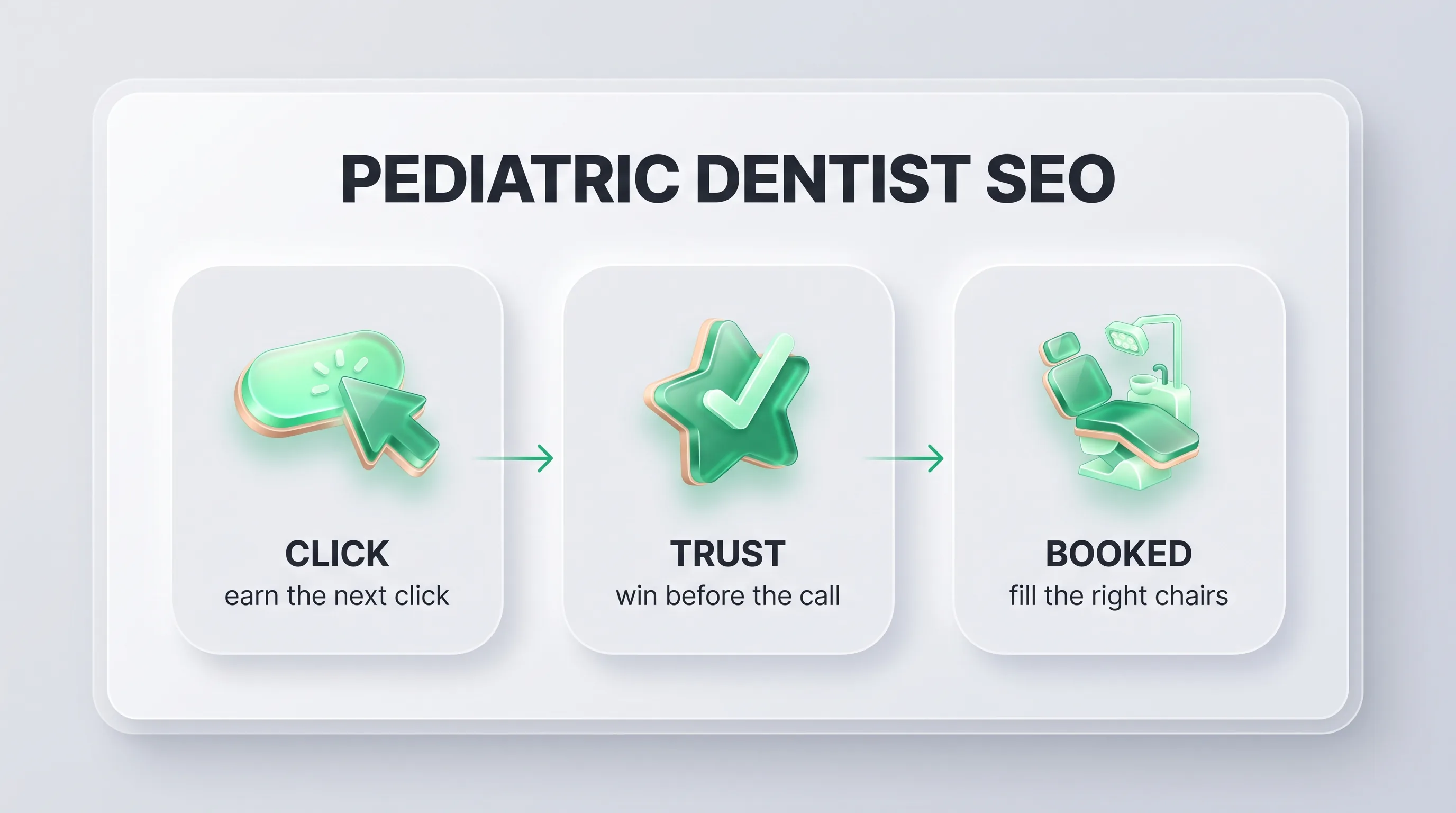
A parent searching "pediatric dentist near me" during her son's nap time has already narrowed her list to three practices. She opens your site. She needs to know you see children from age one, that you accept her insurance, and what the first visit looks like. She needs this in under ten seconds. If those answers are buried, she closes the tab.
This is where pediatric dentist SEO does its real work: not just getting the click, but holding it. Your homepage and first-visit page should surface age range, accepted insurance plans, and a plain-language walkthrough of appointment one, above the fold on mobile. Parents do not read down a page looking for reassurance. They scan, and when they do not find it fast, they leave.
If you want the broader framework behind these decisions, the full picture sits in dental SEO for practices building long-term visibility. For this page, the mechanics are specific: answer the parent's first three questions before she has to ask them.
Most pediatric practice websites carry a single "Services" page listing sealants, fluoride, and cleanings in a column. Parents do not search those terms. They search by the decision they are facing: a toddler's first cleaning, a seven-year-old with a cavity, a teenager's orthodontic referral. Each of those is a separate intent, and a single page cannot rank for all of them.
Build individual pages around those decision points. "First dental visit for toddlers," "cavity treatment for kids," and "dental sealants: what parents should know" each pull a different search query and convert a parent who is at a specific stage. When you map pages this way, the right guidance on choosing dental SEO keywords helps you match each page to the exact phrase a parent types, not the clinical name your team uses internally.
Parents searching about their four-year-old's first cavity carry a specific fear: that the experience will be frightening and that they made it worse by waiting. Your content either speaks to that directly or it does not earn the read.
Write each page at two levels: the clinical fact (what sealants do, why early fluoride matters) and the parent layer (what their child will feel, how long it takes, whether they stay in the room). Mixing both in the same page answers the search query and closes the anxiety gap that separates a ranking page from a booked appointment. Vary the format: a short paragraph for the parent concern, a brief list for the clinical steps. Readable. Fast. Clear.
A parent reads your reviews differently than an adult patient would. She is not looking for clinical praise. She is looking for the word "gentle," for a mention of a child who was terrified and left smiling, for proof that your team handles the four-year-old who cries before the chair. One review that says "my son has severe dental anxiety and they were incredible" converts harder than twenty five-star ratings that say "great office."
Actively ask parents to describe their child's experience, not just rate the visit. When those specific phrases appear in reviews, they reinforce exactly the keywords a searching parent uses. Reply to every review, including the ones that sting. A practice that responds to a complaint calmly reads as trustworthy to the next parent who finds it.
Map pack visibility feeds this cycle directly. The local SEO work that drives map rankings amplifies your reviews by putting them in front of more parents at the moment of search, which is worth understanding even if the mechanics sit outside this page.
Over 70% of parental searches happen on a mobile device. A site that loads slowly, hides the phone number, or buries the booking link behind two taps costs you the inquiry before it starts. The parent does not notice the design. She just notices that something felt hard, and she goes back.
A "Book Now" button pinned to the bottom of the screen on mobile, a page that loads in under two seconds, and a first-visit explainer written at a seventh-grade reading level: these are not design preferences, they are conversion mechanics. For the specific fixes that move the needle on mobile experience and page clarity, the collection of practical dental SEO tips covers the technical side without turning this into a general checklist article.
A pediatric dentist SEO company handles the work that puts a practice in front of searching parents and keeps them on the page: local listings and map presence, age- and visit-based service pages, review prompting and response, mobile layout and speed, and reporting tied to booked first visits. The scope is part visibility, part conversion. A provider that ships rankings alone covers only half of it.
Most pediatric dentist SEO services fall into a few buckets, and a proposal should name the deliverable inside each one rather than promise coverage in general terms.
SEO for pediatric dentists also has to separate audiences that general dental programs tend to blur together: parents, general dentists referring complex cases, and credentialing or hospital staff. Referring clinicians deserve their own page covering procedure scope and referral protocol, which keeps family-facing pages free of clinical depth that only raises new questions.
Pediatric dental practice SEO services should fit the structure of the practice as well. One office needs a tight local footprint on a single site. A group adding locations needs distinct location pages built so they do not compete with each other for the same map results.
Judge a pediatric dentist SEO provider on three things: whether the engagement opens with a diagnosis, how forms and tracking are configured on a site that collects details about children, and which numbers appear in the monthly report. Specific answers point to real experience. The same deliverable checklist applied to every practice points to a template with a new logo on it.
A pediatric dentist SEO expert should start by naming the bottleneck rather than the task list. Low impressions and healthy click-through point to a visibility gap in the map and organic results. Healthy impressions with thin calls point to a page problem, where trust signals and booking paths decide the outcome. Ask a candidate what they would examine in the opening weeks and what decision each finding drives.
Compliance is the part of SEO for pediatric dentist websites that vendors rarely raise unprompted. Pages collect information tied to minors, so a lead form asking for a child's name and date of birth alongside a parent's email deserves scrutiny before it goes live. Ask how forms are configured, which tracking scripts sit on appointment pages, and whether call recordings store anything about a child. Surprise at the question is itself an answer.
Ask any pediatric dentistry SEO company to settle ownership in writing at the start. Content that nobody is authorized to approve sits unpublished while the retainer runs. Document who signs off on clinical claims, who holds site admin credentials, who responds to reviews, and what happens when the staff contact changes.
SEO services for pediatric dentists should also report on fit, not just volume. Segmenting inquiries by accepted coverage shows whether new demand matches the schedule a practice is trying to fill, and separating booked visits from raw form fills keeps spam and existing patients out of the count.
Rankings tell you where you appear. They do not tell you whether those appearances turn into a parent booking her three kids for their annual cleanings, or whether the patients arriving are the type of care the practice is actually built to deliver. One practice ranked well for pediatric terms while still underperforming on new-patient revenue. The issue was that our top-ranking page attracted parents searching for a single emergency visit, not ongoing pediatric care. The traffic looked healthy. The production did not.
Measure booked pediatric visits separately from total new-patient volume. Track which service pages generate scheduled appointments versus inquiries that go nowhere. If your sealant page ranks on page one but generates zero calls, the page has a conversion problem, not a traffic problem. A broader dental SEO strategy ties rankings to revenue outcomes from the start, which prevents this disconnect from running for months before anyone catches it.
A parent finds your site during her lunch break, reads the first-visit page, and decides to call after work. Your front desk is already closed by the time she tries. By then she has booked with the practice that had an online booking link and confirmed her appointment before dinner. That gap is not a marketing failure. It is a handoff failure, and it is invisible unless you track it.
Map the specific drop-off points: how many site visitors click the booking link versus how many calls result in a scheduled appointment versus how many new appointments actually show. Each gap tells you where friction lives. If inquiries convert to calls but calls do not convert to scheduled visits, the problem is phone handling, not SEO. If the schedule fills but with single-visit patients, the problem is which pages rank. Fixing the wrong layer wastes the budget. If the question of what that work should cost comes up as you plan, understanding dental SEO cost gives you a grounded starting point before committing to a scope.
Pediatric dentist SEO works when every page answers the parent's real question and the handoff from search to scheduled visit has no gaps.
We review your pages, search visibility and enquiry path, then show you what to fix first.
.svg)