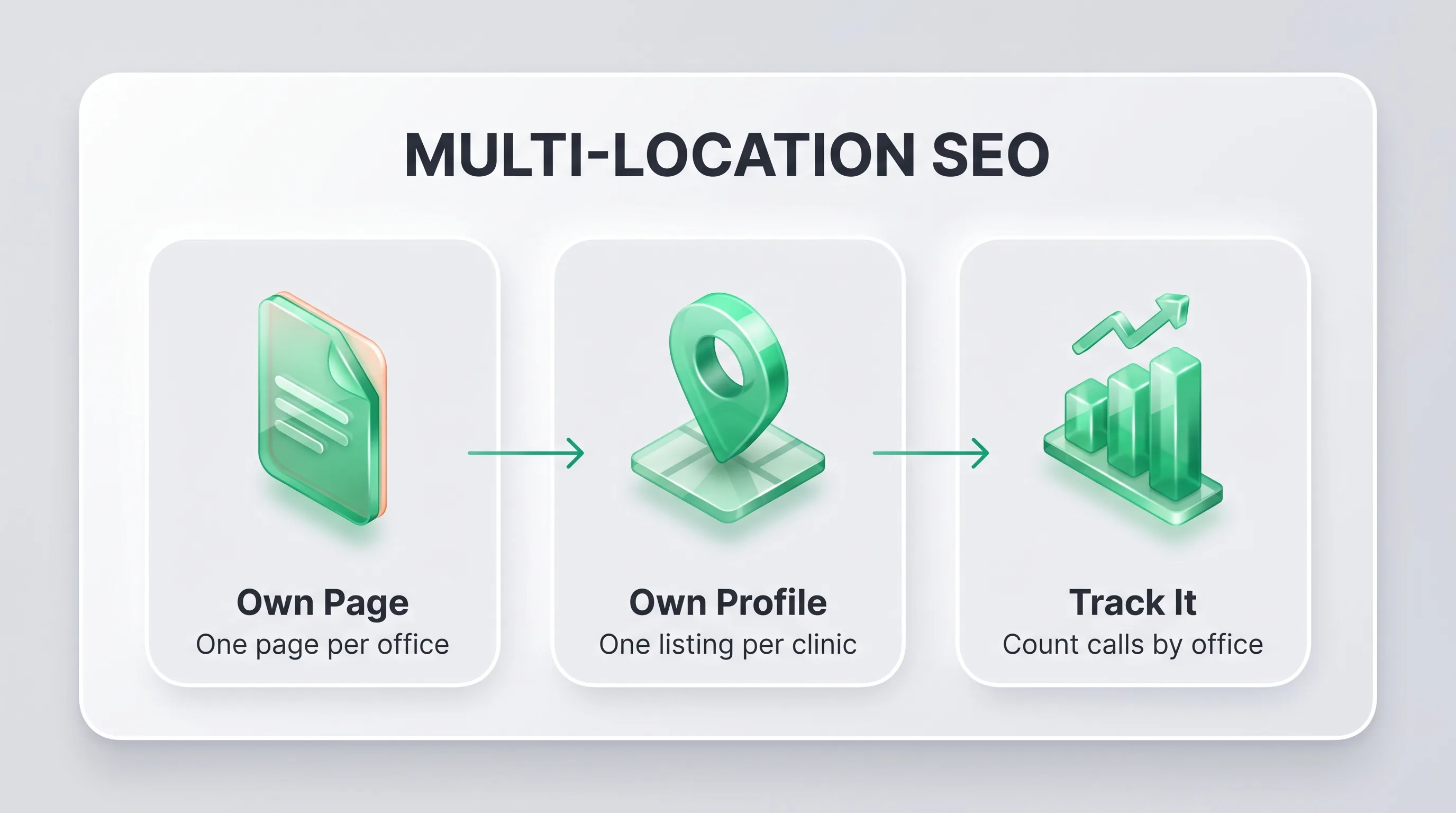
Build multi location dental SEO around each clinic, not one generic site
Give every office its own page with its own services, hours, team, and booking path
A patient in the north suburb searching for a dentist open on Saturday does not care about your downtown office. She types her suburb's name, scans the first three results, and books the one that shows her exactly what she needs. If your site sends her to a generic homepage, she leaves. A dedicated location page fixes that: city-specific copy, the actual team she will meet, the services that office delivers, real hours, and a booking link that routes to that clinic's calendar. Not a copy-pasted template with the address swapped out. A page that earns the click because it answers her question completely.
This is also where dental SEO for multi-site practices separates from single-clinic work. Each page competes in its own catchment, so each page needs its own title tag, meta description, and a URL like /locations/northside rather than a query string nobody reads.
Decide when all locations belong on one domain and when a separate site creates more work
One domain, one subdirectory per clinic. That is the right structure for most groups, and the reason is authority. Every link your brand earns flows to one root domain, and each location page draws on that accumulated strength rather than starting from zero. Separate domains look independent on the surface, but in practice they fragment your link equity, double your content maintenance, and give Google two thin sites instead of one authoritative one.
The exception is narrow: a newly acquired clinic under a different brand name where patients would be confused by the merger, or a specialist referral clinic where the audience and service set share nothing with the parent brand. Outside those cases, a separate domain creates more technical overhead than it ever returns in rankings. When you are weighing location count against budget, understanding how SEO cost scales with site structure helps you set realistic expectations before you commit.
Keep each page aimed at one catchment so locations do not compete with each other
Keyword cannibalization between your own offices quietly kills rankings for both. When two location pages target the same suburb term, Google picks one, demotes the other, and you lose half the ground you worked for. The fix is catchment clarity: each page targets the suburb or neighbourhood that office actually serves, with distinct supporting terms drawn from the real local searches around it. For the mechanics of assigning those terms without overlap, a dedicated guide on choosing the right dental SEO keywords by page covers the process in full. Your internal linking should also reinforce separation: the Northside page links to Northside-relevant content, not to a page that competes for the same term.
Keep every location trustworthy in search and on the site
Match each Google Business Profile to the exact office patients will visit
A patient clicks your Westside profile, the address drops a pin on a street she recognises, and she arrives at the right door. That chain works only if each Google Business Profile carries the unique phone number, address, and URL for that specific clinic, not the main switchboard and not the homepage. One profile per office, each linked to that office's location page. If a profile still points to your homepage, Google cannot confirm which physical location it represents, and your local pack rankings for that suburb suffer for it.
The broader mechanics of Google Business Profile setup, reviews, and map pack fundamentals sit in the guide on local SEO for dental practices, so this section will not repeat them.
Standardize core details across listings while keeping local proof unique
Name, address, and phone number: identical format across every directory, social profile, and listing that mentions each clinic. Not "St" on one site and "Street" on another. Inconsistency tells Google the listings may describe different businesses, which weakens the confidence score it needs to rank you. Standardize those three fields everywhere.
Everything beyond NAP should be local and specific. Photos of the actual waiting room, the actual dentist who works Tuesday mornings, a paragraph that mentions the car park two doors down. A patient weighing implants at your Eastside clinic wants proof that clinic is real, staffed, and easy to reach. Generic brand photography does not give her that. Specific, office-level content does.
Show office-specific trust signals so the patient chooses the right clinic first time
Patients will often call the original location out of habit, then cancel when they realise the drive. The page for a new clinic simply does not feel as established. Add the local team's credentials, a short video walkthrough of the reception area, and the specific services that office has equipment to deliver. Nothing technical needs to change. The page just has to answer the question the patient is already asking before they pick up the phone.
Schema markup reinforces this. A LocalBusiness schema block on each page tells search engines the precise address, opening hours, and service area for that clinic, reducing the chance that a patient two suburbs away gets routed to the wrong office in a featured result.
Track results by clinic before you scale the rollout
Brand searches for your practice name will rise as you grow. That is real, but it is not the signal you need for multi-location SEO decisions. What matters is whether the Southside page generates Southside calls, whether the Northside form generates Northside bookings, and whether those numbers move when you update that specific page. Set up separate call-tracking numbers per clinic, separate form destinations, and filter your analytics by location URL so that a surge at one office does not mask a stall at another. Without that separation, you are reading the whole group's pulse and missing the clinic that is quietly losing ground. For guidance on building the broader reporting framework, the resource on practice-wide dental SEO strategy covers ownership, sequencing, and monthly review structure.
What should you fix when one office ranks and another stalls?
Start with the stalling office's Google Business Profile: verify it is active, matched to the correct URL, and has at least a handful of location-specific reviews. Then audit the location page itself against the ranking office's page. Missing services, thinner copy, no team photo, a booking path that routes to the wrong calendar: any one of these suppresses performance even when the technical setup is correct. The fix is almost always more specificity, not more volume.
If the gap persists after those corrections, check the catchment definition. Two offices targeting overlapping suburbs split their own rankings. Reassign terms so each page owns distinct geography. Practitioners who want to see how those fixes translate into real patient numbers can review a dental SEO case study that tracks location-level movement over time. Once the individual clinics are working, scaling to additional sites follows the same per-office logic, and that is when bringing in dedicated dental SEO services for execution pays for itself.
Get each clinic's own page, profile, and tracking in order, and multi-location dental SEO becomes a repeatable system you roll forward with every new office.