Choose from the top dental SEO companies with a safer shortlist
Start with the problem you need solved first
A practice owner in a competitive California or Texas market once sent me a proposal from three agencies, all claiming top rankings, all with different definitions of success. None had asked what her schedule actually looked like. That is where shortlisting breaks down: you evaluate vendors before naming the problem. Before you compare any of the dental SEO services on offer, define whether your gap is new-patient volume, a specific treatment type, or visibility in a tighter local radius. The answer changes which company belongs on your list.
Separate dental specialists from broad SEO vendors
A generalist agency learns your specialty after you sign. A dental-only firm already understands why a patient searching for implants converts differently than one searching for a cleaning, and they build content architecture around that distinction. Agencies like Delmain, Wonderist, and Golden Proportions work exclusively in dentistry. That focus matters because compliance constraints, patient intent patterns, and high-ticket procedure keywords differ sharply from e-commerce or professional services. If you want to understand how a specialist approaches the work before you commit, reading about what a qualified dental SEO expert actually does is a useful first filter.
Which proof should make a company worth your shortlist?
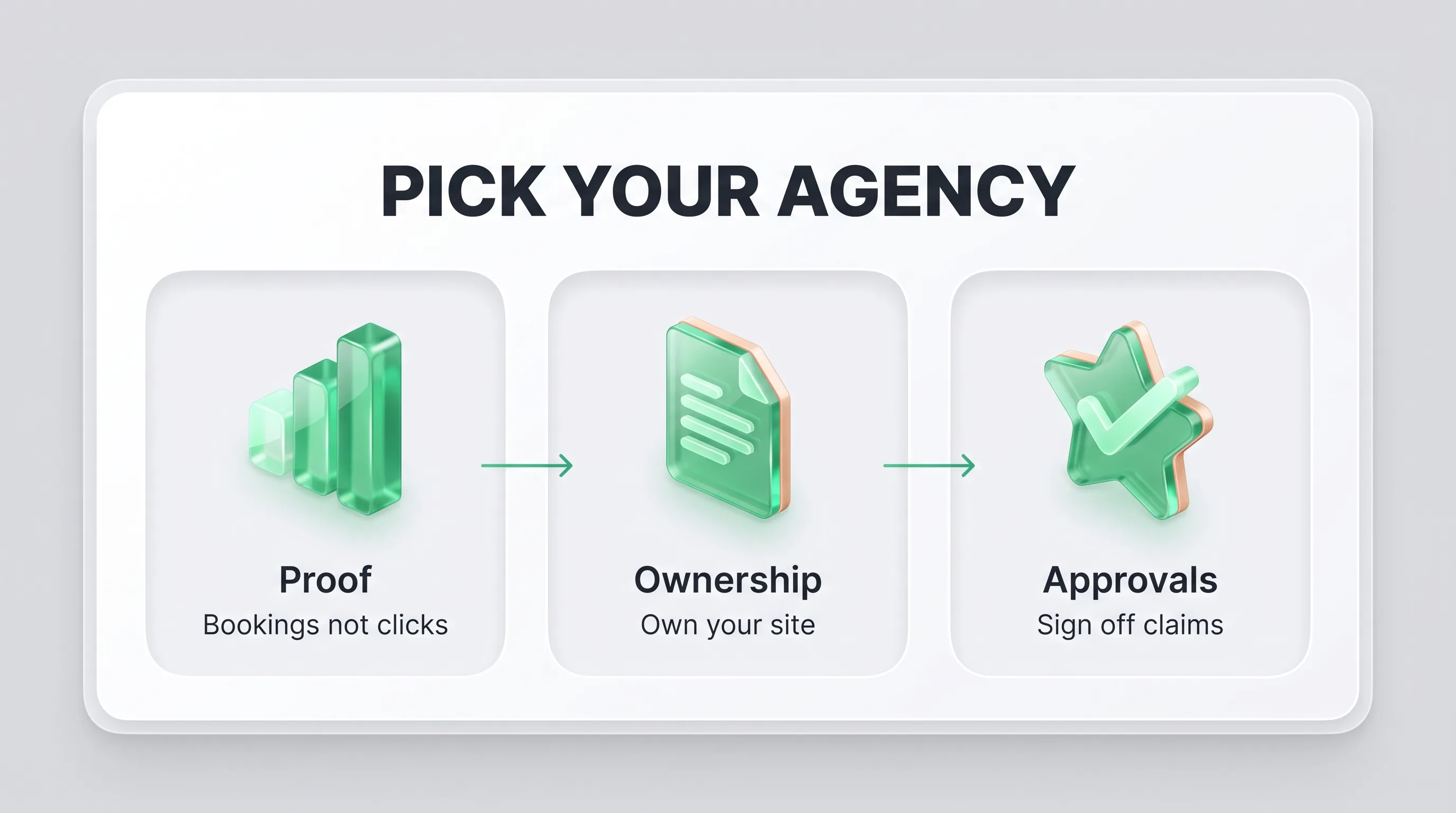
Rankings screenshots prove very little on their own. A position-one result for a low-volume term costs a patient nothing to produce. Ask instead for organic appointment volume over six to twelve months, and check whether results are tied to the treatment categories you actually want to fill. Documented case studies with before-and-after patient inquiry data carry real weight. For a deeper read on how to interpret those examples, SEO case studies from dental-specific campaigns show you what credible evidence actually looks like. Exclude any vendor whose only proof is a rankings report with no conversion context.
Read the proposal before you trust the pitch
Look for a first 90 day plan, not a generic package
Most agency proposals describe what they do in month four. Few tell you what happens in week one. A credible company opens with a technical audit, maps your current keyword gaps against the procedures that generate your highest chair value, and sets a content calendar before asking you to sign. That 90-day sequence is the real signal. A generic package listing "monthly blog posts" and "citation building" tells you nothing about whether the work fits your market. Practices competing in dense metro areas, whether in California, Texas, or any saturated US market, need an agency that sequences local visibility work before site-wide authority building, not the other way around. If you want to see what those deliverables should look like, the page on dental SEO services breaks down a credible scope.
Check who owns content, approvals, reporting, and access
Ownership clauses end more agency relationships than poor results do. Before signing, confirm that your practice owns the website, all published content, your Google Analytics property, and your search console access outright. Some vendors retain content rights or lock reporting inside proprietary dashboards you lose on exit. Ask for a sample monthly report: it should show keyword movement tied to pages, not just a traffic number. Approval workflows matter too. Every clinical claim on your site carries regulatory exposure, so you need sign-off before anything publishes. An agency that resists that process is one that has never worked in a regulated health setting.
Make sure success is tied to booked visits and case type
Traffic is not revenue. A practice generating 4,000 monthly visitors from informational queries about tooth sensitivity and converting none of them into crown consultations has an SEO problem dressed as an SEO win. The top dental SEO companies in the USA measure success at the appointment level, and the best also track procedure type: are new patients booking single-visit cleanings or multi-visit restorative cases? Ask any shortlisted vendor how they connect a keyword click to a completed booking. If their answer involves only rank tracking, that is your answer. When you want to understand what a sound plan looks like month to month before you commit, reviewing a clear dental SEO strategy framework helps you hold vendors to a real standard.
Avoid the company problems that waste six months
Red flags in rankings claims, reviews, and guarantees
No credible SEO company guarantees a number-one ranking. Google's algorithm updates dozens of times per year, and any firm promising a fixed position is either unaware of that or hoping you are. Watch for agencies that inflate review counts with templated responses, cite average rankings across dozens of clients without naming comparable markets, or lock you into twelve-month contracts with no performance exit clause. A firm quoting suspiciously low retainers relative to the market warrants the same scrutiny: if you want context on realistic investment ranges before comparing proposals, the guide on dental SEO cost gives you a benchmark without turning this into a pricing article.
When a local market vendor is enough and when you need deeper support
A single-location practice in a mid-size market with limited competition may gain real ground from a regional agency focused on map pack recovery and local citations. The scope is narrow and a boutique vendor can execute it well. But if you run multiple locations, compete in a metro market, or want to rank for high-ticket procedures like implants or full-arch restorations against established DSOs, you need technical depth: structured data, multi-location page architecture, and content built around procedure-specific intent. At that stage, local SEO for dentists becomes one component of a larger effort, not the whole strategy. Match the vendor's depth to the actual complexity of your market, not to the ambition of their pitch deck.
The right dental SEO company earns its place on your shortlist by showing you exactly how a new patient arrives ready to book, not just ready to browse.