

One generic implants page sends both types of patient somewhere else.
A patient replacing one tooth and a patient wanting full-arch restoration need different pages, or neither feels spoken to and both leave. The practice that answers cost, candidacy, and next steps on each treatment page earns the call before the patient picks up the phone.
✔ Put a price range and the two or three factors that raise or lower it on each implant page.
✔ Change your booking button on the implant page to say 'Request your implant consultation', not 'Book a new patient visit'.
✔ Count how many implant evaluations from your website actually accepted treatment last month.
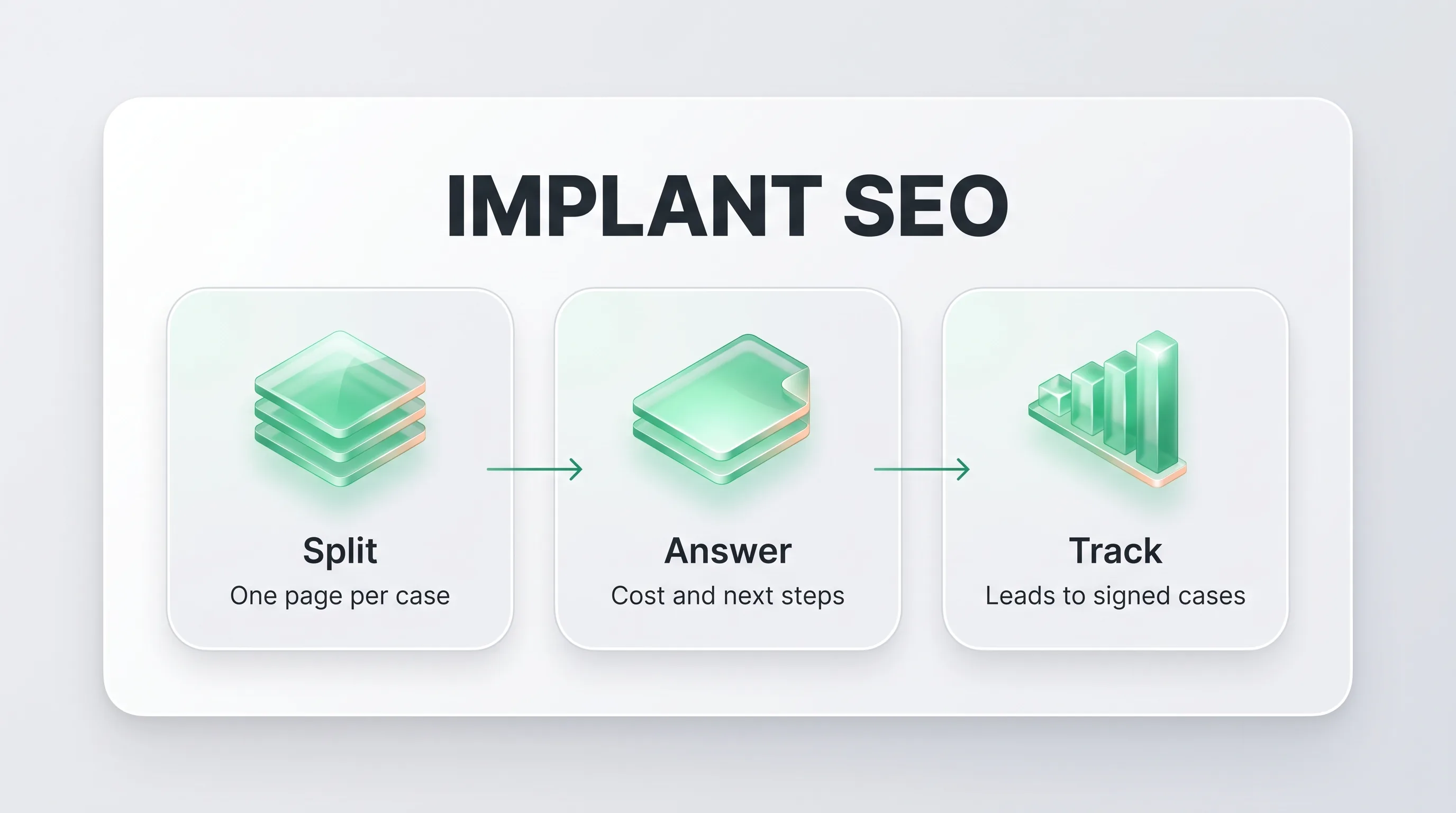
A patient weighing full-arch restoration on four implants and a patient replacing one missing molar are not the same patient. They search differently, read differently, and need different reasons to book. When you put both on one generic implants page, neither feels found. The page tries to serve everyone and converts no one.
The structural fix is straightforward: one page per treatment decision. Single-tooth implant, full-arch, implant-supported dentures, and All-on-4 each earn their own URL, their own headline, and their own consult path. Search engines treat this as proof of depth. More concretely, your dental SEO effort stops spreading ranking signals across one cluttered page and concentrates them where each procedure actually wins cases.
A Tuesday morning, two inquiries arrive. One asks about replacing a single tooth; the other wants to know if she qualifies for full-mouth restoration after years in dentures. Both land on your generic implants page. Neither finds the specific answer they came for. Both leave.
Each page should match the decision the patient is already making, not the procedure category you offer. The full-arch page speaks to the patient who has worn dentures for a decade and wants permanence. The single-implant page speaks to the 42-year-old who cracked a premolar. When the content mirrors the patient's exact situation, time on page rises and bounce drops. Those signals matter to rankings, and to conversion. Choosing the right targets for each page is part of a wider dental SEO keywords approach worth mapping before you write a word.
Candidacy questions are not blog content. They belong on the treatment page itself, because a patient reading about full-arch implants at 10pm is already asking: do I even qualify, how long does this take, and what happens next? If those answers are buried in a separate FAQ post, she stops reading and searches again. Someone else answers her.
Put bone graft candidacy, typical treatment timelines, and a clear consult call to action on the same page that ranks for that procedure. Keep them brief and honest. Patients researching implants spend real time before calling; the page that answers all three questions in one place earns the call.
Cost is the question every implant patient carries and almost no practice answers well. Dodge it entirely and the patient assumes you are expensive and leaves. Publish a flat number and you attract price shoppers who haggle at the consult. The middle path: a transparent range, explained by the factors that move it.
A sentence like "single-tooth implants in most practices range from several thousand to well above that depending on bone volume, location, and restoration type" gives the patient orientation without locking you into a quote. Pair it with a short explanation of what drives cost higher or lower. That combination builds credibility and filters for patients who have already accepted the category of investment. It also helps the page compete for cost-intent searches without becoming a pricing pitch. The same logic applies to how cosmetic dentist SEO handles fee-sensitive elective cases.
Before-and-after photos convert. They show the patient what is possible in a way no paragraph can match. Add a two-sentence clinical note under each case: the starting condition, the approach, the outcome. That framing is proof without a promise, and it keeps you well inside what you can ethically claim.
Treatment detail works the same way. Walk through what happens at the evaluation, what imaging you use, how staging decisions get made. Patients researching implants read this carefully. A page that explains your actual process reads as authority. One that repeats generic procedure steps reads as copied. Depth in the right places also supports broader dental SEO strategy by signaling topical expertise to search engines.
Most practice websites route every inquiry through the same new patient form: name, date of birth, insurance, preferred appointment time. An implant patient fills that out and wonders if you understood why she came. She wanted an evaluation, not a cleaning slot.
The booking path on an implant page should name the evaluation explicitly. "Request your implant consultation" tells the patient this visit has a purpose. A short pre-qualification question, such as whether she is missing one tooth or several, routes her correctly and primes your team before the call. That single change, routing implant traffic to an implant-specific workflow rather than your default new patient queue, closes the gap between a page that ranks and a page that converts. Most competitors miss it entirely. Pairing this with strong dental website SEO ensures the page actually reaches the patients who need that path.
Rankings and organic traffic are leading indicators, not outcomes. The outcome for an implant page is a patient who says yes to treatment, and you can only trace that back to search if you track the full chain: form submission, booked evaluation, and accepted case, all together. Most analytics setups stop at the form. That tells you the page generates leads. It tells you nothing about whether those leads become cases.
Connect your web analytics to your scheduling system, even loosely. A monthly count of implant evaluations sourced from organic search, compared against accepted treatment, shows you whether the page attracts patients who are genuinely ready or patients who are still early in research. That distinction shapes every content decision you make next. If you want to judge these outcomes against a real campaign, a dental SEO case study can give you an honest benchmark.
Practice owners often expect implant pages to perform within weeks. In practice, competitive implant searches in most markets take six to twelve months before organic rankings stabilize. That range is consistent across sources. Local searches in smaller markets move faster; metro-area terms often take longer.
The timeline is not a reason to delay. A page published today earns authority incrementally; one published next quarter starts a quarter behind. Set expectations with your team around the six-month mark for early signals, full traction around twelve. Measuring monthly, rather than weekly, keeps the assessment honest. Understanding what that investment looks like relative to return is part of evaluating dental SEO cost for a high-value service like implants. And for the local visibility layer that runs alongside your treatment pages, the principles around local dental SEO apply directly.
Build each implant page around the one decision your patient is already making, and your search rankings become the first step toward a signed case.
We review your pages, search visibility and enquiry path, then show you what to fix first.
.svg)