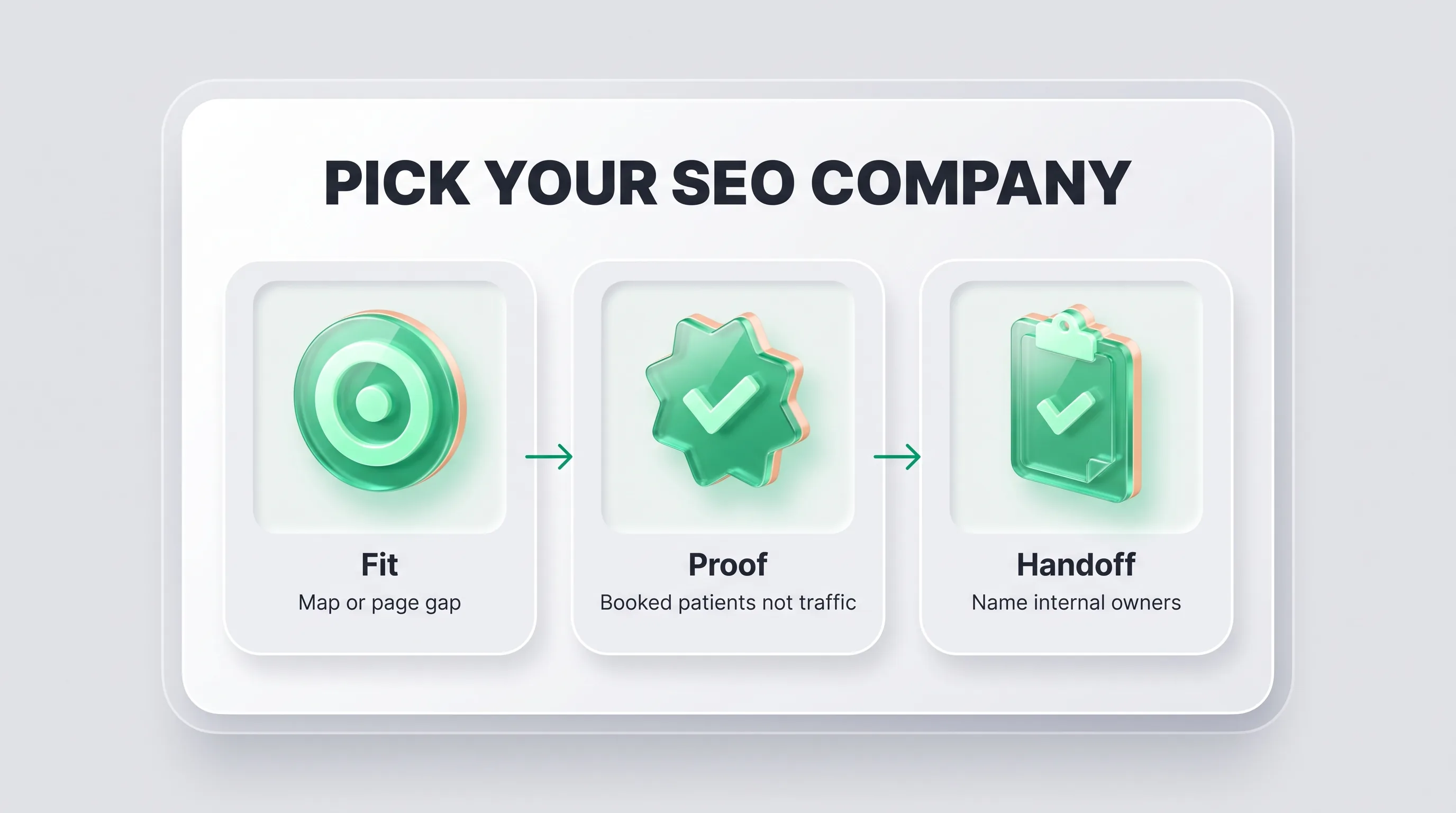
Choose an SEO company for dentists in Mountain Brook that fits the real bottleneck
Start with whether you need map visibility, stronger service pages, or both
A patient searching for a cosmetic dentist in Mountain Brook while scrolling through options on her lunch break sees two things: the map pack and the organic results below it. If your practice does not appear in either, the problem is real but the fix differs depending on where the gap sits. Ranking in the map pack depends on your Google Business Profile, proximity signals, and review volume. Ranking organically depends on service pages, site authority, and technical health. These are related but not the same work. An SEO company that treats them as one solution will likely underdeliver on both.
Before you shortlist anyone, pull up the search your ideal patient would run. Count how many established Mountain Brook practices sit above you and in which column. That answer tells you whether dental SEO for your practice needs to start with local signals, page-level content, or a combination built in phases. A company that cannot frame that distinction in the first conversation is not ready to solve your specific problem.
Match the shortlist to your procedure focus, catchment, and capacity
Mountain Brook draws patients who research carefully and weigh options before calling. If your highest-value treatments are cosmetic or restorative, the patients you want are comparing practices across Crestline Village, Cahaba Heights, and Homewood before they book. That catchment matters. An SEO company targeting only the 35223 zip code may miss the search behavior of patients who drive fifteen minutes for the right provider.
Chair capacity shapes priorities just as much. A practice with two chairs and a full hygiene schedule does not need aggressive new-patient volume; it needs better-qualified patients who accept higher-value treatment plans. Ask any candidate how they would approach that constraint. If their answer is a traffic target, they are solving the wrong problem. If they talk about the specific procedures you want to grow and how search intent maps to those, that is a more honest conversation. Understanding dental SEO keywords tied to treatment intent, not just volume, is where that distinction shows up in practice.
When local market familiarity matters and when it is just sales copy
Most agencies pitching Mountain Brook dental practices will mention the neighborhood by name, reference its demographics, and note the competition. Almost none of that changes the actual work. Keyword research, page structure, and link acquisition follow the same process whether the agency is in Birmingham or Seattle. Genuine local familiarity matters in one specific way: knowing which competing practices are dominant in map results, which treatment searches have real volume in this catchment, and which nearby neighborhoods send patients your way. That requires someone who has run campaigns in this market, not someone who read the census data before the call.
When you ask a candidate about Mountain Brook specifically, listen for whether they name the real competitive landscape or repeat your own website back to you. If they can tell you which practices consistently hold the local pack for high-value procedures, that is evidence. If they tell you Mountain Brook is an affluent, competitive market, that is a brochure. The broader framework for choosing a dental SEO company covers vendor signals in more depth, but local specificity is where a Mountain Brook shortlist gets meaningfully shorter.
Check the proof before you sign
Ask for evidence tied to inquiries, bookings, and treatment accepted
Rankings are an input, not the outcome your practice needs. A company that leads every reporting conversation with keyword positions and monthly sessions is measuring its own effort, not your schedule. The right question is whether the patients who found the practice through search actually booked and accepted treatment. Ask specifically for examples where a campaign increased call volume or new patient visits, not just impressions. If the evidence only runs to traffic, the company has not connected its work to your revenue. Dental SEO case studies that show this chain, from search to call to booked appointment, are the standard to hold candidates to.
Read the first 90 days for diagnosis, priorities, and ownership
The vendor relationships that cost a practice the most are consistently the ones that start with activity instead of diagnosis. A capable SEO company opens with an honest audit: where your site loses authority, which pages carry treatment intent without ranking, and what the map pack gap actually requires to close. That audit shapes a ranked priority list, not a simultaneous launch of every tactic. Ask each candidate what the first 90 days produces and who owns each deliverable. If the answer is vague about ownership or skips the audit phase entirely, the engagement will drift. Knowing the scope of dental SEO services your practice actually needs helps you judge whether the proposed 90-day plan is complete or padded.
Watch for lock-ins, vague deliverables, and reporting that hides the gap
A 12-month lock-in on a contract that promises "ongoing optimization" is not a partnership. It is protection for the vendor. Reasonable agreements run on a defined 90-to-180-day cycle with clearly defined deliverables per period: pages published, links earned, technical fixes completed, and call tracking reviewed. Vague language like "continuous content improvements" or "strategic adjustments" means you cannot hold anyone accountable when the schedule does not change. Reporting should show you call source data, not just sessions and rankings. If you cannot see, in each monthly report, whether organic search is generating calls your front desk received, the report is designed to look productive rather than to inform a decision. Ask what the report would look like in a month where results are flat. That answer tells you more than the pitch deck.
Make sure the handoff will work inside the practice
Who owns content, approvals, access, and review follow-up from day one
Three weeks into a new SEO engagement, your front desk gets an email asking for login credentials to your website, your Google Business Profile, and your practice management software. Nobody told them this was coming. The agency is waiting; your team is unsure what to share. That delay costs a month of work and sets the tone for the whole relationship. Before you sign, name one internal person who owns approvals, one who handles access, and one who manages review follow-up. If the agency does not ask for that structure in the onboarding conversation, they have not run enough practice-side engagements to know how the work actually stalls. Understanding the depth of dental SEO expertise a company applies also means understanding how they integrate with your team, not just what they build externally.
What your front desk must track so good rankings can become booked patients
A patient searching for Invisalign in Mountain Brook finds your practice, reads the service page, and calls during lunch. Your front desk answers, takes a name, and quotes a price before asking a single question about what the patient has already considered. The call ends without a booked consultation. The ranking worked. The handoff did not. Good organic visibility moves patients to the phone; what happens on that call determines whether the investment converts.
Your front desk should log the source of every new inquiry, the treatment mentioned, and whether it booked. That takes one extra field in your scheduling software or a simple tally sheet. Over 60 to 90 days, that data tells you whether the patients arriving from search are the right fit and whether the front desk conversation is converting at a reasonable rate. Without that tracking, you cannot tell whether a flat schedule reflects weak SEO or a weak handoff. Understanding local dental SEO performance requires this practice-side data to complete the picture. If your SEO company never asks for it, they are optimizing a channel they cannot actually measure. Separately, once your shortlist is set, reviewing dental SEO cost against these deliverables gives you a cleaner basis for comparison.
The right SEO company for your Mountain Brook practice solves the specific gap between your current schedule and the patients already searching for what you do.