What dental seo pros should prove before you trust them
Can they tie rankings to booked patients and the procedures those patients choose?
A prospect sits across from you, ready to ask about implants. She found you on page one. What you need to know is whether your dental SEO investment actually put her there, or whether she would have found you anyway. Any agency that shows you a ranking chart without connecting it to appointment volume and case type is selling you the wrong metric. Ask them directly: which procedures drove the most organic bookings in the last six months for a practice like yours? If they fumble that answer, the rankings are vanity, not revenue.
Do reviews show delivery, not just friendliness?
Client reviews for dental SEO providers often read the same way: great communication, responsive team, lovely people. That tells you nothing about results. Read instead for specifics: a practice that mentions moving from page three to a consistent top-three position for a high-value procedure, or one that describes a measurable lift in new-patient calls within a defined window. You can find that kind of evidence in dentist SEO case studies too, where the numbers are harder to soften. Friendliness is a given. Delivery is the filter.
What should a real diagnosis include before any proposal?
Before any reputable dental SEO pro proposes a scope, they should audit your current organic footprint: which pages rank, for what intent, and where Google already associates your practice with specific treatments. A diagnosis that skips your competitors' gap analysis or ignores your conversion rate on existing traffic is incomplete. You should also expect them to flag technical issues that suppress indexing, because a well-written service page that Google cannot crawl earns nothing. The proposal follows the audit; it never replaces it.
Choose support that fits the practice
When a dental SEO expert is enough and when you need a fuller team
A single-location practice chasing local visibility for three or four core procedures often gets everything it needs from one specialist who writes, optimizes, and manages the technical layer. The moment your goals spread across multiple locations, a wider range of procedures, or paid search alongside organic, a solo operator hits capacity fast. That is when a coordinated team, not just a dental SEO expert working alone, becomes the better structure. Scope drives the right staffing model, not the size of the agency pitch deck.
Who should own content, approvals, and site access from day one?
Content that waits three weeks for clinical approval does not rank on schedule. Before you sign anything, map out who on your side clears treatment-specific copy, who grants CMS access, and whether your front desk or practice manager fields keyword briefs or leaves them unanswered. These are the handoff points where campaigns stall. A provider who does not ask these questions in the onboarding conversation has not run a dental account before. That silence costs you months. Pin the workflow before month one starts.
How much dental context should matter in your shortlist?
Dental context matters less than practitioners expect for technical SEO work and more than most agencies admit for content. A team that has never written about osseointegration, sedation protocols, or fee-per-item versus capitation will produce copy that sounds generic to a patient already researching. That patient closes the tab. On the other hand, deep dental experience cannot compensate for weak analytics, slow site audits, or an inability to read a search console report. Weight clinical fluency at roughly one-third of your decision; weight process, proof, and communication the rest. When you move to comparing providers more broadly, a structured look at choosing a dental SEO company can help you apply that weighting systematically.
Avoid the handoff problems that waste months
Set the first 90 days around one bottleneck
Early in my clinic years, I hired a marketing firm that delivered a twelve-point plan in week one. By month three, nothing had moved because everything was in motion and nothing was finished. The right dental SEO pros do the opposite: they identify your single biggest constraint, whether that is a site that loads in six seconds, zero indexed pages for your highest-margin treatment, or a Google Business Profile pulling the wrong location, and they resolve it before layering anything else. One fixed bottleneck compounds. Twelve half-finished tasks do not. Ask any shortlisted provider what they would focus on first and why. The answer tells you whether they diagnose or just execute templates. For a broader picture of what that scope should cover, look at what full dental SEO services typically include.
Make reporting answer the schedule, not just the ranking chart
A monthly report showing keyword positions is easy to produce and nearly impossible to act on. What you need to see is whether organic traffic converted to appointment requests during that period, which pages drove inquiries for treatments you actually want to fill, and where the drop-off happens between visit and contact. Rankings shift constantly; what the schedule looks like at the end of the month does not. Tie the reporting cadence to a metric your front desk can verify, and if your provider resists that framing, they are optimizing for their own renewal, not your growth. If pricing questions come up alongside scope, dental SEO cost breakdowns can help you match spend to the right service tier.
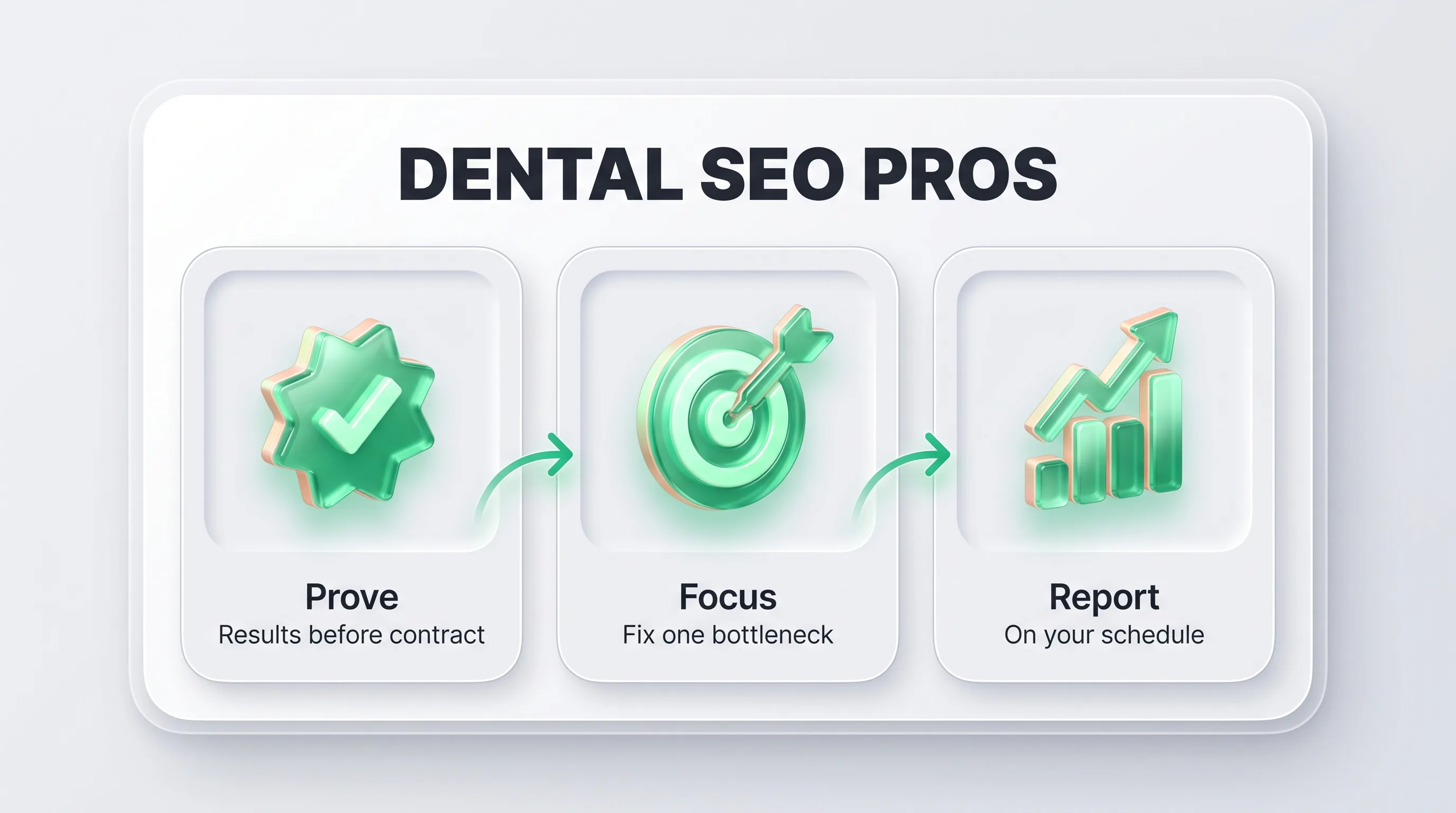
The dental SEO pros worth hiring prove results before the contract, fix one bottleneck before adding ten more, and report on your schedule rather than their rankings.