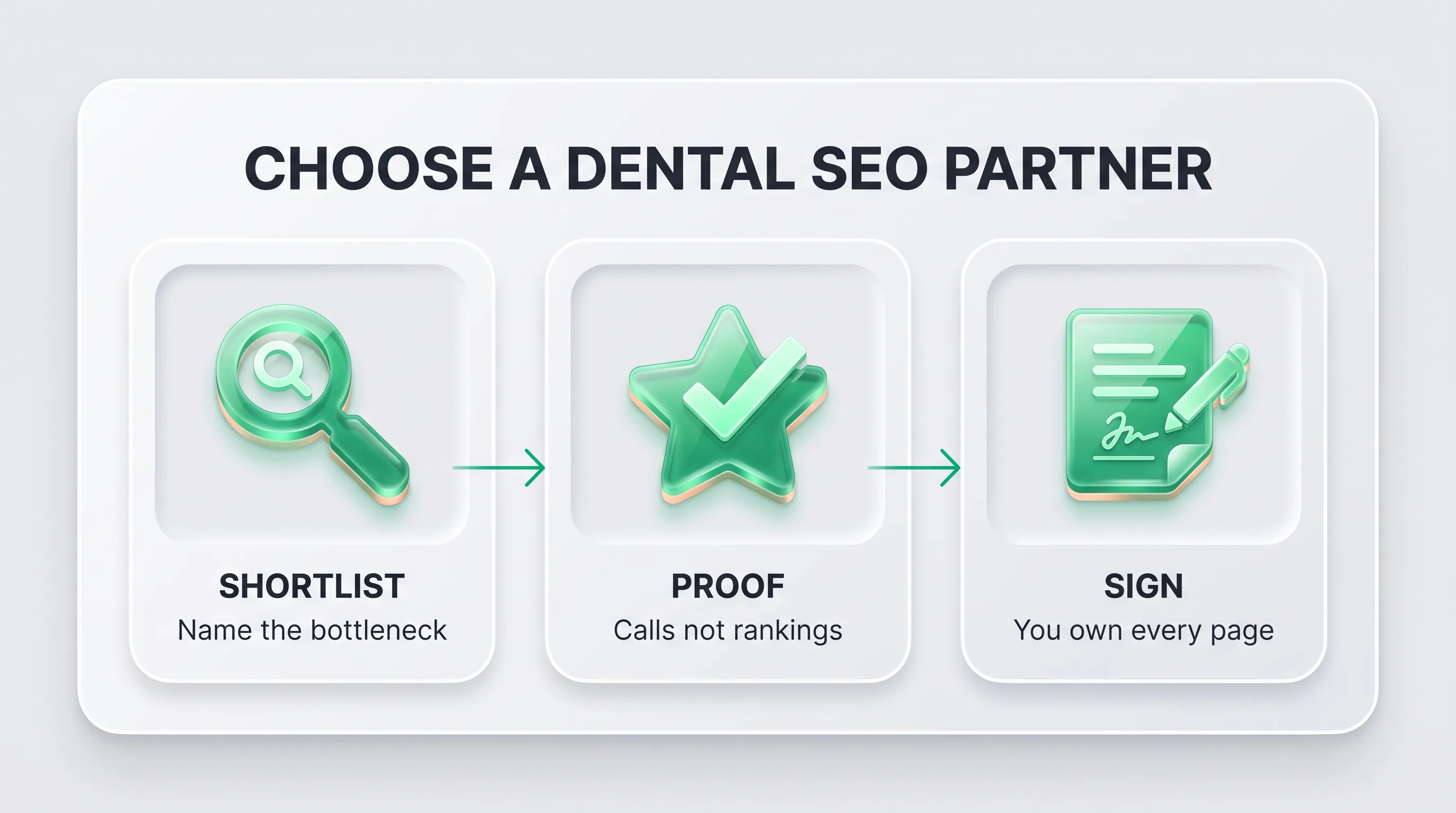
Choose a dental SEO company with a safer shortlist
Start with the bottleneck you need them to fix
A Monday morning, three chairs booked, none of them implants or veneers. You know the patients exist in your postcode. They just found someone else first. Before you call a single agency, name the actual gap: is it that your practice does not appear for the treatments that pay, that it appears but does not convert, or that your existing dental SEO strategy has no structure at all? The answer shapes every question you will ask a vendor. An agency that excels at technical fixes cannot rescue a practice whose real problem is zero service-page content, and vice versa.
When dental specialist experience matters and when it does not
Specialist dental experience matters most when your treatments are high-value and intent-specific: implants, full-arch rehabilitation, Invisalign, or sedation. A clinician weighing a procedure that costs several thousand dollars searches differently from someone booking a check-up. An agency that has never written for that patient will produce content that ranks for the wrong intent. For bread-and-butter preventive care in a competitive suburb, a rigorous general SEO agency with a clear local process can do the job. If you want to compare the broader market before narrowing down, looking at top dental SEO companies by specialty focus will sharpen your shortlist quickly.
Keep local market familiarity practical, not the whole decision
Agencies in California and Texas pitch local knowledge hard, and practitioners in those markets sometimes over-index on it. In practice, local familiarity means two concrete things: knowing which neighbourhoods your patients actually come from, and understanding the competitor map within a realistic drive time. An agency does not need a local office to research that. What matters is whether they pull local keyword data, study your actual competitors, and build location-level pages around real patient geography. If a vendor leans heavily on city-name drops during the sales call but cannot name your three nearest competing practices, that is the signal to move on.
Read the proof before you trust the pitch
Ask for case evidence tied to phone calls and confirmed appointments
Rankings graphs prove a website moved up a list. They do not prove a patient booked a crown. Ask any agency you are seriously considering to show you before-and-after data on phone call volume, contact form submissions, and, where possible, which procedures those calls turned into. A dentist SEO case study that connects organic traffic to specific appointment types is worth ten slide decks full of impressions data. If the agency cannot produce that, they either do not track it or it did not happen. Both are problems.
Check the first 90 days for diagnosis, priorities, and ownership
The first 90 days are where most agencies lose the dentist months they cannot recover. Ask exactly what happens in that window: do they run a technical audit before touching content, or do they start publishing pages on a template before understanding your market? A credible agency names the sequence: audit first, then priority setting, then content, then tracking setup. They should also clarify who owns each task. If the answer to "who approves page content before it goes live" is unclear at the sales stage, it will still be unclear at week eight. Practices can go well into a contract before realising their site had been edited without a single clinical review. That is an onboarding failure, not an SEO failure.
Use realistic timelines instead of rankings promises
Any agency that guarantees a ranking position within a fixed deadline is either lying or planning to use tactics that will eventually cost you the position and possibly a penalty. Organic SEO for a competitive dental market typically takes several months to show meaningful movement. The honest question to ask is not "when will I rank number one" but "what will I be able to measure at 30, 60, and 90 days to confirm this is working." Deliverables at each checkpoint, not a ranking date, are the real commitment. Understand the full scope of what they plan to deliver before you compare prices; the detail lives in what each agency defines as dental SEO services.
What a monthly report should tell you before you sign
A monthly report should show what happened to enquiries, not only what happened to rankings. Ask every shortlisted agency for a real sample before you commit. The format reveals how the team thinks: whether calls, form submissions and the treatment mix behind them are tracked and explained, or whether sessions and impressions are counted and presented as progress.
Read the sample the way you would read a patient chart. The numbers matter less than whether someone has interpreted them and drawn a conclusion you can act on.
| What the report counts | What it actually tells you |
|---|
| Impressions and sessions | Reach only. No indication that anyone contacted the practice. |
| Keyword positions | Movement, but not whether the intent behind those searches was ready to book. |
| Tracked calls by landing page | Which pages start conversations, and which high-value pages do not. |
| Form submissions with treatment noted | Whether the enquiries arriving match the chairs you need to fill. |
| Written commentary and next actions | Whether a person reviewed the account or a dashboard exported itself. |
Two follow-up questions are worth asking about the sample. Who writes the commentary, and will you speak to that person directly or only to an account manager relaying it? And how are calls attributed, since a practice with strong word of mouth will see enquiries that organic search did not earn.
An agency confident in its reporting hands over a sample without hesitation. Reluctance, or a promise that reporting will be built later, tells you the measurement was never central to how they work.
Ask who else the agency works with in your catchment
Exclusivity decides whether an agency is improving your local position or moving traffic between two clients in the same postcode. Ask directly whether they already work with a practice in your catchment, how they define that boundary, and whether the answer is written into the agreement or offered as an informal assurance.
The question is less about loyalty than about effort. Two practices competing for the same implant searches cannot both be pushed to the top of the same map results, and the agency in the middle has no incentive to choose.
Put these to any candidate before terms are drafted:
- Do you currently work with another dental practice in my catchment, and for which treatments?
- How do you define the protected area: postcode, travel radius, or referral pattern?
- Will you tell me if a nearby practice approaches you during our agreement?
- Is exclusivity a contract clause or a verbal understanding?
- If you do work with competitors elsewhere, who is kept separate: the strategist, the writer, or only the account manager?
Exclusivity is not free, and it is not always necessary. A narrow protected area may mean paying for a commitment that constrains the agency more than it helps you, particularly if your growth comes from referrals rather than local search. A practice competing head-on for the same treatments in a dense high street market has more at stake and should insist on the clause in writing.
Whatever the answer, get it recorded. An assurance given on a sales call carries no weight once a competing practice signs a larger retainer.
Sign only when the handoff will actually work
Who owns content, approvals, reporting, and site access on day one
Four questions to ask before the contract appears. Who writes the page content, and who signs off clinically before it publishes? Who holds the login credentials for your CMS and your analytics? Who produces the monthly report, and who explains it to you in plain terms? Who has access to your Google account, and can you revoke that access without losing your data? If any answer is vague, the agency either has not thought it through or prefers the ambiguity. For practices unsure whether they need a full agency or a single specialist, the comparison between a dental SEO expert and a team model is worth reading before you decide.
Read the contract for asset ownership, exit terms, and lock-ins
Ownership clauses are where dental practices get caught. Some agencies retain the content they write, meaning if you leave, the service pages, blog posts, and local landing pages leave with them. Others lock you into 12-month terms with no performance review clause. Check three things specifically: who owns every asset the agency produces, what the exit notice period requires, and whether there is a performance trigger that lets you leave without penalty. If the contract is silent on asset ownership, assume the agency owns the assets. Budget questions that surface during this review belong in a separate conversation; the detail on typical ranges sits in a dedicated piece on dental SEO cost.
What should you ask before you sign?
Five questions that cut through a polished sales call. Who specifically works on your account daily, and can you speak to that person before signing? How do you measure a new patient inquiry, not a website visit? What triggers a strategy change if results plateau at month four? Can you show me a client you lost and why? What happens to my site content and keyword targets if I end the contract? A vendor who answers those questions plainly, with specific names, numbers, and process steps, has earned the next conversation. One who deflects or generalises has told you everything you need to know. If you want to understand how local search fits into what you are buying, the practical detail on local SEO for dentists is worth a read alongside this checklist.
Choose the agency that answers your hardest questions with specifics, owns the onboarding process clearly, and measures its work by patients who booked, not traffic that passed through.