

Your page ranks but the phone stays quiet for one fixable reason.
A Myrtle Beach patient comparing veneers or implants has read for weeks before she contacts anyone, and the first practice whose page answers her exact question gets the call. If your calls are coming in but appointments are not, the bottleneck is usually at the front desk, not on the page.
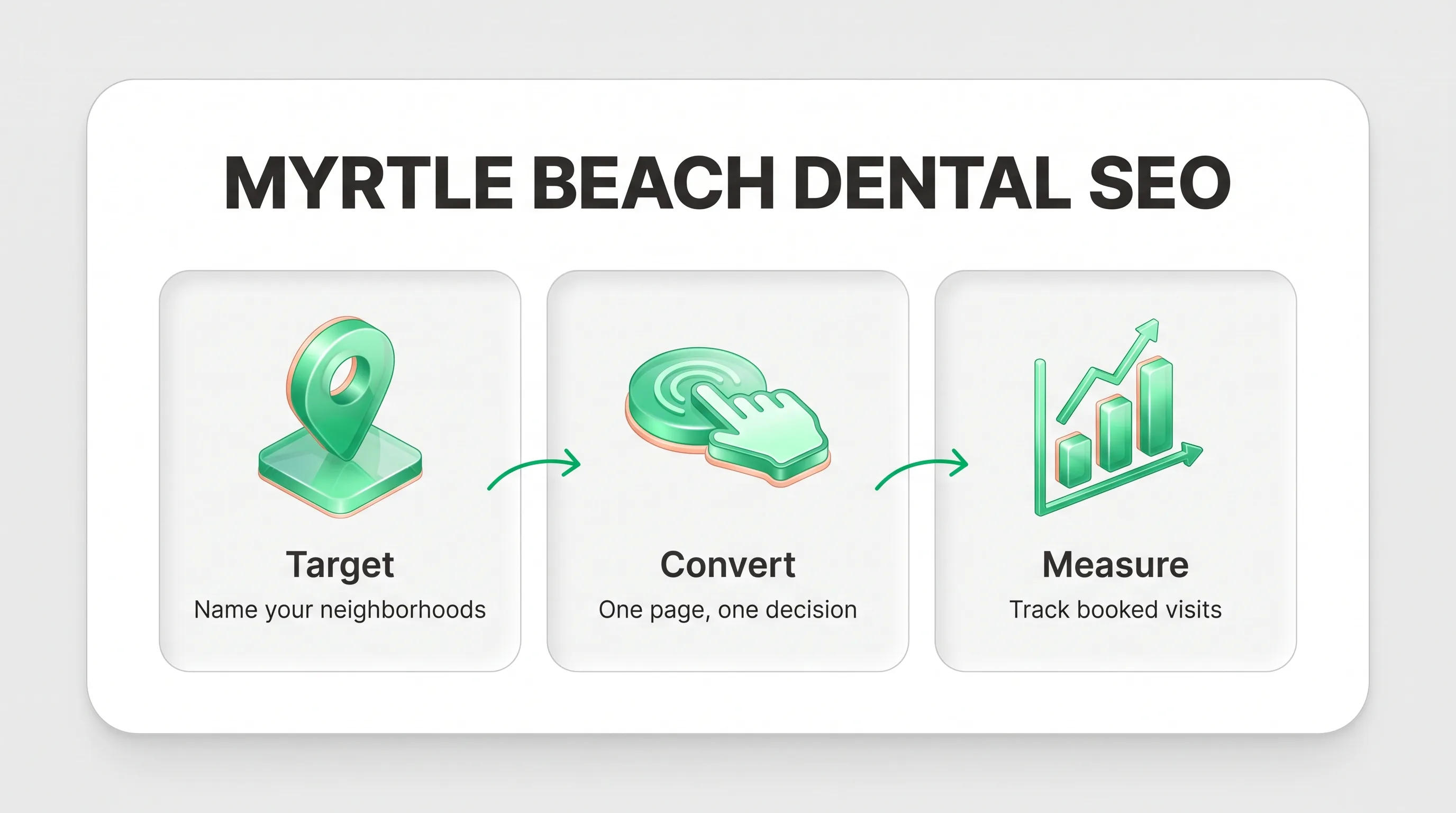
A patient in Carolina Forest searching "dentist near me" and a patient on Ocean Boulevard searching the same phrase land in different map results, even though both searches look identical. Myrtle Beach proper, North Myrtle Beach, Surfside Beach, and Conway each pull their own local pack. If your service pages treat the Grand Strand as one undivided market, you rank weakly across all of it. The fix is pages that name the specific neighborhoods you actually serve, so Google can match you to the right radius. Dental SEO services built for a coastal market account for this geography from the start, not as a revision layer added later.
Invisalign, dental implants, cosmetic whitening, and veneers generate the highest comparison volume in Myrtle Beach searches. These are not emergency needs. A patient weighing veneers has usually spent weeks reading before she types anything into Google. She compares three practices before contacting one. Your service pages for these treatments need to answer the questions she carries into that search, not just confirm you offer the procedure. One dedicated page per treatment, targeting a phrase like "dental implants Myrtle Beach SC," consistently outperforms a single services overview. Thinking through which dental SEO keywords deserve their own page determines whether she finds you or finds a competitor two streets away.
Myrtle Beach runs at two speeds: a full-time population of roughly 35,000 residents and a tourism economy that swells the area to over 20 million annual visitors. That split changes what patients need to see before they book. A snowbird on a three-month stay weighs whether you accept out-of-state insurance. A family visiting for a week needs to know same-day availability exists. Year-round residents care about parking and weekend hours. None of this belongs buried in a "contact us" page. Surface parking, accepted insurance carriers, extended hours, and your policy on urgent same-day cases directly on the relevant service or location page. A tourist with a cracked crown who is only in town for the weekend chooses the practice whose site answers that question, not the one with the most elegant homepage.
Rankings generate clicks. Clicks become booked visits only when the page answers the exact question the patient carried into the search. A page titled "Cosmetic Dentist Myrtle Beach" that opens on your philosophy and office culture answers the wrong question. The patient at that moment wants to know: what does the procedure involve, roughly what does it cost, and can I see results on someone like me. Each service page should resolve one decision, not introduce the practice generally. That constraint tightens copy and raises the share of visitors who request an appointment rather than clicking away. A broader dental SEO strategy sets the sequencing, but the page-level decision focus is where conversions happen.
Before and after photos on a veneers page carry more weight than a paragraph about your technique. A review that names the procedure and describes how the patient felt walking out carries more weight than a five-star average sitting in a widget. Proof works when it is specific enough to feel real and placed close to the decision point, not filed away on a testimonials page a patient will never visit. Case examples and outcome photos belong on the service page itself, near the booking prompt. For a deeper look at what that evidence looks like over a real timeline, a dental SEO case study shows the pattern from ranking to booked visit across a comparable market.
Rankings climb. Calls stay flat. This is more common than most practitioners expect, and the cause is almost always one of three things: the page does not answer the question the search implied, the call-to-action is too passive, or the front desk drops the follow-through. Start by checking whether your booked-visit rate on high-ranking pages matches your call volume. If calls are coming in but appointments are not, the bottleneck sits at the phone, not the page. If clicks arrive but calls do not, the page itself is not converting. Knowing which gap to close first saves months of misallocated effort. For quick structural fixes worth testing before a full rebuild, practical dental SEO fixes often move the needle faster than adding new content.
Impressions and click-through rates describe attention, not revenue. The numbers that matter for a Myrtle Beach dental practice are calls generated, appointments booked from those calls, and the treatment type attached to each booking. Track them together and a pattern emerges quickly: high call volume from emergency searches converts at a lower case value than lower call volume from implant or cosmetic searches. Knowing which procedures each traffic source actually produces tells you where to deepen the SEO investment and where to hold. Comparing this against how another market handled the same shift is easier when you read a city-specific dental SEO example with the same measurement framework.
Rankings were strong at one practice, the phone rang, and new-patient volume still sat flat for two months. The problem was a front-desk script that gave price information before the patient felt heard, so she hung up and called the next practice on the list. The fix had nothing to do with SEO. Diagnosing the real bottleneck requires three separate checks: impressions and click data for visibility, page engagement and call volume for trust, and call recordings or booking ratios for front-desk conversion. Each layer answers a different question. If you are weighing which part of this work to hand off, thinking through choosing a dental SEO company that measures all three layers together keeps the accountability in one place.
Map pack presence, listings accuracy, and review volume feed the visibility layer. That operational side sits cleanly inside local dental SEO practice, worth running in parallel with the content work described here.
Dental SEO in Myrtle Beach works when it matches how a specific patient in a specific neighborhood makes a specific treatment decision.
We review your pages, search visibility and enquiry path, then show you what to fix first.
.svg)