

One unread evening message can hand your veneer patient to the practice next door.
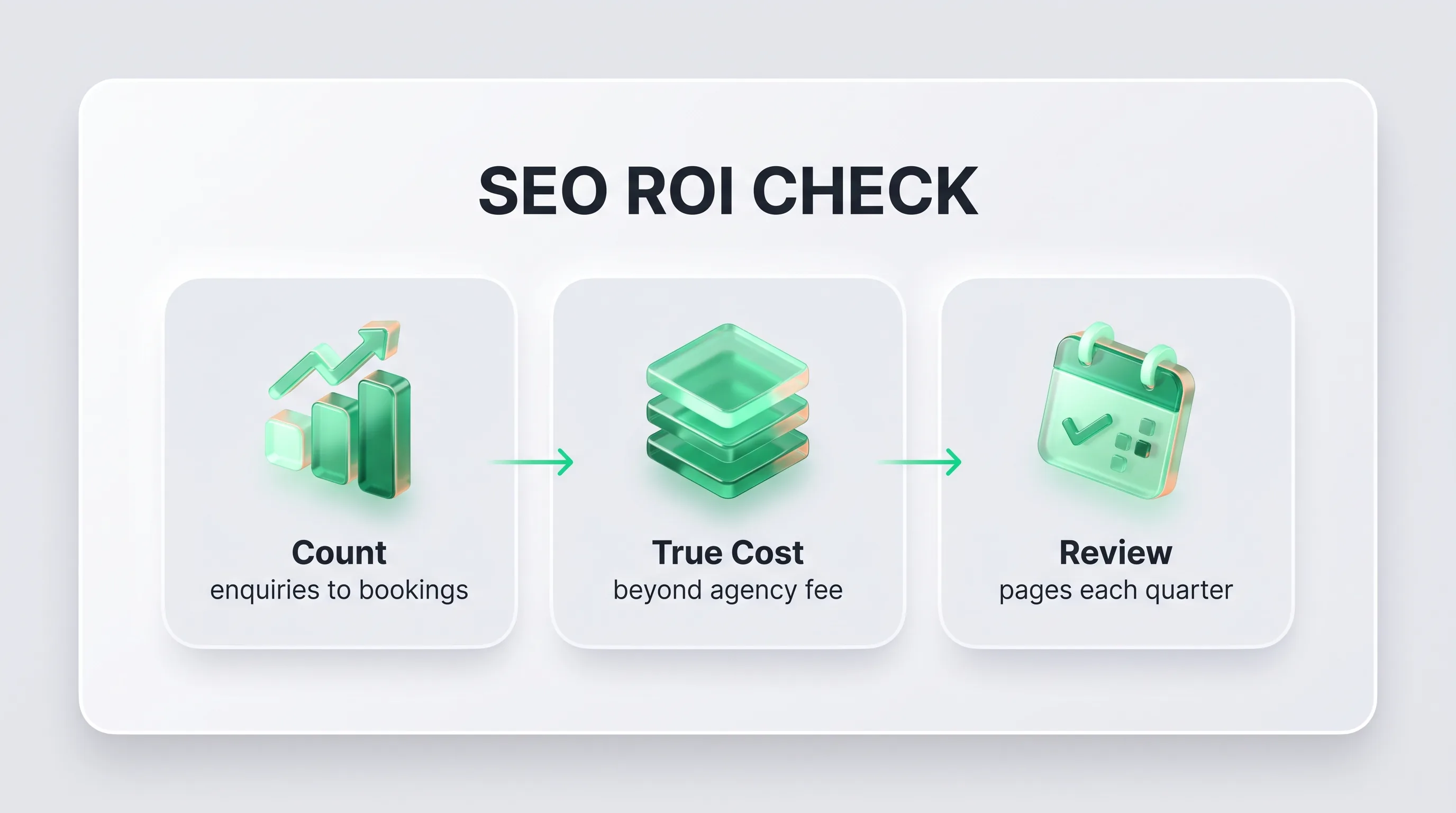
The article shows that most practices lose the return not at Google but between the enquiry and the callback, when a message sits overnight and the patient books elsewhere. It also shows that your true programme cost runs 20 to 40 percent above the agency invoice once your team's time and missed calls are counted in.
A patient searching "dental implants near me" during a quiet weekday morning is worth fundamentally more than one searching "how to whiten teeth at home." Both click. Only one books a case that pays for six months of dental SEO investment. Ranking well for general dentistry terms can fill hygiene slots and little else. The revenue per visit rarely justifies the effort. High ROI SEO for dentists starts with a deliberate list: implants, clear aligners, veneers, full-arch rehabilitation. Procedures where a single patient signing covers your retainer many times over.
Traffic numbers feel satisfying on a monthly report. They rarely tell you whether the spend made sense. A better baseline is the average case value for each treatment you target, multiplied by your closing rate from organic enquiries. If implant cases average between £3,000 and £5,000, and you close one in three consultations, each booked consultation from search is worth more than £1,000 in expected revenue. Measure from there. For context on how this shifts your overall dental SEO strategy, the planning calculus changes entirely when lifetime patient value enters the equation.
Not every page on your site earns its place. Pages ranking for low-value, high-volume terms pull in visitors who never consult, clog your analytics, and make your conversion rate look worse than it is. Audit your organic landing pages quarterly. If a page drives significant sessions but zero consultation requests over six months, it is diluting your ROI picture. Deciding which terms to retire is a keyword-targeting question your dental SEO keywords framework should answer, but the ROI signal is simple: revenue potential per visitor, not rank position.
A prospective Invisalign patient finds your site during a Sunday afternoon search, spends four minutes on your treatment page, and submits an enquiry form. That is the moment most tracking stops. But the conversion happens later: when someone from your team calls back, handles the question about cost, and books the consultation. Without call tracking that ties back to the organic source, you cannot see whether SEO produced that patient or a paid ad did. Tools that assign a unique number to organic visitors close this gap. Without them, you are flying without instruments.
A patient messages at 8pm about a veneer consultation. Your front desk reads it at 9am the next day. By then she has booked with the practice that replied first. This is front-desk leakage, and it is where SEO return quietly disappears. Your rankings improved, your traffic grew, but the ROI report still looks weak because the enquiry never converted. Ranking and response rate are separate variables. Measure both. Track enquiry-to-consultation rate by source each month. If organic enquiries convert at a lower rate than referrals, the problem is almost never the SEO. It is the handling time or the first reply quality. Untangling these lets you fix the right thing rather than cutting the budget that is actually working. For practitioners weighing whether the visibility gain justifies the spend, a dental SEO case study gives you concrete conversion timelines to benchmark against.
Four figures belong on any honest monthly view: organic sessions to treatment pages, enquiries generated from those sessions, consultations booked from those enquiries, and cases signed from those consultations. Everything else is context. Revenue divided by total SEO spend gives you the return ratio. If you cannot connect a signed case to its original search visit, your reporting chain has a gap. Practices that also compete on local dental SEO visibility should track map-pack impressions separately, since that channel drives calls rather than form submissions and needs its own conversion funnel.
Most ROI calculations start and stop at the monthly retainer. That distorts the denominator. Add the time your practice manager spends reviewing content drafts, chasing approvals, or updating treatment prices on pages your agency built. Add the cost of missed calls when enquiry volume rises faster than your front desk capacity. Add any photography, compliance review, or software the campaign requires. When you include these, the true cost of your SEO programme typically runs 20 to 40 percent above the agency line. That does not make the investment wrong. It makes the return figure honest. For a structured view of what goes into that cost stack, the detail on dental SEO cost breaks it down by practice size and scope.
A new implant page on a site with limited authority does not rank in six weeks. Organic pages typically need 90 to 180 days to move into competitive positions, and another few months on top of that before they generate consistent consultation volume. Expecting positive ROI in month two sets up a misleading early verdict. The compound nature of organic search means the return ratio generally improves through the second year as pages mature, authority accumulates, and your team gets better at handling the enquiry flow that results. Practitioners comparing organic timelines against paid search should read the broader search marketing mix analysis before reallocating budget based on short-cycle data. Patience here is not passive. It is the mechanism.
High ROI SEO for dentists comes down to one discipline: measuring what a signed case is worth, then protecting every step between the search and the signature.
We review your pages, search visibility and enquiry path, then show you what to fix first.
.svg)