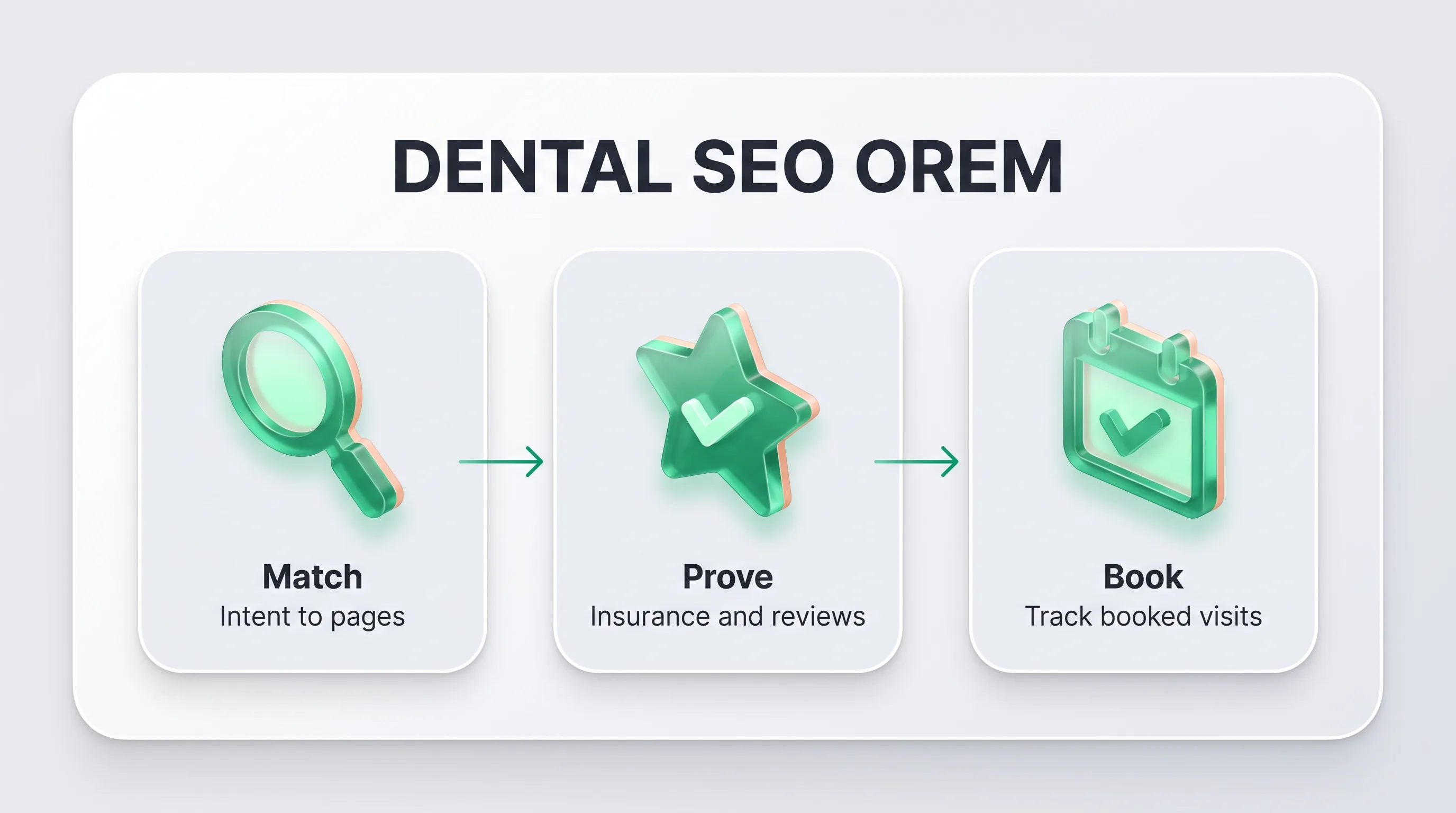
Dental SEO Orem that fits how patients choose
Start with the treatments Orem patients actually search before they call
A patient weighing dental implants in Orem does not search "dentist." She types "dental implants Orem UT" or "implant cost Orem" weeks before she picks up the phone. If your service pages are built around what you offer rather than what she asks, you miss her at the moment she is deciding. Dental SEO Orem work that converts starts with those specific treatment-plus-city queries, not broad terms. Our broader dental SEO services page covers the full execution model, but the entry point is always patient language mapped to a real service.
Separate citywide demand from nearby neighborhood intent
Ranking for "dentist Orem" citywide looks impressive in a report. But a family near UVU searches differently than one near the Orem-Provo border, and proximity still shapes the click. Citywide visibility fills impressions; neighborhood-level intent fills the appointment book. The gap matters because a patient who clicks your site from across the city and sees no mention of her area quietly leaves. Pages that name nearby landmarks, reference Vineyard or Lindon as neighboring service areas, and answer questions specific to that catchment convert searches into booked visits that are actually convenient. Understanding which dental SEO keywords carry location modifiers versus pure service intent is what separates a ranking from a visit.
Match each service page to one next patient decision
A Thursday afternoon: a prospective Invisalign patient lands on your "cosmetic dentistry" page, finds five services stacked together, and cannot work out whether you actually do Invisalign or just list it. She closes the tab. Each service page should answer the one question that patient has at that stage, whether that is candidacy, timeline, or cost range, and end with a single clear action. One decision per page, one CTA per page. Broader dentist SEO fundamentals explain why page focus lifts conversion across the whole site.
Build local proof before rankings stall
Show the insurance, financing, and visit details that affect choice in this market
Orem is a family-dense, value-conscious market. A patient comparing two practices during her lunch break checks whether you take her plan before she reads a single review. If your site does not list accepted insurance, mention financing options, or state your new-patient process, she moves on to the practice that does. These details sit at the bottom of most dental websites, treated as fine print. Move them up. A dedicated "what to expect" section that names real carriers and real payment terms converts browsers who would otherwise call to confirm and never actually call. For practitioners who want to understand how local SEO for dentists ties listings to these on-page trust factors, that connection is direct.
Use reviews to confirm fit, not just boost star count
One mid-size practice carried a strong star rating but thin conversion on cosmetic cases. The reviews all praised staff friendliness. Not one mentioned a veneer, an implant, or Invisalign. Patients researching elective procedures need to see that someone like them chose you for that procedure and was glad they did. Prompt patients to mention the treatment specifically, not just the experience. Respond to every review, but keep HIPAA boundaries clear: confirm nothing clinical in a public reply. A dental SEO Orem strategy that treats reviews as conversion copy, not vanity metrics, closes that gap between a high rating and an accepted case.
Keep treatment claims and before and after proof compliant
Before-and-after photos carry real weight for cosmetic and restorative cases. They also carry regulatory risk in Utah if the caption implies a guaranteed outcome or if consent documentation is incomplete. The fix is straightforward: caption every case with the procedure name and a factual description, skip superlatives, and keep written patient consent on file. A dental SEO strategy built on compliant proof holds up under scrutiny from both Google and licensing bodies. Cutting corners here costs more than the ranking gain is worth.
Judge your Orem plan by booked visits
Which numbers show whether search is filling the right chairs?
Organic impressions going up while new-patient bookings stay flat is a signal, not a success. The numbers that matter are call volume from organic search, form completions tied to specific service pages, and the ratio of consultations to signed cases for high-value treatments. Track those three alongside rankings, and the picture sharpens quickly. If impressions climb but calls do not, the page is ranking for terms that do not match patient intent. If calls come in but few convert, the bottleneck sits further down. Practitioners who want to see how these metrics connect to monthly dental SEO services deliverables will find the reporting structure laid out there.
Spot whether the bottleneck is visibility, trust, or what happens when the phone rings
Low impressions mean the site is not ranking yet: a visibility problem. Decent impressions but poor click-through usually mean the page title and meta description do not match what the patient expected: a relevance problem. Good clicks but no calls point to missing trust signals on the page itself, such as the insurance and financing details covered above. Calls that do not convert to appointments often trace back to front-desk response time. A patient who leaves a voicemail and hears back a full day later has already booked elsewhere. Identifying which layer is leaking tells you exactly where to apply effort, which is what a real dental SEO expert audit surfaces first.
When every layer from search intent to front-desk response works together, your Orem practice stays booked with patients who arrive already decided.