

Your evening patients are choosing a dentist right now, and finding your competitor.
A patient researching composite veneers or implants at 10pm will book the practice whose page answers her questions first. If your phone is quiet while your chairs have room, the gap is probably the pages you have not built yet.
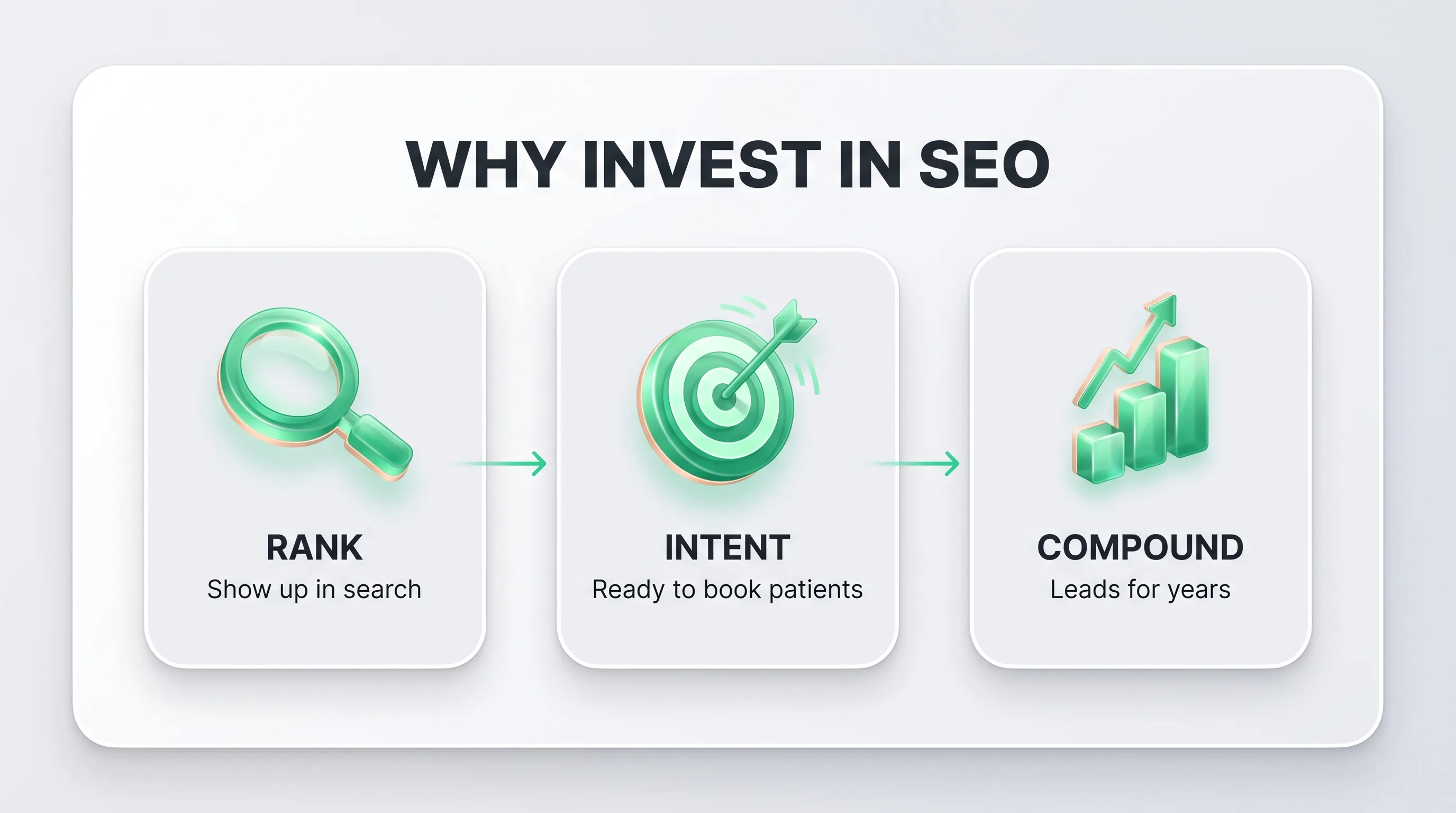
A patient sits at her kitchen table after dinner, weighing two quotes for composite veneers. She opens Google, types a treatment plus her suburb, and scans the first three results. The practice that ranks there gets the call. The one running display ads she scrolled past does not.
That moment is what dental SEO for your practice is built around: appearing at the precise second a patient has already decided to act, not before and not after. No other channel intercepts that moment as cleanly.
Search is self-selected. A patient who types "dental implants" followed by a suburb name has already moved past curiosity. Compare that to someone who sees a sponsored post on social media while scrolling between meetings. The intent gap between those two visitors is enormous, and it shows in how many of them sign a treatment plan.
Understanding how dentist SEO converts the right patients matters here: organic visitors arrive with a specific need named, which means your front desk spends less time qualifying and more time booking.
Paid ads stop the minute the budget does. A page that ranks for implant consultations in your city keeps pulling inquiries at 11pm on a Saturday, without an active spend behind it. That compounding effect is why practitioners who invest in SEO early tend to reduce their cost per new patient over a two-to-three-year horizon, even as competitors keep feeding ad platforms.
Word-of-mouth tends to fill the hygiene chair but rarely brings in the implant or full-arch cases a practice wants. The patients weighing those treatments are searching, not asking a friend. A dedicated page built around what they are typing can change which calls come in.
That specificity is the point. When you build pages around high-value treatment searches, you filter for the patient already considering the procedure, not one who needs convincing from scratch. Matching your pages to treatment demand is how you shift your case mix without changing your clinical offer.
Referral networks thin out when a colleague retires or moves. Ad performance swings with platform algorithm changes and competitor bids. Organic search rankings, built on content and site authority, absorb those shocks better because no single external party controls them.
Practices with strong local search visibility spread their patient sources across several channels, so a dry month from one does not stall the schedule entirely. That diversification is worth as much as the raw volume SEO produces.
A single, well-optimized service page answering the questions a patient types before booking can generate inquiries for years. It does not fatigue like an ad creative. It does not require a media buy to stay live. Once it ranks, it works every day the practice is closed, every evening a patient researches from the sofa.
If you want to move from the decision to invest toward a workable plan, a clear SEO strategy for dental practices maps which pages to build first and in what order, so the compounding starts on the treatments that matter most to your revenue.
Search volume for dental implants, clear aligners, and cosmetic work in most metro areas is real and measurable. If patients are typing those terms near your postcode and your practice does not appear on the first page, a competitor captures every one of those inquiries by default. That gap is the clearest signal that the timing is right.
Before committing, it is reasonable to ask what the spend actually looks like. Reviewing what dental SEO typically costs against your average treatment value gives you a concrete return threshold, not an abstract one.
More inquiries arriving at a practice that misses half its calls, runs at full capacity, or loses cases at the consultation stage will not improve revenue. They will frustrate your team and produce a worse conversion rate on a larger number of leads. SEO lifts the top of the pipe. If the pipe leaks further down, ranking higher accelerates the leak.
Be honest about where patients actually drop off. If your front desk returns evening inquiries the next morning, a patient has already booked with a competitor down the block before your team picks up the phone. Fix that first. Once your phone handling, chair availability, and case acceptance are solid, what SEO services actually include each month becomes a straightforward conversation about scaling something that already converts.
The practices that get the best return from SEO are not the ones that start fastest. They are the ones that start when they can genuinely handle what ranking produces.
When your operations are ready to handle the volume, investing in SEO gives your practice a patient pipeline that compounds quietly while you focus on care.
We review your pages, search visibility and enquiry path, then show you what to fix first.
.svg)