

One dentist got weekly reports for eight months. New patient calls barely moved.
An agency can show you impressive numbers while the pages that matter most to your income go unexamined. The proof worth asking for is what happened to booked consultations for high-value treatments, not how many people landed on the site.
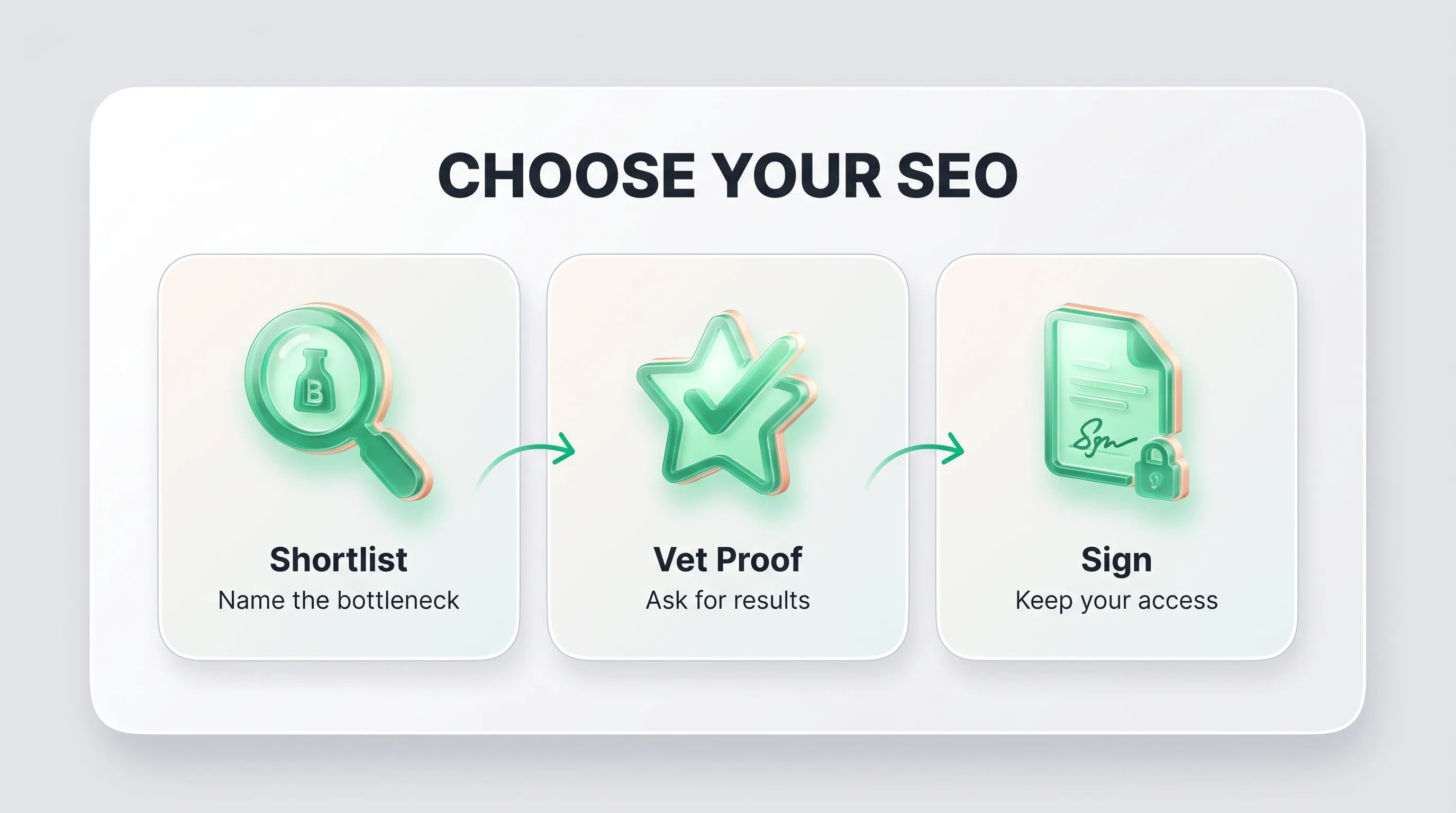
A practitioner I know spent eight months with an agency that delivered weekly ranking reports. New patient calls barely moved. The problem was never keywords: it was that his implant pages converted at a fraction of his hygiene pages, and nobody had looked. Before you shortlist anyone, name the actual gap. Low organic visibility, weak conversion on high-value service pages, and thin local map presence each need a different emphasis from whoever you hire. If you cannot state the bottleneck in one sentence, you will evaluate vendors on the wrong criteria and end up in the same position he was. A sharper starting point also protects you when an agency's proposal sounds comprehensive but addresses nothing specific to your practice. Understanding dental SEO as a discipline helps you ask the right diagnostic questions before the first call.
Dental-specific experience matters most when your growth depends on high-intent, procedure-level searches: implants, Invisalign, full-arch restorations. A generalist who has never written a service page for a surgical procedure will miss the patient intent that separates an information search from a booking decision. That said, a strong local SEO operator with two or three verifiable dental clients often outperforms a dental-only agency that has grown complacent. The test is not the niche label; it is whether they can show you a dental practice, by name, where organic traffic translated into a measurable shift in booked consultations. If they cannot, the specialization claim is marketing, not proof. You can browse top dental SEO companies to see how agencies position themselves before you start interviewing.
Two to three case studies, real practice names, and results tied to patient volume or the procedures those patients ultimately booked: that is the minimum. Rankings screenshots without call or booking data tell you nothing useful. A case study that shows organic traffic doubling but omits what happened to new patient appointments is incomplete. Ask for a sample monthly report before you sign anything. The report format reveals more than a sales deck: you see whether the agency tracks calls, form submissions, and the procedure mix driving inquiries, or whether they count sessions and impressions and call it a day. Keep your shortlist to teams that clear this bar. For practitioners who want to understand what persuasive proof actually looks like in practice, a dentist SEO case study walkthrough is worth reading before you sit down with candidates.
A patient weighing full-arch implants does not convert the same way a routine cleaning inquiry does. The agency you hire should know that distinction and show you they have tracked it. Ask specifically: what was the procedure focus in the campaign, how did call volume move over the first six months, and did booked consultation rates shift for higher-value treatments? If the answer is traffic numbers and keyword counts, stop there. Agencies that measure what matters to a practice, not to their own dashboard, report differently. They know your chair time is finite and that one implant case outweighs a dozen hygiene appointments. That is the frame you want them working in. Dental SEO services vary widely in what they actually track and report, so comparing scope before signing protects you.
Most agencies will send a proposal that lists deliverables: audits, keyword research, on-page optimization, content calendar. That list tells you what they do, not how they think. The question that exposes the difference is simple: what will you learn about my practice in the first 30 days before executing anything? A templated approach starts tasks on day one because the plan was written before anyone understood your local competitive position, your current conversion gaps, or which pages already earn qualified traffic. A diagnostic approach reserves the first few weeks for reading your analytics, your call data, and your geographic market. Practitioners often lose three to four months to generic task completion before an agency realizes the real problem is different from what the proposal assumed. That is avoidable. Ask for a written 90-day plan, and check whether week one says "audit your existing traffic and calls" or "publish first content batch."
No credible agency guarantees a specific ranking position. Search algorithms shift, competitors invest, and a page that ranks today can slip next quarter without any fault on either side. What a serious agency offers instead is a realistic window: meaningful local momentum for a dental practice typically builds somewhere in the 90-to-180-day range, with measurable call and inquiry shifts usually appearing in that window across multiple sources. If a vendor promises first-page placement within weeks, the claim itself is the red flag. You are looking for a team that ties milestones to patient-facing outcomes rather than ranking positions, because a ranking that sends the wrong intent traffic fills your schedule with the wrong cases. Understanding the full range of dental SEO cost versus expected timelines helps you calibrate whether a proposal is realistic or optimistic.
Ownership questions feel administrative until something goes wrong. A practice I worked with paused their agency relationship mid-campaign and discovered they had no access to their own Google Analytics property, no exported content files, and no login to the Google Business Profile the agency had been managing. Recovering those assets took weeks. Before you sign, confirm in writing: you hold admin access to your website CMS, your analytics account, and your business profile. Content published on your site is yours. Reports go directly to you, not through a filtered agency portal. Approvals for new pages or claims about your services run through you, not around you. For practices promoting high-value procedures, this last point also carries compliance weight. One agency-authored page that overstates an outcome can create a problem no ranking improvement fixes. Make the approval workflow explicit in the agreement. A dental SEO expert working inside a clear ownership structure moves faster, not slower.
Three clauses deserve close reading before any signature. First, asset ownership: does the contract state explicitly that your domain, your content, your analytics data, and your business profile listings remain yours if you leave? Some agencies build sites on proprietary platforms that cannot be transferred. If the contract is vague on this, treat it as a no. Second, exit terms: how much notice is required, and what happens to active campaigns mid-cycle? A 30-day exit window is reasonable; a 12-month lock-in with no performance benchmark is not. Third, exclusivity: does the agency work with a competing practice in your postcode or service area? The answer shapes how motivated they are to protect your local position. Reading the contract carefully also helps you spot whether the scope matches what was promised in the pitch. If you want a parallel framing for the overall vendor selection decision, choosing a dental SEO company from a different angle covers complementary ground.
The right SEO company earns your signature by showing real dental results, a diagnostic first 90 days, and contract terms that keep your assets firmly in your hands.
We review your pages, search visibility and enquiry path, then show you what to fix first.
.svg)