

Your pages can come up first and still not fill a single appointment slot.
A clinic whose pages match what local patients actually search for, show insurance details upfront, and have a working booking path will pull ahead of one with better placement but no answers. The gap between being found and getting the patient to say yes is almost always on the page itself, not in how Google sees the practice.
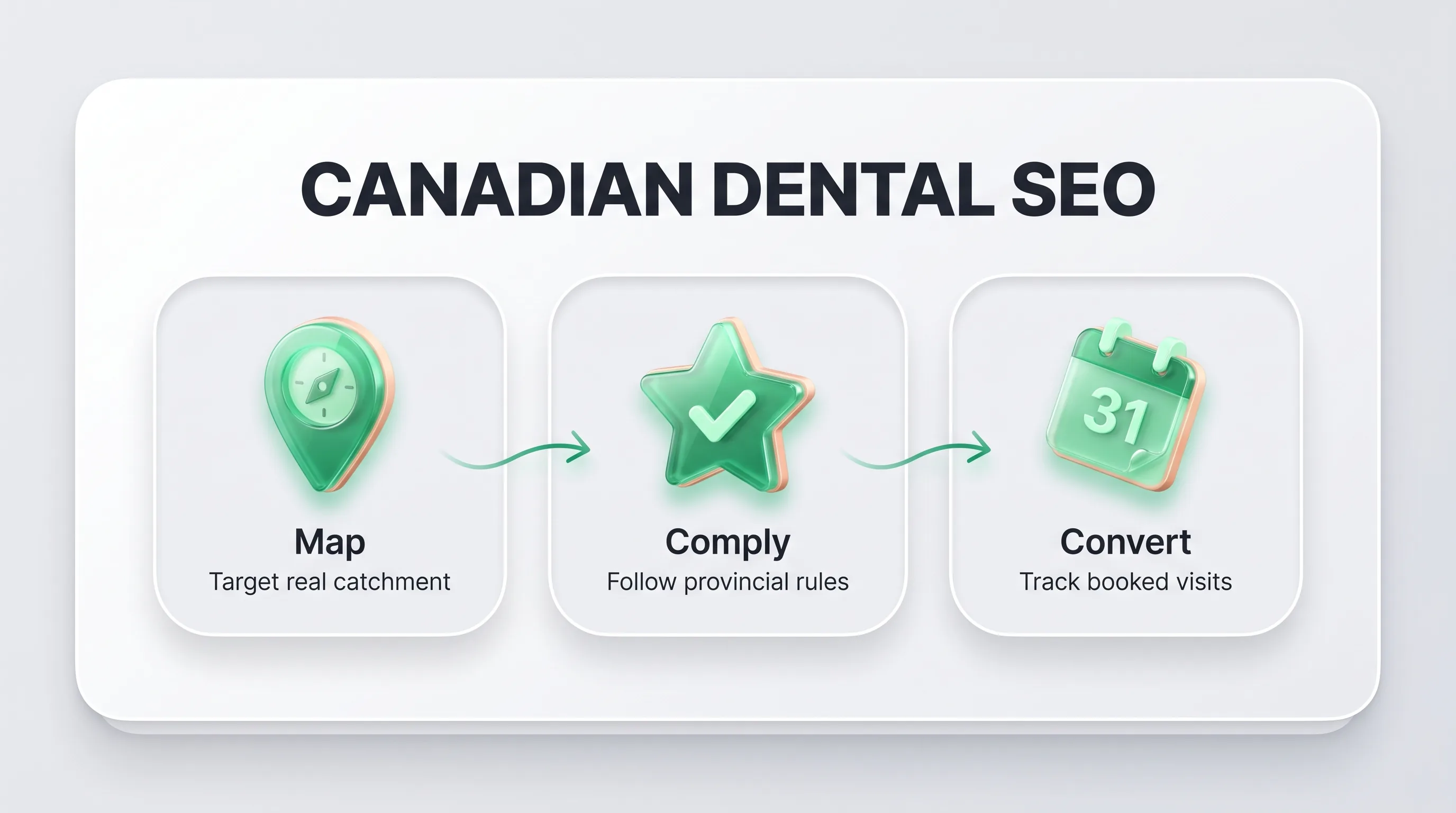
A patient in Burnaby searching for a family dentist behaves differently from one in Laval doing the same search from a different transit line and a different insurance market. National averages tell you nothing useful. What fills your chair is the specific neighbourhood, the transit corridor, or the suburb where your patients actually live, and whether your pages appear when they search from there.
Canadian dental SEO, done well, means mapping your real catchment area before writing a single page. A clinic in North York competes against practices within a few kilometres, not across Ontario. Your dental SEO services strategy should reflect that geography precisely, not a Canada-wide abstraction.
Implant demand in a mid-sized Prairie city runs differently from cosmetic demand in downtown Vancouver. If your service pages list every treatment with identical copy, Google treats them as thin, and patients skip them as generic. A dedicated page for a specific treatment in a specific city, written to reflect real local questions, consistently outperforms a catch-all services list.
Solid SEO keyword planning at the city and treatment level tells you where real search volume lives before you build those pages, so you spend the work where it returns appointments, not traffic that never books.
A clinic in Gatineau or Moncton that publishes both English and French pages for the same treatment faces a structural risk most Canadian practices ignore: if those pages are near-identical translations sharing the same URL signals, they split authority and push each other down. Separate URLs with distinct hreflang attributes, genuinely adapted copy, and region-specific terms keep each page targeting the right language audience without cannibalizing the other.
Regional wording matters even within English. A patient in Calgary searching "tooth whitening" and one in Halifax searching "teeth bleaching" may want the same procedure. Match the local phrasing, not the clinical standard term, and your pages capture both without competing against each other.
The Royal College of Dental Surgeons of Ontario and the College of Dental Surgeons of BC both restrict before-and-after images, testimonials, and superiority claims in ways that most generic dental SEO guides do not mention. Publish a page with a patient photo carousel and a headline like "best dentist in the city" and you risk a regulatory complaint, not just a Google quality flag. Provincial rules vary, so what clears approval in Alberta may not pass in Quebec.
Review every service page against your provincial regulator's advertising guidelines before it goes live. That step belongs at the content-creation stage, not as an afterthought when a complaint arrives.
A patient comparing two practices on a Thursday afternoon often makes the shortlist decision before calling either clinic. If one practice clearly shows which insurers it accepts, whether it offers financing, and how the Canadian Dental Care Plan applies to their family, that practice answers the question the patient is already asking. The other clinic gets skipped.
CDCP eligibility and accepted insurers belong on your service pages and booking path, not buried in an FAQ. Patients weighing a larger restorative case or orthodontic treatment factor cost coverage into the decision early. Surface that information where they look, and you reduce the friction between a search and a patient who actually books. For readers thinking through SEO budgeting alongside these content investments, the per-page effort here pays back in conversion, not just rankings.
A multi-location group with offices in Calgary and Edmonton that lists different phone formats, varied address abbreviations, or mismatched hours across directories gives Google conflicting signals about each location. That inconsistency suppresses local rankings for both. Name, address, and phone number must match exactly across your website, Google Business Profile, and every Canadian directory where your clinic appears.
Booking paths compound this: if a patient lands on your Edmonton page but the booking widget routes to a Calgary number, she leaves. Clinics running multi-location SEO across provinces need each location treated as its own entity, with distinct URLs, consistent details, and a booking path that never confuses where the appointment actually sits.
Rankings are an input, not the outcome you run a practice on. I worked with a clinic group that had strong Google positions in two markets simultaneously. One location converted inquiries into consultations at a healthy rate. The other had similar traffic and almost no booked visits. The difference was a broken booking form nobody had caught. Ranking data alone would never have surfaced it.
Connect your analytics to call tracking, form submissions, and your booking system so you can see which city pages produce appointments and which produce abandoned sessions. SEO planning that includes measurement from the start tells you where the drop-off is: the search result, the page, or the booking step.
Rankings climb, but the schedule stays thin. That gap usually sits in one of three places: the page attracts the wrong intent (information seekers, not booking-ready patients), the offer on the page does not match what the patient expected from the search result, or the booking path adds friction at the last step.
Start with the page that ranks highest for a treatment term but converts the least. Check whether the content answers a booking-ready question or an educational one. Then check whether the call-to-action and the booking tool work on mobile, where most local dental searches happen. Website SEO basics cover the technical layer, but the fix here is often simpler: a clearer offer and a visible, working booking button. If the bottleneck is broader, practical SEO fixes can close the gap without rebuilding the whole site.
Canadian dental SEO rewards specificity: the practice that matches its pages to real local demand, stays compliant, and tracks what converts will consistently outpace the one chasing national rankings.
We review your pages, search visibility and enquiry path, then show you what to fix first.
.svg)