

Your schedule fills, but not with the cases you actually wanted.
Which words your website shows up for determines which patients call, and right now those words may be pulling people whose needs do not match your best work. The fix starts with listing the five procedures you most want to grow and building each one its own dedicated page around the exact phrase that patient types.
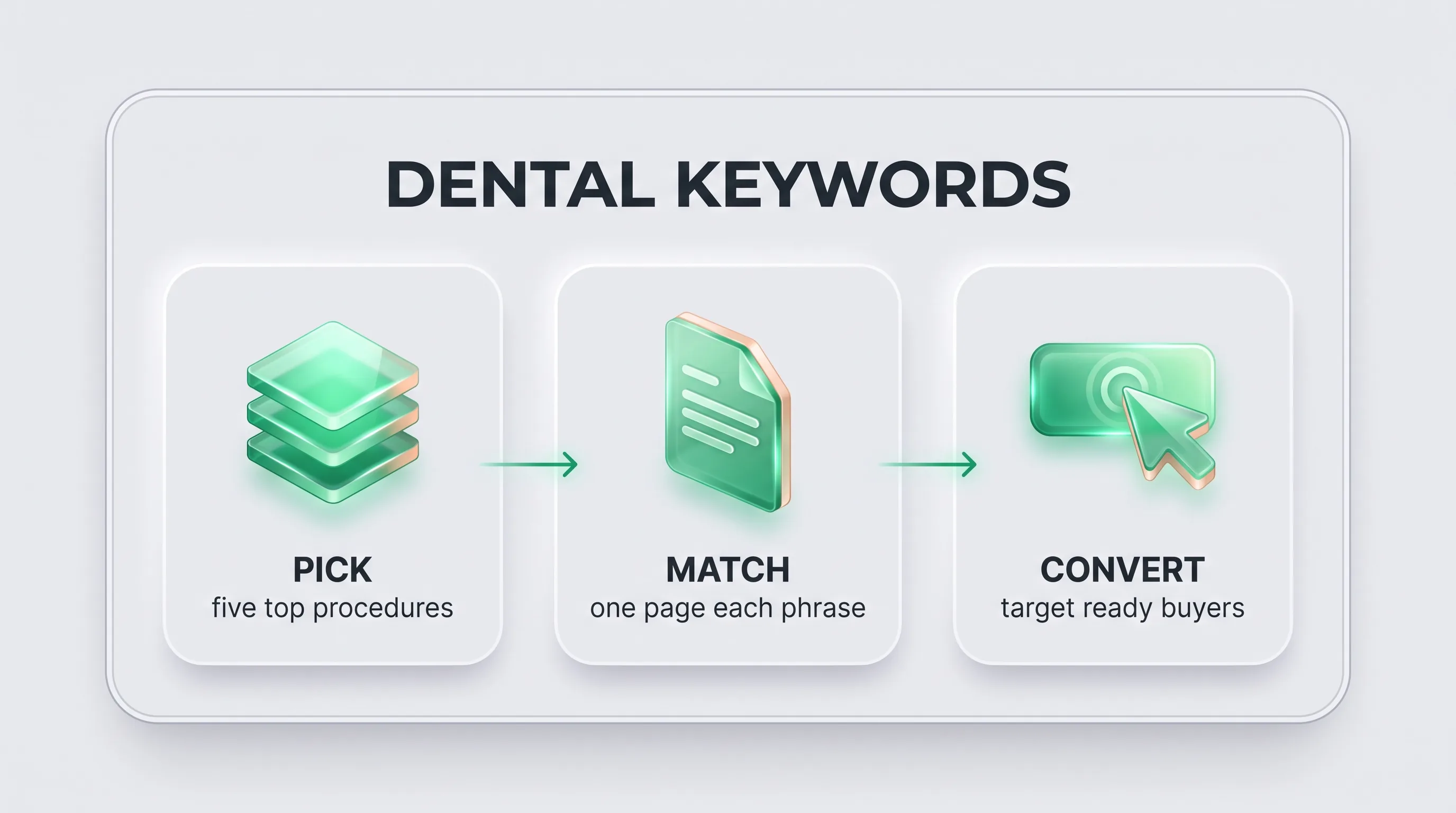
A Thursday afternoon: your schedule shows three hygiene checks and one emergency extraction. You wanted two implant consultations. The gap between what fills your chair and what you planned to grow almost always traces back to which dental keywords your site actually ranks for. Start there, not with volume charts.
List the five procedures that drive the most revenue or the ones you want to grow in 2026. Those become your keyword anchors. A practice pushing full-arch restorations needs phrases built around implant-supported solutions, not general cleaning terms. Procedure-first selection keeps every page earning toward a case type you actually want, rather than attracting patients whose needs you cannot serve well.
A patient typing "how much do veneers cost" is still comparing options. One typing "cosmetic dentist in Scottsdale" has already decided to call someone. Both matter, but they need different pages and different conversion goals. Mixing them on one page serves neither well.
For dental marketing that moves cases forward, map each keyword to a stage: research phrases belong on educational content, booking-intent phrases belong on service and location pages. If you want help distinguishing which terms signal each stage, keyword research for dentists covers the validation process in more depth.
Patients search "gum surgery" far more often than "osseous resection." They type "teeth straightening" before they learn the word orthodontics. Your site ranks for what people type, not what you were trained to say.
Pull language from your own intake forms, your Google reviews, and the questions your front desk hears daily. Those sources give you the exact phrasing a patient uses when she sits in her car outside your building, phone in hand, deciding whether to walk in. Long-tail keywords built from that wording convert better precisely because they match the thought the patient already has.
One page cannot rank well for implants, veneers, and Invisalign simultaneously. Each high-revenue service deserves a dedicated page built around one primary phrase. That phrase should be specific enough to describe the procedure and the patient outcome, not so broad that it competes with every general dentistry result in your city.
In practice, a site with six strong service pages, each targeting one clear dental keyword, outperforms a site with twenty thin pages chasing overlapping terms. Fewer targets, better supported, win more consistently. Your content marketing effort then feeds those pages rather than scattering across topics that never gain traction.
"Dental implants near me" drives consistent search volume across markets. "Pediatric dentist" with your suburb's name may pull almost nothing if your suburb is a smaller district inside a larger city people search by differently. Adding a local modifier costs nothing to write but wastes a page's authority if nobody actually searches that combination.
Check whether patients in your area search by neighborhood, city, or metro before you build location pages. A few verified searches matter more than a dozen assumed ones. The execution side of local search for dentists addresses how to confirm real geographic demand before committing a page to it.
This is the mistake I see most on dental sites, and the one competitors rarely explain clearly. A practice builds a page for "dental implants," another for "implants cost," a third for "implants near me," and a location page that also mentions implants. Google now has four pages making the same claim. None earns full authority because they split the signals that should concentrate on one.
Cannibalization, meaning two or more of your own pages competing for the same search, silently suppresses rankings without showing a visible error. The fix is a simple page-mapping check: list every service and location page, write one primary keyword beside each, and confirm no two rows share the same phrase. Where they do, merge, redirect, or sharpen the focus of each page until the map shows clean, distinct targets. If you run separate pages for emergency visits, implants, and three location areas, each page needs a phrase the others do not touch.
"Dentist" as a standalone keyword is dominated by directories, major chains, and sites with years of accumulated authority. A single-location practice targeting that term in 2026 will wait a long time for a ranking that may never arrive. That time and effort cost real money even when no ad spend is involved.
Ranking for a precise phrase like "all-on-four consultation in [your city]" is harder to discover but far easier to own, and the patient who searches it is already past the research stage. High-volume dental searches are worth knowing, but volume alone should never decide which terms you pursue. Difficulty relative to your site's current authority is the filter that matters.
A patient searching "affordable dentures" and landing on a page built around premium implant-supported restorations will leave immediately. That exit tells Google your page did not satisfy the query, and over time it suppresses the ranking you worked to build. Low fit traffic is not neutral: it actively damages performance.
Before adding any term to your target list, ask one question: does the patient this phrase attracts match a case you can close? If the answer requires a significant price objection, a service you rarely offer, or a patient profile outside your typical mix, skip it. Paid search follows different rules when testing fit quickly, but for organic pages, a wrong keyword costs you months of diluted effort before you can reverse course.
The right dental keywords do not just bring more visitors; they bring patients who arrive already aligned with the cases you want to treat.
We review your pages, search visibility and enquiry path, then show you what to fix first.
