
Your implant ad worked. Your front desk did not answer in time.
A paid ad earns a patient's click in seconds, but three things kill the booking before your team ever speaks: a page that buries the treatment, a form with too many fields on a phone screen, and a reply that arrives the next morning. The article shows where the money leaves and what to fix first.
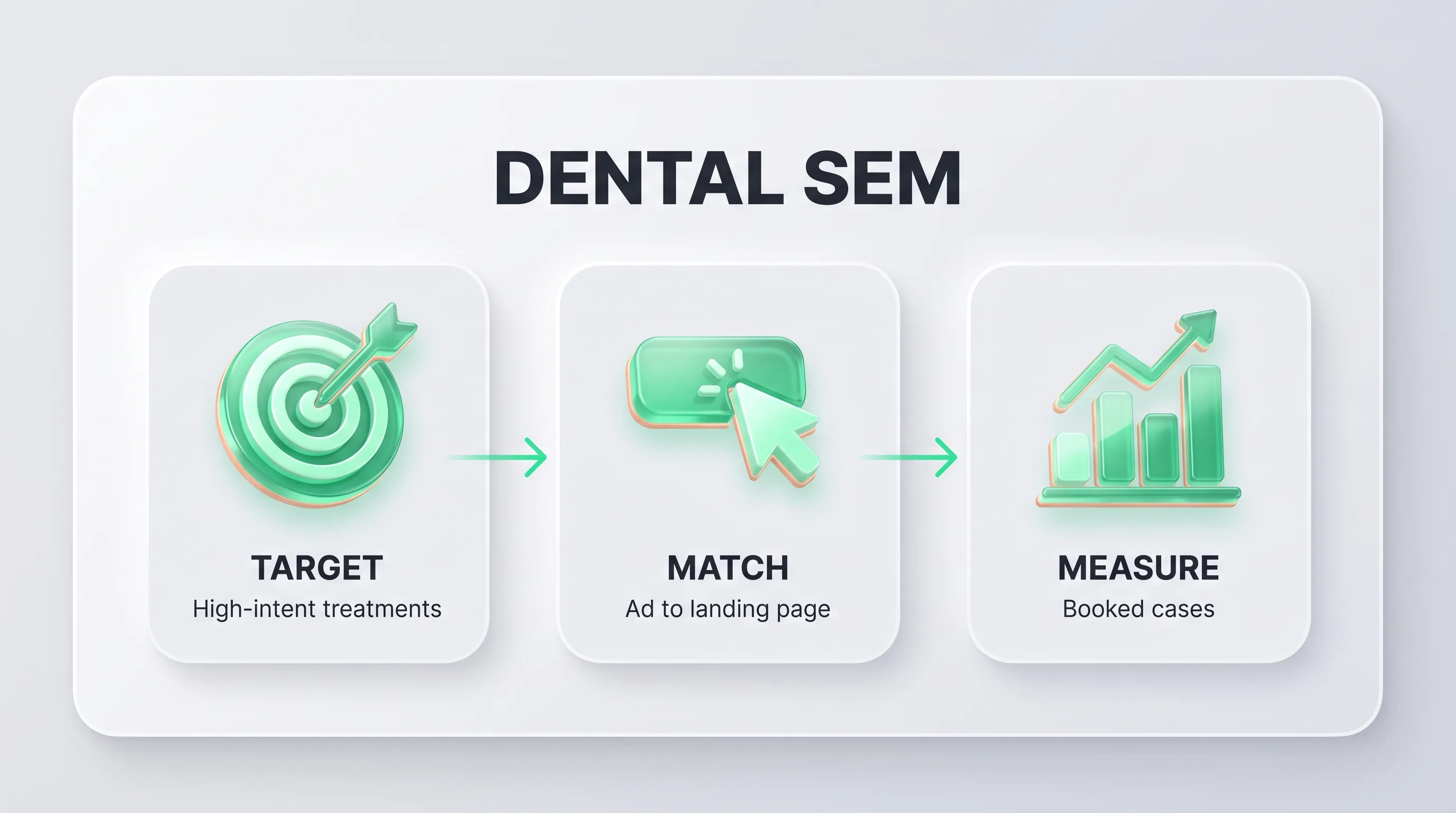
A patient searching "dental implants near me" during her lunch break has already decided she wants the procedure. She is choosing the practice, not the treatment. That is the moment dental SEM search engine marketing captures, and it is worth protecting. Paid search ads appear within days of launch, not months, which makes them the right tool when a treatment generates high revenue and the patient is ready now.
Start with your highest-value, highest-intent services: implants, clear aligners, full-mouth rehabilitation. These searches signal a patient close to booking, and the cost per click earns back quickly on a case that clears several thousand pounds or dollars. For a broader view of how paid and organic search should divide the work, your dental SEO strategy sets the foundation that makes paid spend more efficient over time.
A patient clicks your implant ad and lands on a page listing every service your practice offers, from check-ups to whitening to emergency care. She cannot find the implant information quickly. She leaves. You just paid for that exit.
A dedicated landing page, one that speaks only to the patient considering implants, removes that friction. It should confirm she is in the right place within the first two seconds: the treatment name, a clear next step, and a phone number or booking widget visible without scrolling. Website conversion pages that match the ad's promise convert at meaningfully higher rates than generic service pages, because the patient's decision does not have to restart on arrival.
Paid search wins when you need volume on a specific treatment now: a new implant offering, a gap in the schedule, a service not yet ranking organically. Organic search earns more over a longer horizon, lowering cost per booked visit as rankings build. The two are not rivals. In competitive urban markets, practices that rely on organic alone often watch paid ads from competitors sit above their best-ranked pages.
A working rule: run ads on treatments where you need immediate patients and where the case value justifies the click cost. Let organic handle discovery queries, condition-based searches, and the longer research phase. Understanding how paid and organic reinforce each other is part of a sound channel coordination plan.
Most practices that waste budget do it early: one campaign, every treatment, the entire city. The clicks come. Nothing books. The problem is dilution. A focused campaign for one service in one radius converts because every element points at one patient decision.
Pick the treatment your chair time needs most and the postcode radius your patients realistically travel. Geo-targeting in an urban practice often makes sense within three to five miles of the practice. Suburban catchments can stretch further, but wider radius means lower relevance, which means a higher cost per booked visit. Matching your scope to actual demand is also where treatment keyword targeting discipline pays off: the terms you bid on should mirror the exact service page you send patients to.
3 out of 4 high-intent clicks that do not convert fail because the ad promises one thing and the page delivers another. The copy, the landing page headline, and the booking step must form a single unbroken thread. If the ad says "same-week dental implant consultation," the page must say it too, and the form or phone number must be the next visible element.
Keep the booking path short. Every additional step, an extra form field, a redirect to a generic contact page, costs a percentage of completions. A click-to-call button matters most on mobile, where most searches now happen. A practice can spend adequately on ads and still lose leads to a long form nobody finishes on a phone screen.
A prospective implant patient submits an enquiry right after dinner. Your front desk picks it up the next morning. By that point, the same patient has likely called two other practices that responded the same evening. The click cost was real. The booking went elsewhere.
Response time is a conversion variable, not an operational detail. Before any campaign goes live, the practice needs a defined protocol: who handles after-hours enquiries, what the response window is, and how a missed call gets followed up within the hour during business time. This is the gap competitors consistently overlook. No level of ad spend recovers the lead that waited overnight. Reviewing your broader search growth plan will surface where response gaps undermine paid and organic demand equally.
A click report that shows 400 clicks and a 6% click-through rate tells you nothing about whether a single implant case was signed. The only metrics that matter connect to revenue: calls answered, forms submitted, consultations booked, and treatment plans accepted. Track each of these back to the campaign and keyword that generated them.
Call tracking assigns a unique number to each ad campaign, so your team knows which calls came from paid search. Combined with form submission tracking in Google Ads, this gives you a real cost-per-booked-visit figure. Some practices discover their "best-performing" campaign by clicks produced zero booked cases. For practitioners who want outcome evidence before committing further, a proof and performance review gives a concrete reference point.
Three sources drain dental SEM budgets quietly. First: search terms that sound relevant but attract the wrong visitor, job seekers searching "dental practice jobs," patients seeking NHS care when you are private, people researching costs with no intent to book. Negative keywords block these; without them, spend bleeds steadily. Second: a landing page that loads slowly or buries the call to action on mobile drives bounce before the patient reads a sentence.
Third, and most underestimated: a call answered poorly or not at all. If your front desk cannot handle the volume a campaign generates, or if calls go to voicemail during business hours, the ad has done its job and the practice has not. Fixing the page and the response protocol often recovers more revenue than increasing the budget. Local search visibility compounds this, because patients comparing practices check your map listing immediately after clicking an ad.
Run dental SEM with a tight scope, matched pages, and a front desk ready to answer, and paid search earns its cost per case.
We review your pages, search visibility and enquiry path, then show you what to fix first.
.svg)