

A plan with six items becomes background noise by week two.
Most practices stall not because they lack ideas, but because no single person owns each task with a deadline. One treatment page a month, one review process, one booking fix per quarter is a plan that survives a busy schedule.
A patient spends six weeks researching implants before she types anything into Google. When she finally searches, she lands on a generic services page that lists twelve treatments in three sentences. She leaves. That visit cost you nothing to earn and nothing to keep, and the practice with a dedicated implants page kept her.
The clearest of the best SEO dental marketing ideas is also the most skipped: give each high-value treatment its own page. Implants, veneers, Invisalign, and full-mouth rehabilitation each deserve a URL that answers the exact question the patient is already asking. One page per treatment means one focused signal to search engines and one clear door for the patient. If you want to understand how dental SEO connects page structure to revenue, that relationship starts here.
A treatment page without proof is a brochure. The patient weighing veneers has already read three brochures. What she needs is a before-and-after gallery with real cases, a plain-language explanation of what the procedure involves, and a sentence that tells her what happens at the first visit. Those three elements do more conversion work than any headline.
Patient testimonials tied to a specific treatment, not generic five-star praise, carry the most weight. Pair them with accurate procedure details and a visible booking path. Strong dental website SEO treats proof as content, not decoration, because a page that earns trust also earns time on site, which search engines register.
More traffic into a broken booking path just means more people leaving. A prospective implant patient arrives on your page right after the practice has closed for the day. The call button dials a front desk with the lights off. The online form asks for insurance information before it asks for a name. She closes the tab.
Check three things before you invest another hour in content: does the page have a visible call-to-action above the scroll, does the mobile experience allow booking in under three taps, and does an evening inquiry get a response before the next morning. Traffic you cannot convert is just a metric.
Weak page intent means your site attracts visits from people who were never going to book. They arrived on a post about tooth sensitivity and left. That is a content-match problem, not a volume problem. The fix is tighter targeting: rewrite page titles and headers around procedure-plus-location terms, and audit which pages are pulling non-converting traffic. Swapping one generic page for a focused treatment page with clear dental SEO keywords aligned to what patients actually search shifts the intent of your incoming audience before you touch anything else.
46 percent of Google searches carry local intent, but a patient searching for a periodontist in her neighbourhood and landing on your site still needs a reason to call. If visits are healthy and calls are not, the bottleneck lives on the page: no social proof, no clear next step, or a booking form that asks too much before it gives anything. The right idea here is conversion-focused, not traffic-focused. Add a testimonial above the fold, shorten the form, and make the phone number tap-to-call on mobile. For practices where map pack visibility is part of the gap, local dental SEO covers that angle separately.
A thin schedule usually means two problems at once: low visibility and low conversion. Trying to fix both simultaneously with a long tactics list is how practices spend three months busy and see nothing move. Pick the one bottleneck that sits earlier in the sequence. If your pages rank but nobody calls, conversion work comes first. If your pages do not rank at all, visibility work comes first. Running both in parallel only makes sense once you have an owner for each, which is why the sequence in the next section matters more than the idea count. A broader dental SEO strategy can map the full roadmap once you know which bottleneck you are starting from.
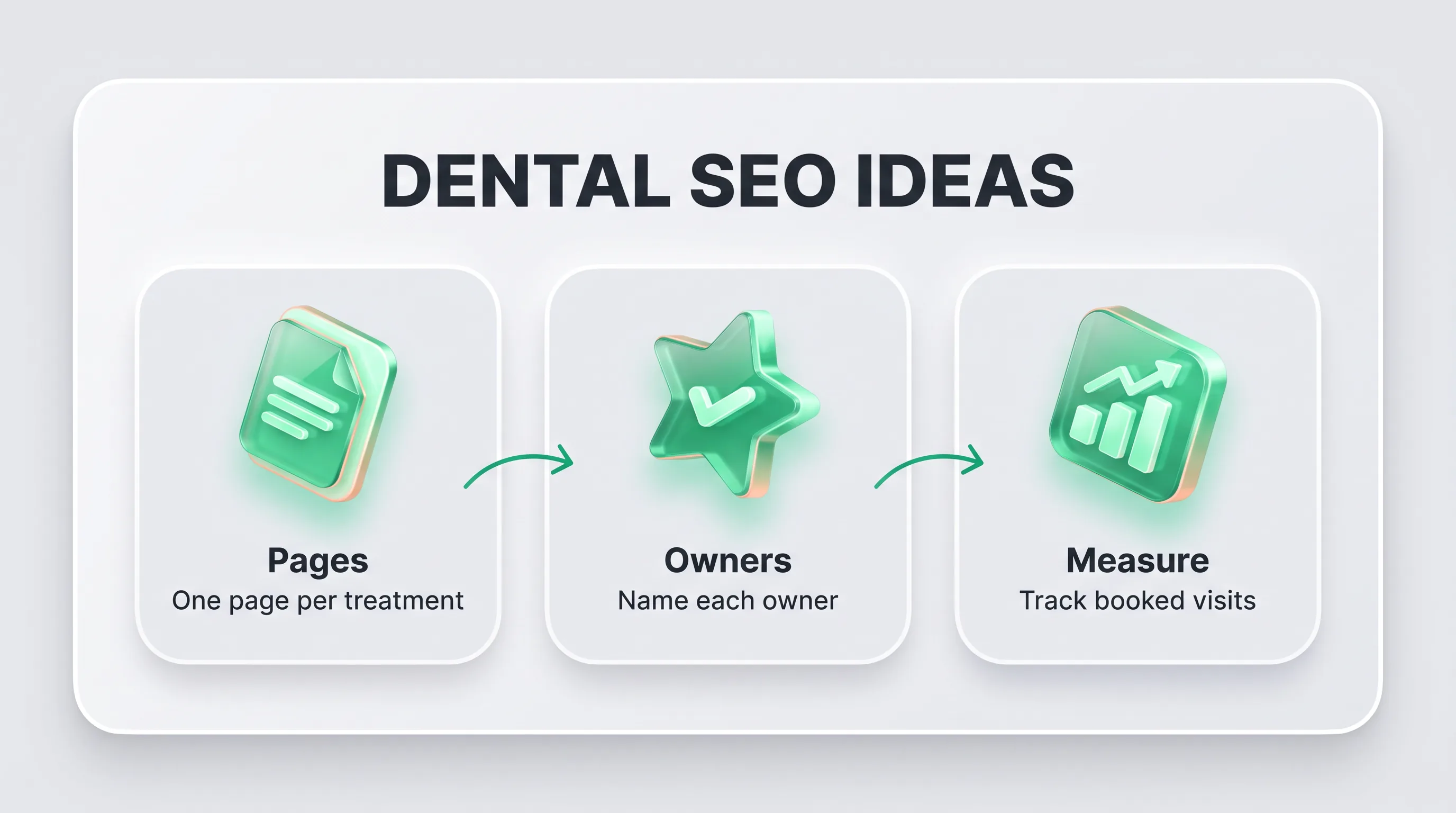
When a marketing plan grows long, it becomes background noise. Three moves executed consistently outperform eight moves started and stalled. For most practices the working short list looks like this: one treatment page built or revised per month, one review request process embedded in checkout, and one booking path element improved per quarter. That is a plan a busy practice can actually run. The dental SEO tips that compound fastest are the ones with a repeating owner, not the ones with the highest theoretical impact.
By week three of most plans, the treatment page draft is waiting on the doctor for approval, the review request text is waiting on the front desk manager to test it, and nobody has touched the booking form because it lives in the website platform and nobody has the login. Execution does not stall for lack of ideas. It stalls for lack of a named person on each task with a deadline that pre-dates the next patient rush.
Assign each of your three moves to one person before the plan starts. The page content has an author and an approver with separate, staggered deadlines. The review request has a front-desk champion who owns the script. Named ownership is the difference between a plan on paper and a plan in motion. If your practice needs outside execution support, understanding what dental SEO services cover helps clarify where internal ownership ends.
Organic traffic and keyword rankings confirm that work is landing, but neither number pays a salary. The metric that tells you whether an SEO idea is earning its place is booked visits attributed to organic search, and specifically which procedures those visits convert into. A page that pulls fifty visits and books three full-arch consultations outperforms a page that pulls two hundred visits and books ten hygiene recalls. Measure both volume and case value monthly, and cut any idea whose booked-visit number has not moved in two consecutive months. For a view of how SEO fits alongside paid and referral channels, the dental marketing mix covers where each channel contributes.
The practices that grow through search are not running more ideas than you, they are running fewer ideas with clearer owners and better-matched pages.
We review your pages, search visibility and enquiry path, then show you what to fix first.
.svg)