

Your Pelham competitor owns the map. Your service pages do not matter yet.
Patients searching for a dentist in Pelham see a short list of three practices on Google before anything else. If your practice is not in that list, the real problem is not your website content, it is that patients never reach it.
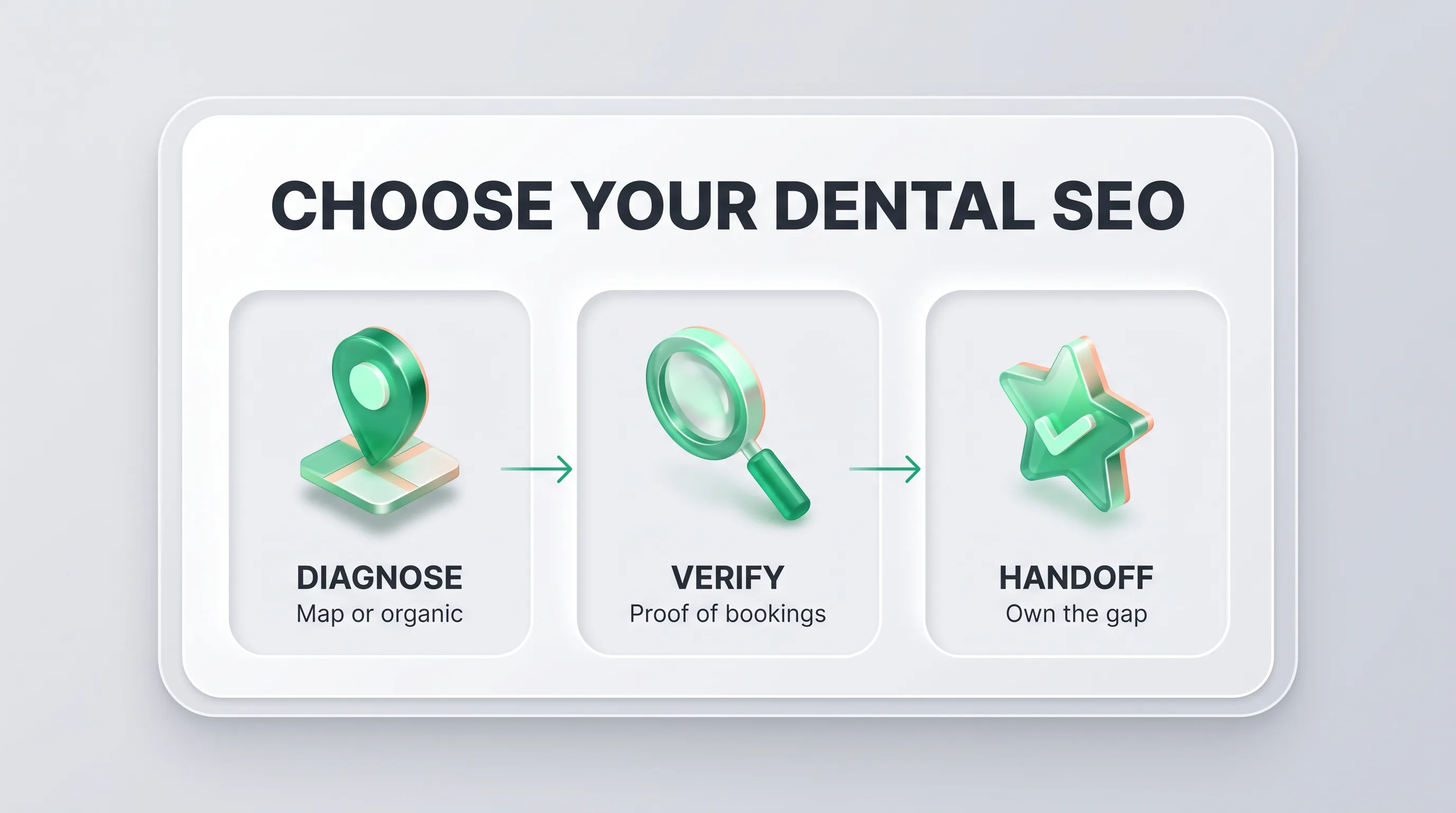
A patient searching "dentist Pelham AL" the week after moving into a new house sees the map pack first. If your practice is not in those three slots, the service pages beneath do not matter yet. That single diagnostic question, map pack or organic, should open every conversation with a vendor before you hear a word about deliverables.
Pelham sits in the Greater Birmingham corridor, where established practices like Stone Creek Dentistry and Huntington Family Dentistry already hold strong local signals. Whether a competitor down the road dominates the map or the organic listings tells you which gap a company must actually close. Sound dental SEO strategy starts with that split, not with a package menu.
If your chairs fill with hygiene recalls and you have two unfilled implant consultation slots each week, those slots represent the revenue gap. An SEO company that writes general "Pelham dental care" content will not move that number. You need a vendor who builds pages around the specific procedure patients weigh for weeks, not the ones they book in an emergency.
Catchment matters here too. A practice drawing from Pelham, Hoover, and the edge of Homewood needs a different geographic content plan than one whose patients walk from two streets away. Ask any shortlisted company how they map your real draw area before they recommend a single keyword cluster. That question separates vendors who read your situation from those selling a template.
Every agency pitching a Pelham dental practice will claim to know the local market. Test it. Ask them to name the overlap between your catchment and the Homewood or Alabaster patient base, or to explain why a search for "Spencer Moore dentist" behaves differently from a search for "dentist near me." A vendor who can answer that specifically understands local intent. One who pivots to generic talk about Birmingham digital trends does not.
For practices weighing local dental SEO execution in detail, the mechanics of citations, map signals, and review velocity belong on a separate track from choosing the right company. Keep those two decisions in sequence, not mixed together in a single sales call.
Rankings are not revenue. A company showing you a chart of keyword positions moving from page two to page one is showing you an intermediate metric. What you need is the next column: did that movement produce more calls, and did those calls convert to booked visits and accepted treatment plans? Ask for that chain explicitly. If the vendor cannot produce it, they have not measured what you are actually paying for.
When reviewing SEO case studies from dental practices, look for the period between ranking gain and booking increase. That lag, typically several weeks to a few months, is normal. A company that claims instant new-patient flow from organic SEO is misrepresenting the channel.
The first 90 days of any engagement tell you more about a company than their pitch deck. A credible vendor opens with a technical and content audit, identifies the two or three highest-leverage fixes, and assigns clear ownership for each. Vague first-quarter plans built around "onboarding" and "strategy alignment" often mean the real work starts in month four, after the contract locks in.
Ask specifically: what will be live on the site by day 60? Which pages will be rewritten or built, and who approves the clinical claims? Ownership of content approval matters especially in a dental practice, where a claim about implant success rates or sedation protocols carries regulatory weight. The company that anticipates that question earns more trust than the one you have to prompt.
A proposal that ignores the competitive map around Pelham is a generic proposal with your name on it. Pelham practices compete with Homewood, Alabaster, and the southern Birmingham suburbs for the same patient searching "dentist" from a zip code that sits between all of them. A vendor worth hiring names those competitors by domain, not by vague reference to "your local market."
The proposal should identify which competitors rank in the map pack for your core services, which hold strong organic positions for high-value treatment pages, and where their content has gaps you can close. If two nearby practices both target implants and one has thin service pages, that gap is actionable. A Pelham-specific proposal that does not address service overlap, for example a competitor already owning "clear aligners Pelham AL," gives you no reason to choose that vendor over a cheaper national template shop.
Understanding the full scope of what a retained engagement should include before you compare proposals helps frame those gaps clearly. A quick review of what dental SEO services typically cover gives you a baseline before you compare vendors.
The single most common breakdown inside a dental SEO engagement is not a bad vendor. It was an unclear handoff. The agency waited on content approval. The front desk had not been told to ask for Google reviews. The practice manager did not have website access to share. Three months in, nothing had moved because no one owned the bottleneck.
Before you sign, write down four names: who approves clinical content, who manages website credentials, who handles the review follow-up protocol, and who the agency contacts when a page needs a correction. If two of those names are the same overwhelmed person, flag it now. Choosing a dental SEO company includes auditing your own internal capacity, not just theirs.
Twelve-month lock-ins with no performance benchmarks protect the agency, not your practice. A contract that lists "monthly SEO activities" without specifying what those activities are gives a vendor room to deliver the minimum and bill the maximum. Ask for a deliverable schedule by month, not by quarter.
Reporting that shows traffic growth but omits call tracking is reporting that hides the gap between visits and revenue. If the dashboard your vendor provides does not show call volume alongside rankings, you are missing the metric that connects their work to your chair. Questions about dental SEO cost structures and what they include belong in that same conversation before you sign.
A patient finds your practice through an organic search for "Dr Bates dentist" or a nearby Pelham dental care result, clicks through, and calls. Your front desk answers on the fourth ring, cannot quote a new-patient appointment within two weeks, and does not follow up. The ranking did its job. The conversion did not.
Ask your team to log the source of every new inquiry for 30 days: search, referral, map, or ad. Cross that against which inquiries became booked visits. That single habit shows you whether an SEO gap or a front-desk gap is the real constraint. Google Maps SEO for dental practices drives the top of that funnel, but the booking rate is yours to own.
The right SEO company for your Pelham practice is the one that diagnoses your actual gap, names your real competitors, and hands you proof tied to booked patients, not traffic charts.
We review your pages, search visibility and enquiry path, then show you what to fix first.