

Sixty families a month may leave your site without booking a single visit.
The gap between parents finding your site and parents actually calling is almost never fixed by doing more of the same work. Knowing whether your problem sits in how many parents see you versus what they read when they arrive tells you exactly what to demand from any provider you interview.
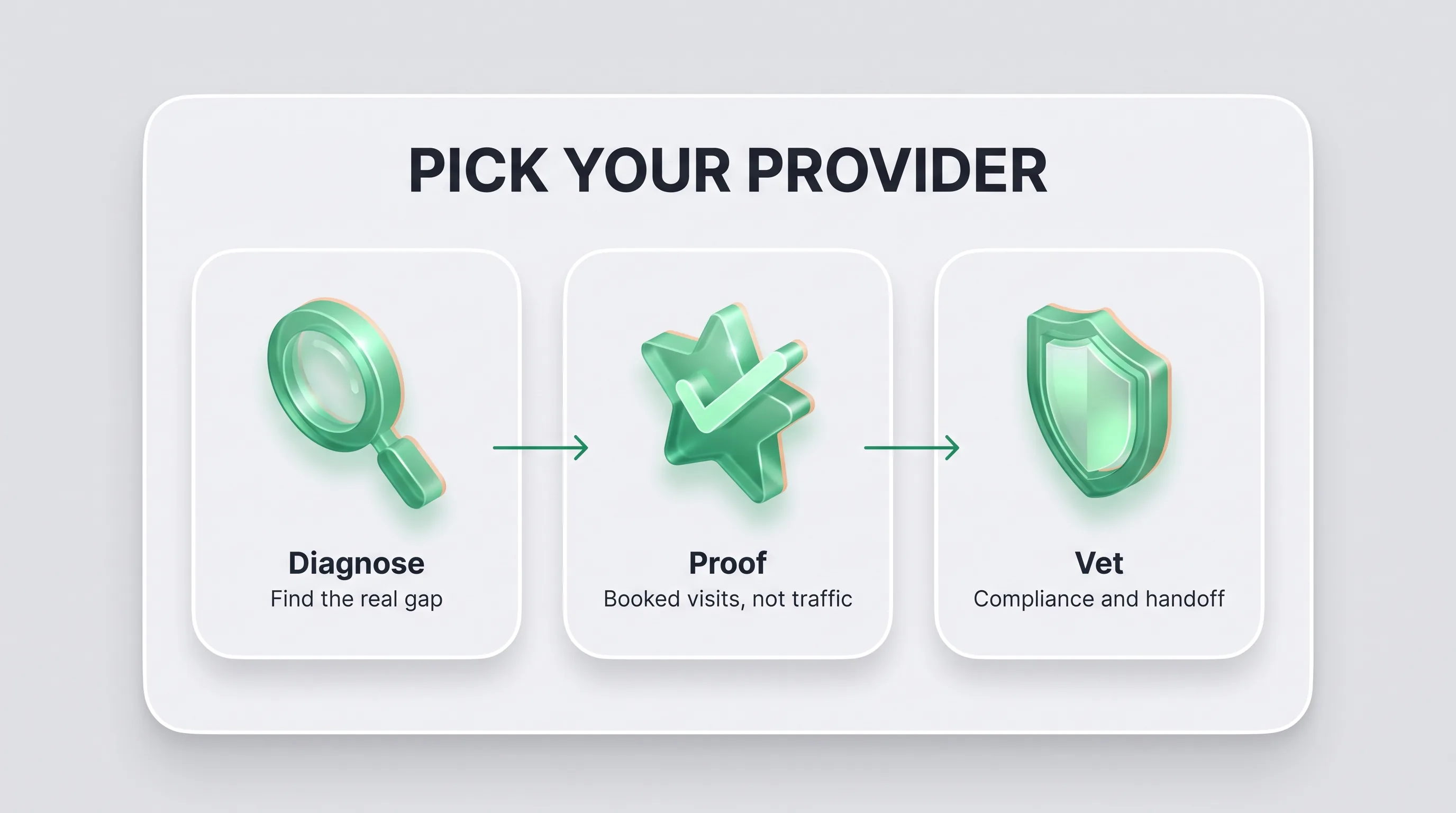
A parent searching "pediatric dentist near me" the morning after her son chips a tooth at recess has already scrolled past three listings before she notices yours. Whether she stops depends on what your provider actually built, not what they promised. The question worth asking first is whether your real gap is pediatric-specific knowledge or simply competent execution of dental SEO services applied to a child-focused practice. Those are different problems. A provider with broad dental experience who understands parent search behavior will outperform a pediatric-branded agency that delivers generic content with a different logo.
Sixty families a month might already find your site and leave without booking. That is a conversion problem, not a rankings problem, and no amount of keyword work fixes it. Before you hire, pull your Google Search Console data and check whether impressions are low or click-through is low. If impressions are healthy but calls are thin, your bottleneck sits on the page, in the trust signals parents read before they dial. If impressions are low, map visibility is the actual gap. Misreading this costs you a full season of retainer fees pointing at the wrong target. Knowing the difference also tells you what to ask any candidate provider on the first call.
A solo pediatric practice in a mid-sized city and a group expanding to a fourth location need entirely different SEO structures. Single-location practices need a tight local footprint: one well-built site, a clean Google Business Profile, and consistent citations. Multi-location groups need providers who can manage separate location pages without cannibalizing each other's rankings. Ask any candidate directly how they have handled this. If they describe the same deliverable list for both scenarios, they have not done it. For a broader framework on evaluating candidates before you shortlist, the guide on choosing a dental SEO company covers contract and scope questions that apply here too.
Traffic screenshots prove nothing. A provider who shows you a chart of organic sessions rising from 400 to 900 a month without telling you how many of those became booked first visits is showing you the least useful number they have. Ask specifically: how many new pediatric patient calls did this practice receive per month before and after the engagement? If they cannot answer, their tracking was not set up to measure what actually matters to your practice. When you read examples, the guide on SEO case studies explains how to read proof without being swayed by rankings screenshots alone.
Most providers start month one the same way regardless of client: title tags, meta descriptions, a few blog posts. That sequence is not wrong. It is just not a diagnosis. A provider worth hiring starts by auditing what is actually suppressing your visibility, whether that is a technical crawl issue, thin service pages, or a Google Business Profile with the wrong category selected. Ask them: what would you look at in the first two weeks, and what would you decide based on what you find? A vague answer about "comprehensive audits" means generic tasks dressed up. A specific answer names the tools, the outputs, and the decision it drives. That specificity is the tell.
This is the vetting checkpoint almost no provider raises on their own, and it can create real problems. Pediatric practices collect information about minors, which means contact forms, call tracking scripts, and analytics tools sit at the edge of COPPA compliance. A careless vendor who installs a standard lead-capture form asking for a child's name and date of birth alongside a parent email has exposed your practice to avoidable risk. Before you sign, ask the provider exactly how they configure forms for pediatric patients, which tracking pixels they place on appointment pages, and whether their call tracking setup stores any data tied to a child. If they look surprised by the question, that is your answer. For what responsible monthly delivery should look like once a provider is chosen, see what well-structured dental SEO services actually include.
I watched a pediatric group lose four months because nobody had agreed in writing who approved content before it published. The provider wrote, the office manager reviewed, the lead dentist disagreed, the article sat in a folder. Four months, zero published pages. That is not a provider failure or a client failure. It is a missing conversation. On day one, document who approves clinical claims, who holds site admin credentials, who responds to reviews within 48 hours, and what happens when the contact changes. These are operational questions, not marketing ones, and the providers who raise them unprompted are the ones who have learned from the same mistake. The execution side of parent-facing page strategy, once ownership is clear, is covered in the detail on pediatric dental SEO tactics.
Payer mix is the metric most dental SEO reports never mention, and it is often the metric that decides whether a campaign is actually working for your practice. If your SEO is pulling in families on plans you do not accept, you are filling your schedule with inquiries you cannot convert. Ask your provider to segment reported leads by insurance type where call data allows, and to flag whether new patient volume is shifting toward or away from your target cases. On top of that, booked pediatric visits, not form fills, should anchor the monthly report. Form fills include spam, misdials, and existing patients. A dental SEO expert worth retaining will already track this distinction without being asked. Budget expectations for this level of reporting vary by market; the breakdown of dental SEO cost by scope puts realistic numbers on what you should expect to invest.
The right pediatric dentist SEO provider solves your specific bottleneck, proves it with booked visits, and handles compliance before it becomes your problem.
We review your pages, search visibility and enquiry path, then show you what to fix first.