

Your page can come up first and still hand you a full schedule of cases you never wanted.
When calls rise but booked cases stay flat, the problem is usually what your page says after a patient finds you, not whether she finds you at all. Measuring calls, booked evaluations, and accepted treatment plans separately shows exactly where patients drop off.
A patient wakes up at 2am with a throbbing molar. She does not search "endodontist." She types "emergency root canal" or "severe tooth pain specialist" and books the first practice that answers her question before she finishes her coffee. That is the demand window your pages need to own.
Build one dedicated page per core procedure: root canal therapy, endodontic retreatment, apicoectomy, and emergency dental pain. A single catch-all "services" page splits the signal and ranks for nothing specific. Each page earns its own position by matching one search intent precisely, so the right patient lands on the right answer.
For broader keyword architecture that maps procedure terms to search volume and competition, the guide on dental SEO keywords covers the mapping framework without repeating it here.
Endodontics runs on two very different buyers. A general dentist searching "endodontic referral form" or "root canal specialist for complex cases" expects a professional handoff, not a fear-reduction paragraph. A patient searching "does a root canal hurt" wants reassurance. One page cannot serve both well.
Build a dedicated referral pathway: a secure form, expected turnaround, and clinical contact. Keep it distinct from your patient-facing service pages. The two audiences carry different calls to action, different objections, and different reading speeds. Mixing them muddles both. Your dental SEO strategy should map these audiences before choosing page templates, not after.
"Apicoectomy" belongs in the page title and the H1 because a patient who has already been referred knows the word. On the same page, the body copy should say "a small procedure to treat infection at the root tip" before it uses the clinical term again. Specialist vocabulary earns trust when the reader is ready for it. Used too early, it creates distance.
The rule is simple: match the vocabulary to where the patient is in their decision. Search terms get the clinical label. Body paragraphs earn the right to use it by first explaining what it means in plain language.
A referred patient arrives at your root canal page already carrying three unspoken questions: Is this the right treatment for me? How soon can this happen? What do I actually do next? If the page does not answer all three above the fold, she clicks back and calls the first number that does.
Structure the service page to resolve urgency first, candidacy second, and the next step last. That means same-day availability near the top, a plain-language description of who qualifies, and one visible booking prompt. The sequence mirrors the patient's mental checklist. When the page follows that order, the consult almost books itself. For practices balancing paid and organic demand for urgent cases, the search marketing mix covers when ads should supplement SEO for emergency intent.
Credentials reassure a patient only once she already likes what she reads. A page that leads with board certifications and fellowship memberships buries the thing she actually came for: whether you can stop her pain and whether you have done it before.
One or two trust markers placed after the clinical answer work better than a credential section at the top. A specific caseload range, a clear explanation of the microscope or CBCT you use and what it changes for her outcome: these are specialist proof. A list of acronyms is noise. For site-level structure that supports this without slowing load times, the guidance on website SEO for dental practices covers the technical decisions cleanly.
Two patients land on the same page: one in acute pain who needs an answer in thirty seconds, one planning an apicoectomy consult for next month. A single call to action cannot serve both without failing one of them. The emergency patient needs a phone number or same-day request button at the top of the page. The planned patient needs a form that sets expectations around evaluation timing.
Route them differently from the first visible line. A short sentence near the hero section, "In pain now? Call directly. Scheduling a consult? Use the form below.", resolves the fork instantly. When both paths are visible and labeled, neither patient stalls. Conversion happens because the page decided for them.
Both problems show up as too few signed cases, but they need different work. Thin organic call volume usually points to local visibility — profile accuracy, location signals, map-pack presence. Calls that arrive but stall before the consult point to treatment pages that list procedures without answering candidacy, urgency, or cost expectations. Pin the actual gap first, because it sets the order of everything that follows.
Two endodontic practices in the same city can miss the same cases for opposite reasons. One holds the map pack and loses the click to a treatment page that reads like a printed brochure. The other has a credible apicoectomy page that almost never surfaces locally. A proposal that does not name which problem it is solving first is a package, not a plan.
| What you are seeing | Likely bottleneck | First lever |
|---|---|---|
| Few organic calls at all | Local visibility | Profile consistency, location and proximity signals |
| Calls come in, consults do not book | Treatment pages | Candidacy, urgency, and next-step content |
| Referring offices cannot confirm scope | Referral-facing content | Clear case-acceptance and procedure detail |
Scope follows the same logic. A single-location practice in a low-competition market is often served well by general dental SEO covering brand visibility and basic local rankings. Specialist work earns its keep once you compete for terms like endodontic retreatment or apicoectomy specialist against hospital-affiliated groups. Those terms are less contested than broad dentist searches, but the page structure and clinical credibility signals they require are entirely different.
Specialist SEO stalls on approval far more often than on writing. Before work begins, name the clinician who reviews procedural language, confirm who holds CMS and profile access, and agree on a turnaround for sign-off. Referral-sensitive updates lose their value sitting in a draft queue while referring offices search your name and find a thin page instead.
Settle these items in onboarding rather than mid-engagement:
Pull a performance baseline before the first change ships. Without it, later reporting compares against an impression of prior performance rather than a record, and every conversation about progress turns into a debate. Expect narrower procedure terms to move before broad specialist searches do, and treat any provider describing immediate map-pack placement as either overpromising or quoting paid ads. A provider who never raises ownership questions during onboarding has likely not run content for a specialist practice.
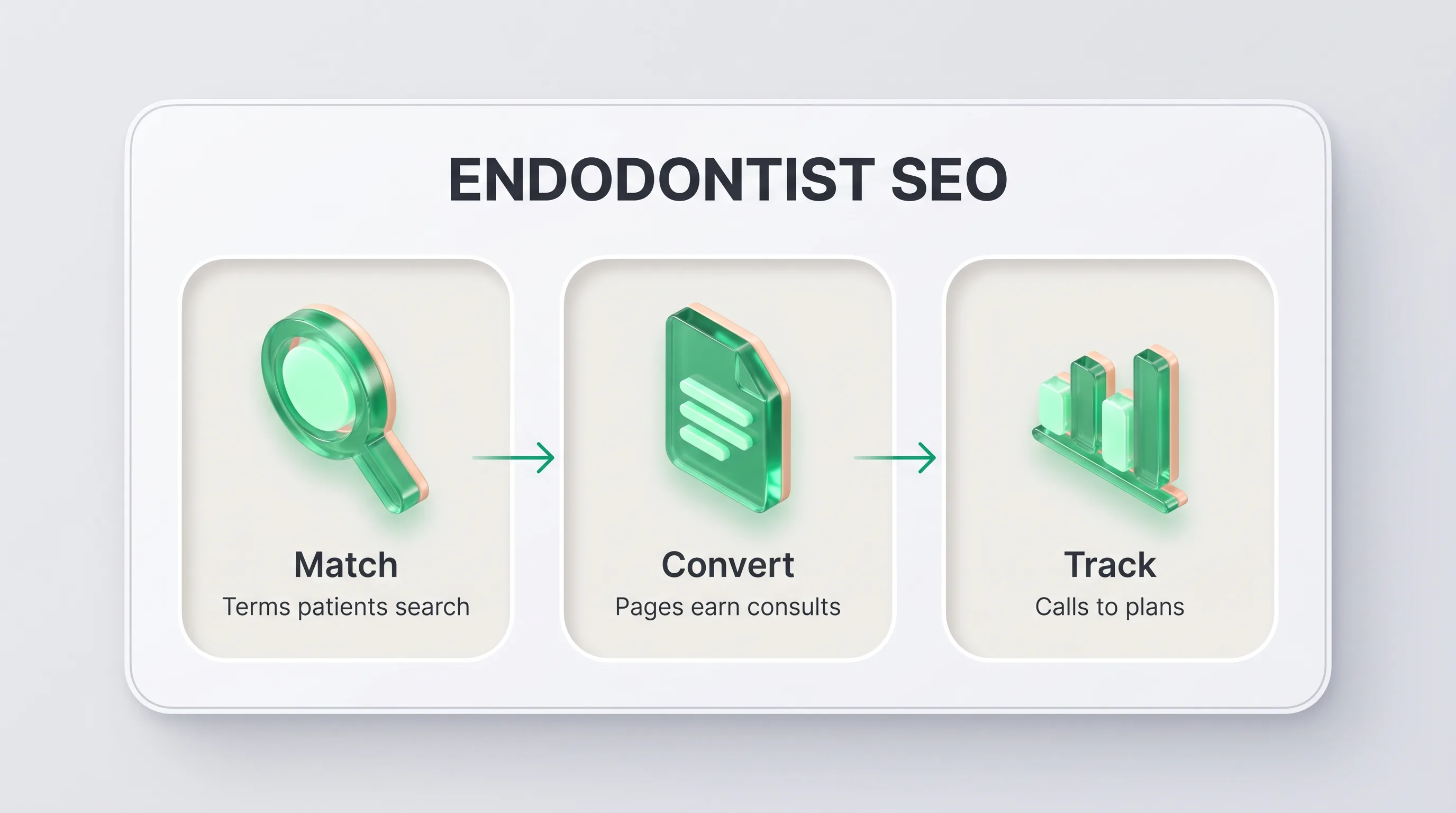
Rankings tell you where you appear. They do not tell you whether the patient who called actually needed retreatment or walked in for a second opinion on an extraction. Your organic traffic can grow while chair utilization barely moves, because you are ranking for informational queries that never convert. The fix is measuring three things in sequence: calls from organic search, booked evaluations, and accepted treatment plans.
When you track all three, the gaps locate the problem. High calls but low bookings: the front desk or the phone experience is the friction. High bookings but low accepted plans: the consultation is not closing. Tracking rankings alone hides both. Real examples of how to read those gaps appear in SEO case studies from dental practices that went through the same diagnostic.
Ranking on page one for "endodontist near me" and receiving no meaningful call volume usually means one of two things: the page ranks in a geography too broad to convert, or it ranks for a term the patient searches but does not act on immediately. Both are keyword-targeting failures, not traffic failures.
Check which queries actually drive clicks in Google Search Console, then cross-reference with call data. If "root canal cost" drives impressions but no calls, the page answers the wrong question for where that searcher is in the decision. Shift the page to answer candidacy and urgency, not price comparison. Your local map presence compounds this: a strong organic rank with a thin local profile still loses to a competitor with five times your reviews. The full local picture is addressed in the guide on local SEO for dental practices, which covers the map pack and review strategy without duplicating what this page handles.
When your pages match how patients actually search and route them clearly to the right next step, SEO for endodontists stops being a visibility exercise and starts filling your schedule with cases worth treating.
We review your pages, search visibility and enquiry path, then show you what to fix first.
.svg)