

Your paid and organic teams can both show green dashboards while patients slip away.
When your paid and organic efforts share no data, you end up paying for clicks your own pages already win for free. The real number to watch is booked visits by source, not how many people landed on the page.
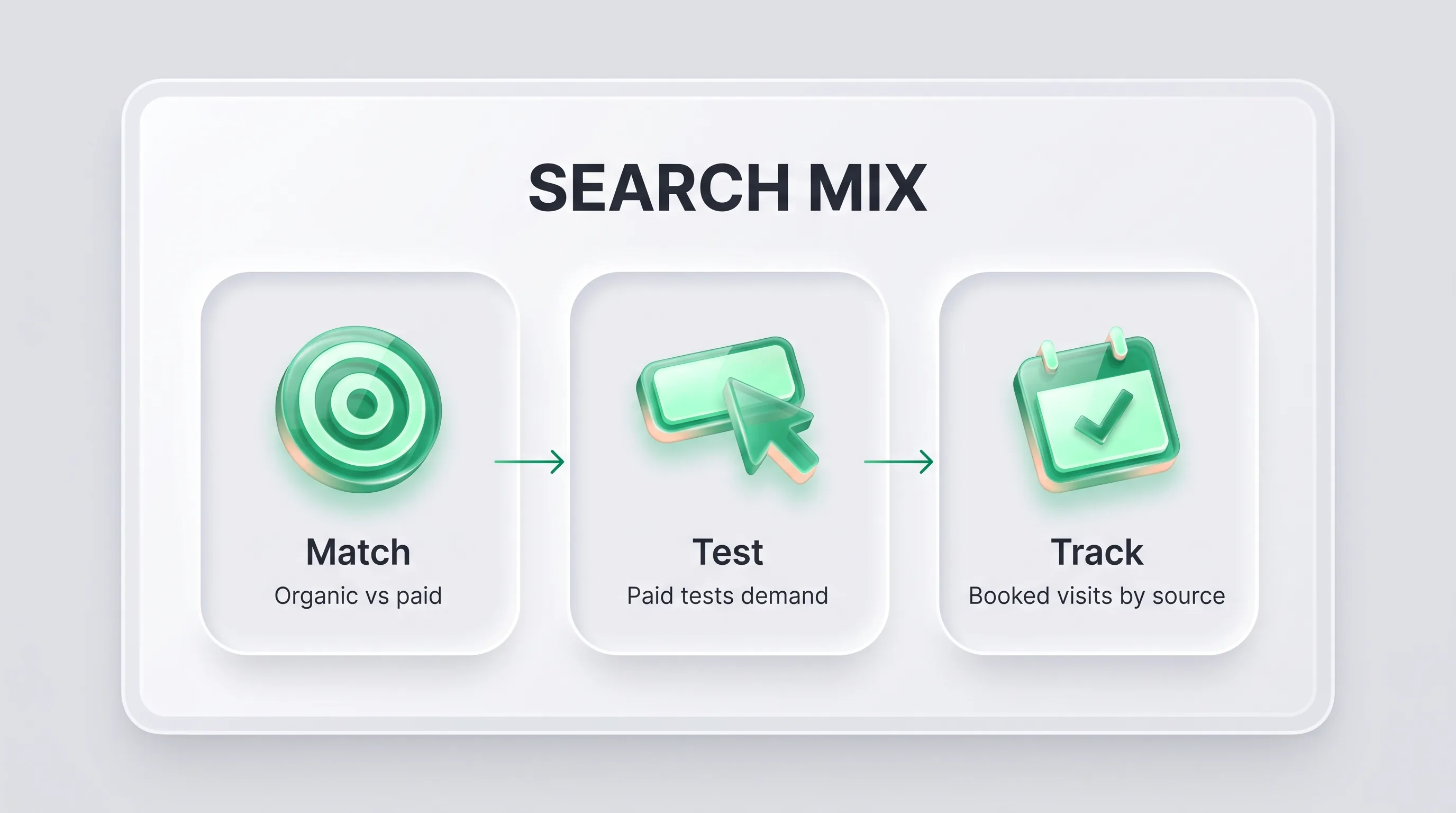
A patient weighing Invisalign compares three practice websites over a single evening and books a consultation before your front desk opens the next morning. Whether she finds you at that moment depends on one decision you made months earlier: which channel owns that query. Organic search earns that position over time — usually somewhere between month three and month six before a new page ranks competitively. Paid search can place you there by Thursday. Knowing which situation calls for which tool is the whole game in dental SEO and paid search combined.
Organic should lead when you have established pages, a steady review profile, and treatments that patients research slowly. Paid search carries the load when you open a new location, launch a service with no ranking history, or need chair time filled inside a specific window.
Cosmetic cases, implants, and full-arch rehabilitation attract patients who compare carefully before committing. Those patients read, return, and read again. Organic rankings compound over months and keep working after you stop paying. For those treatments, organic content is the right primary channel. Paid search for an implant query costs considerably more per click than for a hygiene query, so spending it on a treatment your organic pages already explain well doubles your cost with no added return.
Urgency flips the equation. A patient searching for same-day crown availability is not comparing six practices: they want the first credible answer. Paid search wins on urgency because it responds to demand now. Match spend to the treatments where speed matters and where your chairs actually have room, and you stop buying clicks that land in a full schedule.
Two agencies, one handling SEO and one running ads, can each send you a green dashboard every month while the practice loses patients in the gap between them. Coordination means the paid team knows which organic pages already rank, and the SEO team knows which queries the paid campaigns are testing. Without that, you end up bidding on terms you already own and writing pages for demand you could have validated in two weeks with a small ad budget. A shared dental SEO strategy document, reviewed by both sides monthly, closes that gap faster than any reporting tool.
Before we built out the sleep apnea section of one practice's site, we ran a two-week paid campaign on three query variants. One converted at nearly double the rate of the others. That single data point shaped the page title, the headline, and the call to action before a word of organic content was written. Paid search is the fastest demand research tool you have. Spend a modest budget, watch which treatment descriptions and landing page angles drive form fills, then build organic pages around the winners. You skip months of guessing about dental SEO keywords that resonate with real patients versus ones that only look logical in a spreadsheet.
Call tracking numbers reveal which channel drove a call. They do not tell you whether the caller booked or walked away after hearing the price. Front desk notes close that loop. When your coordinator marks each booked visit with its source, organic or paid, you can compare cost per booked visit rather than cost per click. That number changes every decision. A paid campaign showing a high click cost may still outperform a cheap organic source if its callers convert to consultations at a higher rate. If you want to see how those mechanics play out across a real practice, a dentist SEO case study shows the full attribution picture more clearly than a traffic chart.
Your homepage ranks first organically for your practice name. Running a branded paid campaign on top of it means you pay for clicks you would have received for free. That spend is not incremental: it replaces free traffic with paid traffic. The same logic applies to any treatment page sitting in positions one through three without ads. Pull the search term report from your paid account, cross-reference it against your organic ranking data, and pause any keyword where your organic page already dominates. Redirect that budget toward queries where you rank on page two or where a competitor consistently outbids you on high-value terms. Understanding the full scope of what these efforts require helps clarify dental SEO cost relative to the paid budget you free up by cutting overlap.
A channel report showing rising organic traffic means nothing if the sessions bounce at 80 percent and no one calls. Booked visits by source is the metric that connects search to revenue. Set up call tracking at the campaign and page level, tag form submissions with UTM parameters, and ask your front desk to record source at booking. Then push the data one step further: track which booked visits turned into a patient who accepted care. A cosmetic patient who arrives having already read your before-and-after gallery and your fee overview converts faster and drops fewer objections. That outcome is what good local search visibility, including your map presence through local SEO for dentists, is actually built to produce.
Three patterns signal trouble before the monthly report arrives. First, click volume rises but booked visits stay flat: your landing page is the problem, not the channel. Second, cost per click climbs while organic impressions for the same query also climb: you are bidding against your own rankings. Third, your highest-value treatment pages rank well but generate almost no calls: the page answers questions without asking for the appointment. Each pattern has a different fix, and misreading one as another wastes weeks. If your team lacks the bandwidth to monitor both channels weekly, working with a dental SEO expert who oversees both paid and organic removes the blind spots that individual channel managers miss.
When your search channels share data and a common goal, every patient who finds you arrives closer to a yes.
We review your pages, search visibility and enquiry path, then show you what to fix first.
.svg)