

Your implant page ranks, but the patient booked with the practice just down the block.
Most Georgetown practices lose patients not because they are hard to find, but because the page a patient lands on does not answer whether you take her insurance or have a Thursday opening. By the time your front desk reads her 8pm message, she has already booked somewhere else.
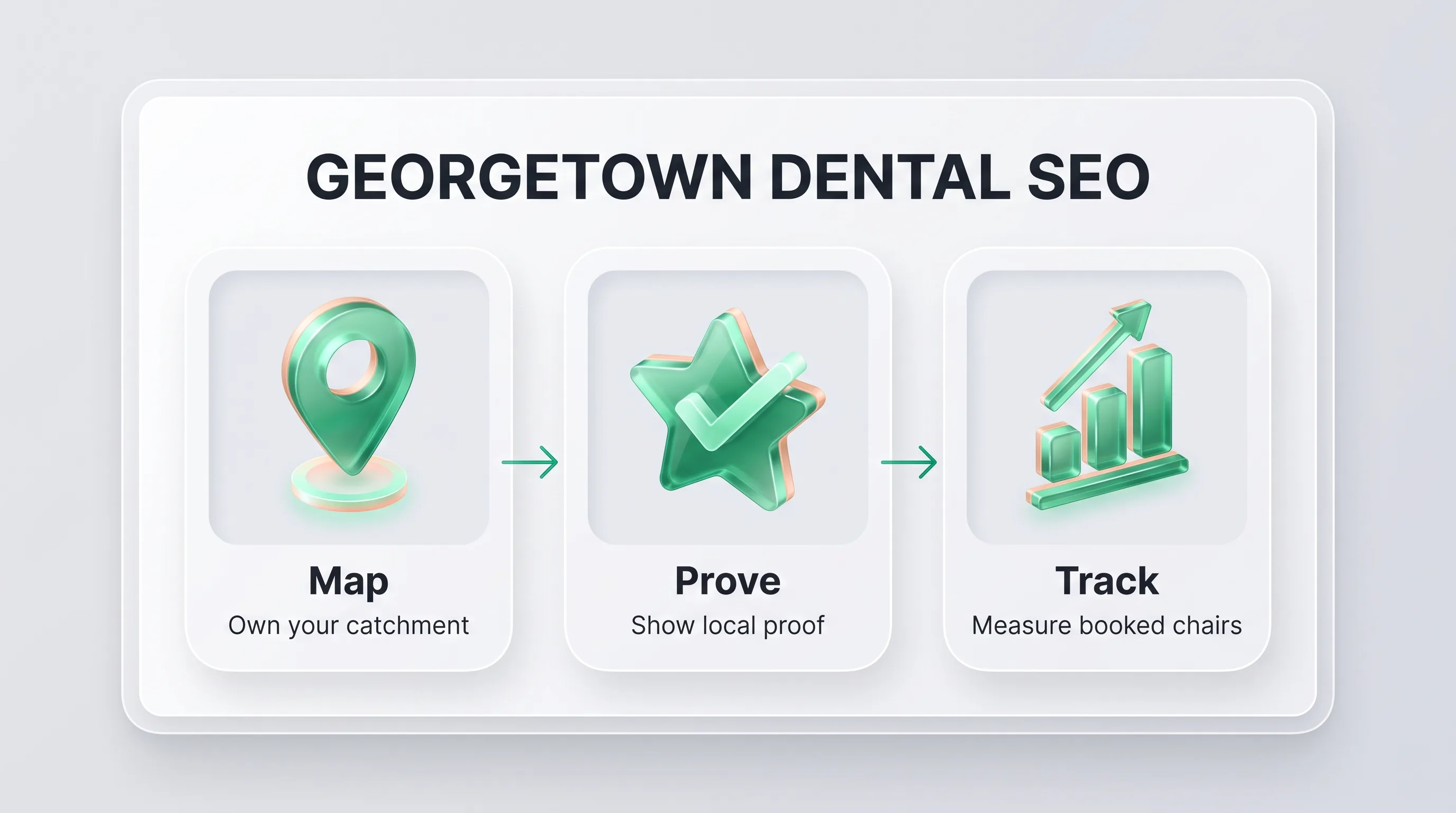
A patient in Georgetown, TX searching "dental implants near me" during her lunch break is not the same patient as one in Round Rock doing the same thing that evening. Both land on Google, both see local results, and if your pages blur that boundary, they compete with each other instead of winning either. Dental SEO services built for Georgetown specifically map the demand zone first: where do your confirmed new patients actually live, and which zip codes consistently produce the searches your practice needs? That boundary becomes the brief. Pages outside it drain your crawl budget; pages inside it compound.
Georgetown's overlap with surrounding areas is the practical problem most practitioners skip. If you serve Round Rock or Leander patients but every page targets Georgetown alone, you miss adjacent demand. Build one clear Georgetown core page, then let sibling location pages handle the surrounding areas separately rather than stuffing every city into a single URL.
Four or five procedures drive the majority of high-value comparisons in most suburban Georgetown markets: implants, Invisalign, teeth whitening, veneers, and family preventive care. Ranking for all of them at once is not the starting point. The question is which two or three your chair mix actually needs, and which those Georgetown patients already search with enough volume to justify a dedicated page. A single well-built page for "dental implants Georgetown" outperforms a sprawling services list that mentions implants twice. Prioritize by case value and search specificity, not by how many treatments you want to mention. For a structured approach to selecting those terms, dental SEO keywords covers the assignment logic in depth.
Every page your Georgetown practice publishes should move one type of patient one step forward. Not "learn about implants," but "decide whether implants are right for you and book a consultation here." When I ran my first clinic, I made the mistake of writing long educational pages that answered every question and converted none. A patient weighing Invisalign in Georgetown already knows Invisalign straightens teeth. Your page needs to answer whether you are the provider she trusts in her area, on her insurance, available on a Thursday. That is a different brief entirely. One decision per page keeps the structure tight and the call to action clear.
A prospective patient comparing two Georgetown practices will often decide on what looks like a small detail: does this office accept my insurance, can I book online without calling during business hours, is there parking? These are not trivial. They are the concrete friction points that stall a booking. Your Georgetown pages should surface accepted insurance networks, new-patient scheduling windows, and financing options in plain text, not buried in a FAQ accordion. A practice two streets away that answers those questions visibly will take the call that should have been yours. Mechanics like map-pack tuning and listing consistency sit under local dental SEO, but the on-page signals are yours to control today.
46 reviews averaging 4.8 stars tells a patient you are reliable. A review that says "Dr. Khourda explained every step of my implant process and I never felt rushed" tells her you are the right fit for the procedure she is weighing. That distinction matters on a Georgetown page because credibility is table stakes; fit is what converts. Curate your review strategy so that patients who had the treatments you most want to grow leave the specific, treatment-named feedback that mirrors what new patients search. Responding to reviews with a brief, practice-voiced reply also signals to Google that the listing is active. For the direction-request and map-view signals underneath that, Google Maps SEO for dentists handles the mechanics.
Before-and-after galleries and outcome language tighten quickly into regulatory territory, especially for practices in Texas subject to the Texas State Board of Dental Examiners guidelines. "Dramatically transformed" is a claim. "Restored full chewing function" may require a disclaimer. The safe frame: show real cases with patient consent, describe the procedure performed, and let the image carry the outcome. Avoid predicted or typical result language unless your compliance counsel has reviewed it. A Georgetown practice that publishes a strong gallery without that check creates liability faster than it creates new patients. Keep the content factual, consent-documented, and specific to the treatment rather than the cosmetic promise.
Rankings move. What matters is whether a Georgetown patient who finds your implant page actually calls, books, and shows up for a consultation rather than a cleaning. Track those three steps as a linked sequence, not in separate dashboards. Call tracking tied to the source URL tells you whether the implant page drove the inquiry. Your practice management software tells you whether that inquiry became a booked visit. Your case acceptance data tells you whether the visit became a signed plan. Without that chain, you are optimizing for rankings that may not connect to revenue. A broader look at sequencing those metrics sits under dental SEO strategy if you want the full framework.
A patient messages your Georgetown practice at 8pm, ready to ask about the veneer consultation she has been putting off for six months. Your front desk reads it at 9am. By then she has already scheduled with the office down the block. If your pages rank but inquiries do not convert, the bottleneck is rarely the SEO. It is response time, front-desk scripting, or a booking flow that asks too much before confirming anything. Separate the three failure points: low visibility means the page is not ranking; low trust means the page ranks but the patient leaves; low follow-through means the inquiry arrived and nobody closed it. Each demands a different fix. Understanding what your dentist SEO fundamentals can and cannot solve saves you months of misdiagnosed spend.
When your Georgetown pages match real patient decisions and your team closes the inquiries they generate, SEO stops being overhead and starts filling the chairs that matter.
We review your pages, search visibility and enquiry path, then show you what to fix first.