Likes and followers do not fill your schedule in orthodontic marketing, and dentist referrals thin out as more GPs offer aligners in house. Here is how to be findable early and judged on attended consults and starts, not vanity metrics.

Mild aligner cases you used to get now stay at the dentist's office.
General dentists now plan mild crowding and single arch aligner cases themselves, since aligner companies sell straight to them. A vague ortho eval slip does not say which complex cases you still want, so some of those drift elsewhere too.
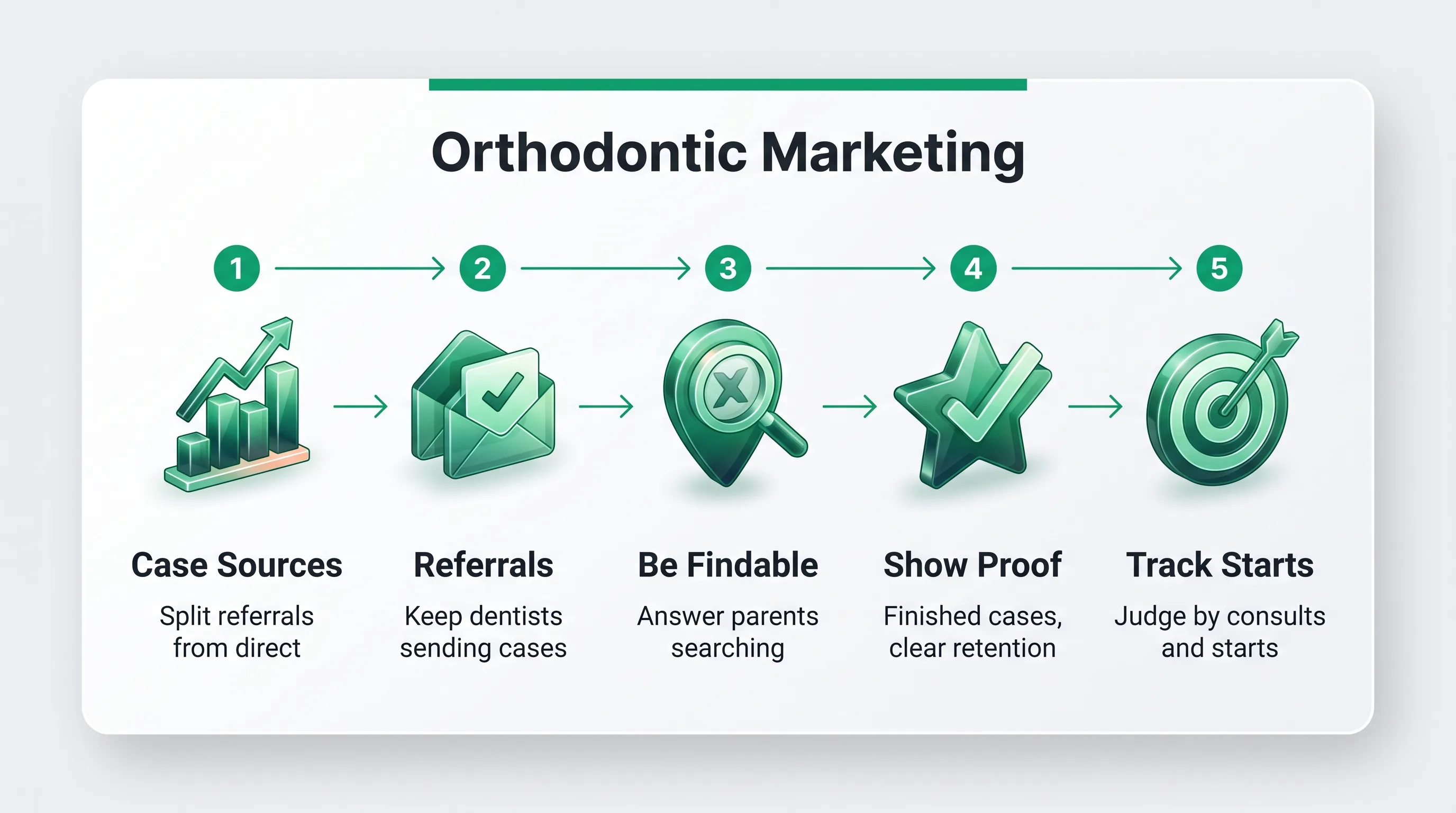
Your schedule last year was filled by two different machines, and most practice software reports them as one number. One runs on the general dentist who spots crowding at a hygiene visit and writes a referral slip. The other runs on a parent or an adult who found you unaided, shortlisted a few practices, and booked.
Pull last year's starts and split them on that single line: referred by a named practice, or arrived direct. Any plan for orthodontic marketing that skips this split funds channels you may not need. Most practices find the referral column thinner than they remember, and thinning in one specific direction.
Now cut the same list a second way, by case type. Phase I interceptive work, the crossbite you expanded and the ectopic canine you made room for, behaves nothing like a comprehensive teen case or an adult who wants a deep bite corrected without brackets showing at work. Each group arrives through a different door. Phase I nearly always comes from a dentist or a paediatrician; adults nearly always find you themselves.
Count the three columns for last year and the one before. If teen starts sit flat while adult enquiries climb, you face a real choice about building for teen referrals before adult aligner cases, and it sets everything downstream. Decide that on your own numbers.
Your referral log tells you which cases stopped arriving. Look for the mild adult crowding, the minor relapse cases, the single-arch touch-ups: general practices took those in-house the moment aligner companies began selling directly to them with treatment planning attached. What still crosses your door is work a general dentist will not plan alone.
Ask the practices that once sent you most whether they now treat mild cases themselves. Most will tell you straight. That answer decides whether your effort defends a referral base that has already moved on, or reaches adults who never had a dentist to send them.
A referral slip that reads "ortho eval" is a slip you have lost control of. General dentists are not withholding cases out of loyalty to an aligner rep; they decide, case by case, what they feel safe planning themselves. Tell them where that line sits for you, in clinical language rather than a lunch-and-learn slogan.
Send that page to the practices that still refer, and say plainly which mild cases you are glad for them to keep. A dentist who knows exactly what you want stops guessing, and guessing is how your complex cases reached someone else.
One associate leaves a referring practice and your March looks different. A schedule built on other people's decisions moves for reasons you never see and cannot answer.
Direct demand is the counterweight. It means parents and adults who reach you without anyone forwarding them: a map listing, a treatment page that answered their actual question, a neighbour's recommendation, a school screening you turned up to. None of it replaces referrals, and you should not want it to. It changes what a referral swing does to you.
When two practices go quiet in the same quarter, a steady direct line keeps chairs working and keeps you from accepting cases you would rather have sent on. Build it while referrals are healthy, because building it during a drought takes months you do not have.
A mother whose dentist just flagged a blocked-out upper canine opens her phone in the car park and compares three practices. She reads the map listing, scans the newest reviews, and checks whether any parent mentions a nervous child. She has not read your treatment philosophy. She wants to know which practice to phone first, from a list she did not assemble.
What she sees is the name, the distance, the review count, and what the last few parents wrote. Whether early treatment searches need their own pages is a separate decision, and worth settling before you spend on visibility. Here the narrower point holds: at the moment she compares, a parent sees almost nothing you wrote.
Parents arrive at the consult having already decided, usually wrongly, that aligners are the modern option and brackets are what they had. Then you explain that a severe rotation or a molar needing uprighting tracks better in fixed appliances, and the teenager's face falls.
Handle that comparison before they sit down. Put it in plain terms on your site and in the confirmation email: which bite problems each appliance handles well, what compliance actually demands (aligners out only for meals, worn nearly all day), what a broken bracket costs in extra visits, and why some cases run both. A family that reads this beforehand argues less and signs more, because you confirm what they already understood instead of taking something away.
An adult weighing a direct-to-consumer kit is not comparing you with another orthodontist. They compare a photo-and-impression box at home with a course of treatment that includes records, a clinical exam, and someone watching root position.
Say what the difference buys them, concretely. You take a panoramic and assess periodontal support before anything moves, because thin bone and existing recession change what is safe. You place attachments and do interproximal reduction, which no remote plan can deliver. When a tooth stops tracking, you see the bite in person and change the plan that week. Adults respond to that once someone spells it out, and most have never been told what an impression kit skips.
Debond day produces the photographs that persuade your next wave of families, and most practices lose them. The patient leaves, the retainer scan happens, and nobody took a final intraoral series in the same light as the pre-treatment set. Fix the capture first: same camera, same retractors, same angles, at records and at debond.
Then handle consent properly. Keep a signed release with the chart that names where the image may appear (site, social, print) and how long it stays up, and hold a separate conversation with the parent when the patient is a minor. Publish complete cases, including the ones that ran longer than planned. Families comparing practices spot a stock photo instantly, and one local smile persuades more than a gallery of strangers.
Most practice sites say "experienced" and stop. A parent cannot do anything with that word.
Give them facts they can check against the practice down the road: how many cases you have finished, how long you have treated with each appliance system, whether you place TADs yourself or refer them out, whether Phase I stays in-house, which surgeons you work with on orthognathic cases. State it flatly, without adjectives. If you qualified recently, say so and say what you have handled; a real count of finished cases carries further than a vague claim of long experience. Overstating gets tested at the consult, and the correction costs you more than the modest claim ever would.
Lower incisor crowding returns. Every orthodontist knows it, most websites pretend otherwise, and then a patient who lost a bonded lingual retainer years after debond writes the review that costs you.
Say it at the start instead. Explain what retention actually involves: a fixed wire behind the lower anteriors or a removable appliance worn nightly, checked at intervals, replaced when it breaks, and worn for years rather than months. Tell them what relapse looks like when wear stops. Parents accept this easily when they hear it before treatment and feel misled when they hear it at debond. Retention in the consult material also filters out the family who wanted a quick cosmetic fix and would have quit halfway.
Judge orthodontic marketing on attended exams rather than booked consults. Count both for last quarter and set the figures side by side. The gap runs wider than most front desks believe, and it concentrates in new-patient slots booked more than a week out.
Every practice loses some; you can still change the reasons. Families who found you directly miss appointments more often than referred families, because nobody vouched for you first. Shorten the wait for direct enquiries, even if that means holding two slots a week. Confirm by text, with the child's name in it. Send what the first visit involves: records, photographs, how long it takes, whether treatment can start that day. Recount next quarter and see whether the gap moved.
Success in one direction quietly reshapes the practice. Push hard on adult aligner visibility and, a few months later, your Phase I column sits empty, complex referrals have thinned, and your chairs fill with cases that need frequent short reviews and refinement scans. That may be exactly what you wanted. It turns into a problem only when nobody chose it.
Compare this quarter's case-type counts with the same quarter two years ago; drift shows up there long before it shows up anywhere else. Watch whether Phase I volume holds, since those patients come back for comprehensive treatment later; whether surgical and impaction referrals still arrive; and whether your associates' days match what they were hired to do. Drift moves slowly, and you can reverse it while the referring relationship is still warm.
Hand over one page: a row for each month, columns for referred, direct, and returning family, then the same grid split by Phase I, teen, and adult. Add attended exams and starts at the bottom. Anyone at the partner meeting reads it in a minute and sees what changed.
Agency dashboards report impressions, clicks, and form fills, and none of those tells you whether a child started treatment. When the direct column climbs while starts stay flat, your consult process needs work rather than more visibility. When one source sends consults that attend but rarely start, look hard at the cases it brings before spending more there. That reading is also how you decide when paid search is worth running for consults, instead of deciding from a proposal.
Read your three newest reviews and check whether any names something a parent could not have learned from your homepage. Regularly auditing local SEO for orthodontists profiles helps catch outdated information before a parent notices it first.
We review your pages, search visibility and enquiry path, then show you what to fix first.
.svg)