Start with the actual practice menu, group related search tasks and record the evidence each page needs.
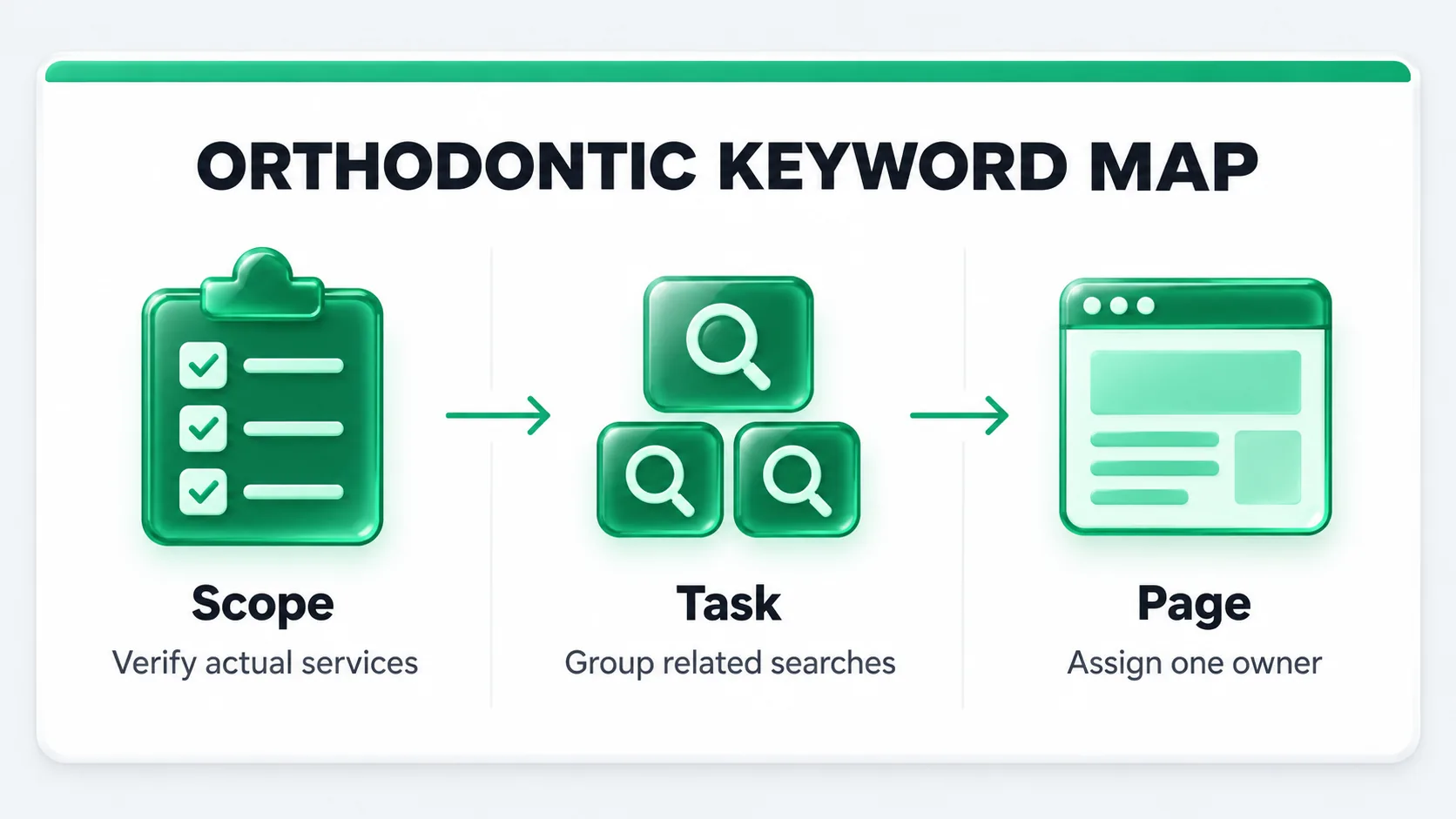
An orthodontic keyword map assigns a visitor task to a useful page. Its first inputs are the appointments, services, clinicians and locations that the practice can verify. A list of popular treatment phrases cannot establish those facts.
Ask the practice owner and clinical reviewer to confirm which services are currently available, who provides them, where patients attend and how the first contact works. Record an existing page for each. Keep a separate list of information that needs confirmation, such as whether a replacement-retainer appointment is available to someone treated elsewhere.
Then collect wording from Search Console, the current website and questions the team can summarize without identifying patients. A third-party keyword tool can suggest additional phrases. Record its country and collection date, and label its volumes as estimates. A national estimate is not the number of people within driving distance of your office.
This map belongs within the practice's broader orthodontic marketing plan. It does not decide treatment eligibility or replace a clinician's explanation.
Illustrative planning example for a hypothetical US practice. Replace each row with your verified service and location information.
| Example search | Visitor task | Possible owner page | Confirm before writing |
|---|---|---|---|
| orthodontist in Cedar Park | Find a provider at a real office | The verified location page | Address, provider attendance and contact route |
| braces Cedar Park | Understand the practice's braces service | An existing braces service page | Options actually offered and clinical reviewer |
| clear aligners for adults | Explore the service and assessment process | A clear-aligner service page, if offered | Actual scope and clinician-approved limits |
| braces payment options | Understand the practice's payment arrangements | A payment section or dedicated payment page | Current terms, inclusions and responsible approver |
| first orthodontic appointment | Prepare for the initial visit | A first-visit guide | The actual process and any charges |
| replacement retainer appointment | Find the appropriate follow-up contact | A retainer or existing-patient page | Who the practice can see and the approved route |
The last column is what turns the map into a writing brief. If it is empty, the writer may fill the gap with assumptions. The owner page should also contain the answer a visitor needs before following its next step.
Two phrases can share one page when they concern the same service and the same decision. Different wording alone does not justify another URL. Compare what the reader must learn, which provider or office is involved, and what happens next.
For example, a practice might answer several payment questions in one maintained payment page. It could link to that page from its service pages while explaining any service-specific limitation beside the link. That approach can be easier to keep accurate than copying the full terms into many articles.
Consider a separate page when the task needs a distinct explanation and the practice has enough verified material to support it. A first-visit guide may need preparation details and a description of the appointment process that would overwhelm a location page. The decision comes from the content and reader task, not a required number of keywords.
Google's people-first content guidance provides a useful quality check. A page should help its intended audience accomplish something, rather than exist only to capture a variation of a search phrase. Ongoing orthodontic SEO work should apply this same quality test to every page a practice publishes.
Give clinical descriptions to a named, qualified reviewer. The marketing brief should ask for the practice's actual service scope, assessment process and approved explanation of limitations. It should not supply a diagnosis, an appliance recommendation or a promised treatment duration.
Check professional titles and memberships separately. The American Association of Orthodontists' provider-selection guidance distinguishes orthodontic specialty training from general dental training. Verify the particular clinician's credentials before describing them; an association's general explanation does not verify a person.
Brand names also require a factual check. Use an appliance brand only when the practice actually offers that system and the proposed wording has been approved. A generic clear-aligner page should not silently become a claim about a particular branded service.
List every current URL that already answers part of the task. Check its visible content, canonical URL, incoming internal links and Search Console performance. If two pages overlap, note the overlap and the evidence needed to choose an owner. Do not redirect a page merely because two titles look similar.
Use a decision register with four actions: keep, improve, investigate overlap or propose a new page. For an existing page, attach the specific gap. “Explain whether the first visit is a request or a confirmed booking” is reviewable. “Optimize for conversions” does not tell the editor what to change.
When a page is retained, connect it through descriptive links from relevant services and guides. Google's link documentation explains the importance of crawlable links and informative anchor text. The destination still needs to answer the question promised by the link.
Choose the next page by the importance of its missing information, the evidence available and the team's ability to complete it. A wrong office address or unclear contact route may deserve attention before a new informational article, even when the article's estimated search volume is larger. Reviewing business profiles and office pages supports local SEO for orthodontists and keeps location details accurate over time.
The finished map should help a reviewer explain why each page exists and what will make it complete. If you need help turning that map into an implementation scope, request an initial diagnostic from Forge. Before hiring outside help, reviewing how to choose a healthcare marketing agency can clarify qualifications and scope of work.